What Is a Curriculum Vitae and When Do You Actually Need One
A curriculum vitae is a structured, reverse-chronological record of your full academic and professional credentials, and it's used most often for academic, research, medical, fellowship, grant, and international applications. It's usually longer than a resume because it's meant to show the complete record, not a targeted pitch.
Many get tripped up because they've been taught to treat CV and resume as length words, when the key difference is purpose. A CV is the document you hand over when the reader needs evidence of training, publications, teaching, appointments, and other credentials in one place, arranged so the newest items appear first.
A Curriculum Vitae Is a Credentials Record, Not a Pitch
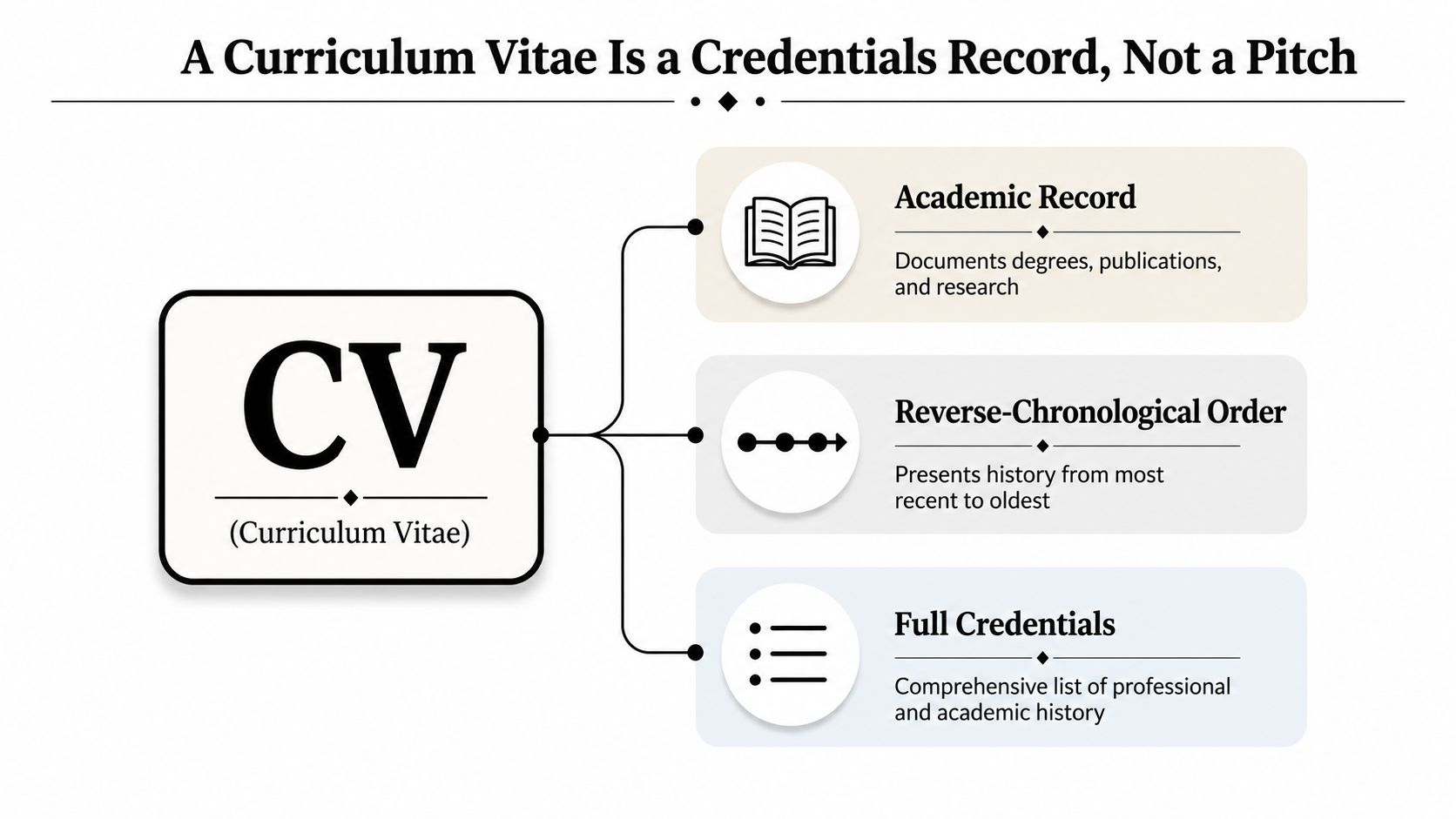
A curriculum vitae is a credentials record, not a sales document. In practical terms, that means it's a structured summary of your academic and professional life, usually arranged in reverse chronological order so the most recent work, education, or training appears first, which matches the standard guidance from university career offices and medical publishing sources. The phrase itself means “course of life,” and that's exactly how the document should read, like a timeline of qualifications rather than a one-page argument for why someone should hire you.
That distinction matters because a CV answers a different question than a resume. A resume asks, “Why are you a fit for this role?” A CV asks, “What is the full record of this person's credentials?” That's why academic hiring, research appointments, fellowships, grants, and many international applications expect a CV, while a job-specific resume is usually the better tool for most US private-sector openings.
A lot of generic advice blurs this line, which is why candidates send the wrong document type and wonder why the response is lukewarm. If you're building materials for a role that needs domain evidence, a CV gives the evaluator more to inspect, more to compare, and more reasons to trust that your background is real. If you're also shaping a separate job-specific pitch, a resource like essential marketing skills for jobs can help you understand how role targeting works in a narrower document.
Practical rule: If the evaluator needs a complete history, use a CV. If the evaluator needs a tailored case for one opening, use a resume.
How Does a CV Differ From a Resume?
The simplest way to separate the two is to compare purpose, length, content, and geography. A CV is a complete record, while a resume is a focused pitch. In the United States, that distinction is especially important, because recruiters outside academia usually expect a resume, not a long CV, and the wrong document can make an otherwise strong candidate look inattentive.

A resume is selective by design. It drops older or less relevant material so a hiring manager can skim quickly and see fit. A CV does the opposite, it preserves the track record, which is why it's the right document for settings where publications, teaching, grants, or professional licenses matter.
The mistake isn't just sending a long document. It's sending the wrong kind of evidence for the audience.
For readers who want a stricter sense of document length, this guide on how long a resume should be is a useful companion, because the contrast becomes obvious once you see how deliberately short a resume is meant to be.
What the evaluator is looking for
A CV reader usually wants proof of scholarly or professional seriousness. A resume reader wants a clean match to the posting. That's why a CV can keep older appointments, conference presentations, and publication history, while a resume trims to the most relevant work.
The most common error
The most common mistake is sending a multi-page CV to a US corporate recruiter who expected a resume, or sending a one-page resume to an academic committee that wanted a full record. Both failures are preventable, and both usually come from treating the words as synonyms instead of signals about what kind of review is happening.
What Sections Belong in a Standard CV?
A standard CV is built from a few predictable sections, and the order matters because reviewers expect to skim for credentials in a familiar sequence. Academic and career services guidance consistently points to contact details, education, experience, publications, presentations, awards, service, licenses, and references, with reverse chronological order used in dated sections so the newest evidence comes first. The point isn't decoration, it's readability.

Start with identity and contact details
Your name, email, phone number, and professional identifiers belong at the top. In some fields, a website, portfolio, or institutional profile link also belongs there. Georgetown's CV guidance says not to use first-person pronouns or a picture, and that matters because the top of the document should identify you without turning into a personal profile.
Put education in clear reverse order
Education should list your most recent degree first, then older degrees underneath it. Include institution, degree title, and dates, and for academic candidates, relevant honors or distinctions can sit here too. A reader should be able to tell, in seconds, whether your training matches the level they need.
Add research, teaching, and professional experience
These sections are where the substance lives. For academic or medical candidates, research experience and teaching experience are not optional filler, they're core evidence. For professional CVs, roles should still be described in a way that shows scope, responsibility, and domain depth.
Include publications, presentations, and scholarly output
Publications, conference presentations, posters, and similar outputs deserve their own sections when they're relevant to the field. Use consistent citation style, italicize journal names if that's your house style, and keep entries clean enough that a reviewer can quickly distinguish one item from the next.
Round out the document with distinctions and service
Awards, honors, fellowships, grants, affiliations, service, licenses, and certifications show outside recognition and field participation. Many applicants also include references in the document itself, especially in international contexts, while some US systems prefer “available upon request” or omit references entirely.
For people who want a practical parallel, this guide to listing skills on a resume shows how a shorter document handles credentials differently, but a CV usually needs more than a simple skills block.
Where in the World Do You Actually Need a CV?
Geography changes the answer more than most guides admit. In the United States, CV usually means an academic, research, medical, fellowship, or grant document, while a resume is expected for most corporate or general business roles. Outside the US, especially in the United Kingdom, much of the European Union, the Middle East, Africa, and much of Asia-Pacific, the word CV is often the default term for the standard job application document, even when the document is closer to a resume in practical use.

A US candidate applying to a London employer can get confused by that naming difference, and an applicant in the other direction can misread a US posting that explicitly asks for a resume. The safe rule is simple, follow the document name and format the employer uses, because that's usually a test of fit as much as content. If you're applying to a role like remote physician assistant jobs, the document expectations can shift again, since healthcare postings often care more about clinical history and licensure than a standard corporate resume would.
Academic and grant contexts are different everywhere
Academic hiring, scientific roles, medical positions, fellowships, and grants are the places where the longer CV record appears across borders. Reviewers in those settings need to inspect training, publications, teaching, and credentials in detail, so a short resume can look incomplete even if it's well written.
Match the local expectation, not your home-country habit
International applicants get penalized for ignoring formatting norms more often than they expect. A five-page CV sent to a US tech recruiter can feel off-target, while a too-short resume sent to a UK firm may look underdeveloped. If you're unsure, use the employer's wording and their country's hiring convention, then adjust the content to match.
For applicants dealing with public-sector or regulated roles, these federal resume examples and templates can help show how structured document expectations differ when the audience wants detail but still expects a job-specific format.
What Personal Data Should You Include, and What Should You Leave Off?
This is the part many CV guides avoid, which is a mistake. Some CV traditions and online application systems still ask for date of birth, nationality, marital status, gender, or a photo, but US academic guidance from Georgetown and Drexel explicitly tells applicants to leave out first-person pronouns, photographs, date of birth, sex, marital status, race, and citizenship status. That difference isn't cosmetic, it reflects privacy, fairness, and, in some places, legal risk.
Practical rule: If a US application doesn't ask for sensitive personal data, leave it off. If an international form requires it, provide it, but understand it shouldn't drive the hiring decision.
Why omission is often the safer default
Sensitive personal details can invite bias or distractions that have nothing to do with your qualifications. That's why many US academic documents are stripped down to professional facts only. If a system asks for demographic information, it usually belongs to the employer's compliance process, not the body of the CV itself.
When to follow local convention
In some countries and sectors, a photo or personal data field is routine, and excluding it can make the application look incomplete. In those cases, you're not “over-sharing,” you're following a market norm. The mistake is copying one country's conventions into another country's hiring process without checking whether the expectation changed.
A useful boundary
Keep the CV focused on credentials, not identity markers. The more your document behaves like a professional record, the easier it is for a reviewer to assess you on the merits of your training and experience.
What Formatting Rules Survive ATS and Human Review?
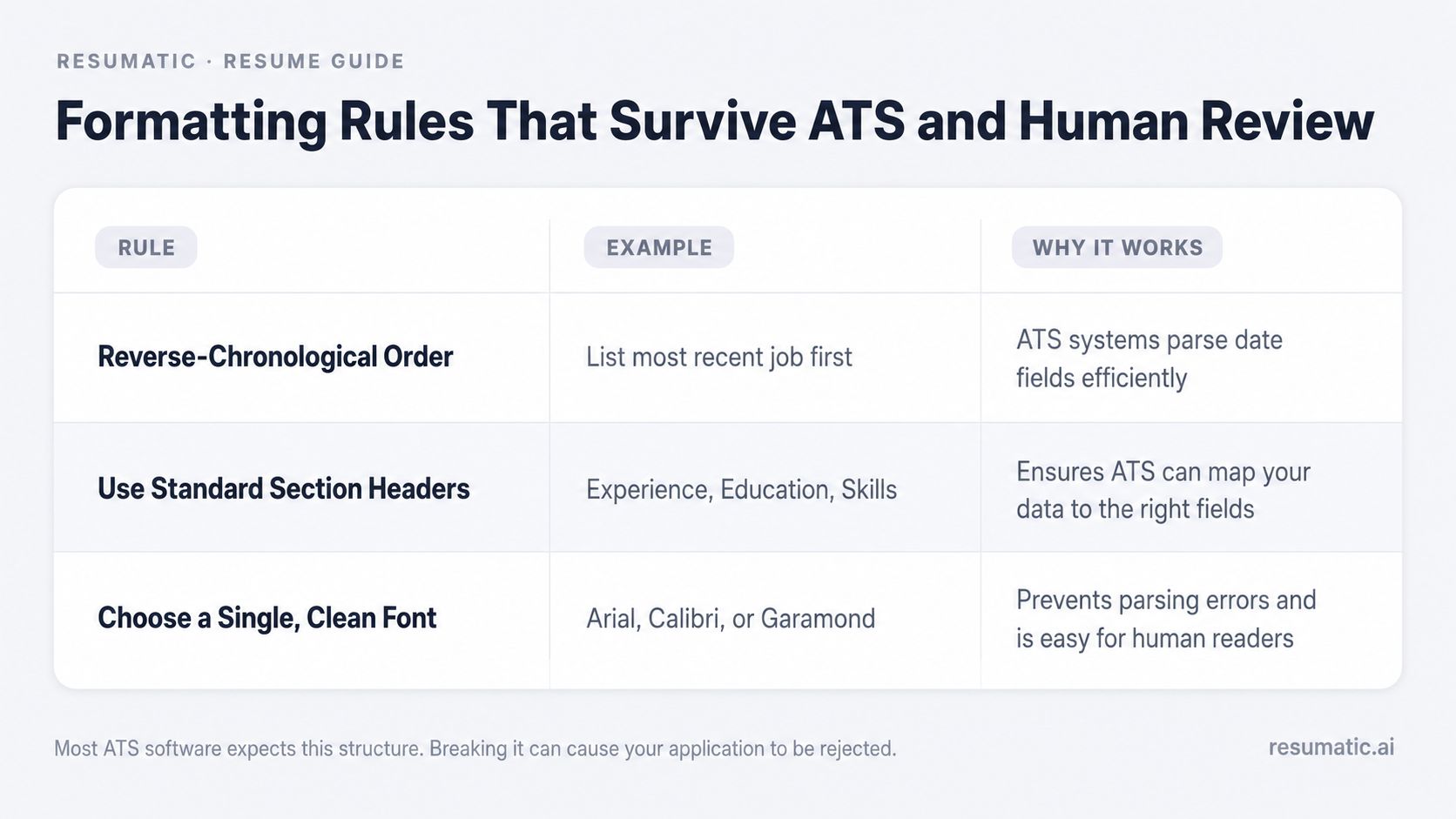
Formatting matters because the document has to work for two different readers, a recruiter skimming fast and software parsing text for keywords. Career services guidance from the University of Florida and Drexel both favor reverse chronological order for dated sections, and that's the safest structure for almost any CV, because it's familiar, readable, and easy to scan. The cleanest CV is usually not the prettiest one, it's the one that survives both human review and automated parsing.
Keep the structure boring on purpose
Use simple headings like Education, Experience, Publications, and Awards. Avoid decorative labels that sound clever but confuse a parser. A hiring system can't reward creativity if it can't identify the section.
Use dates consistently
Pick one format and stick to it. Month and year are usually clearer than vague seasonal language, and the same style should appear in every section. Consistency signals care, and inconsistency makes a CV feel assembled in pieces.
Preserve readability after export
Use a standard font such as Calibri, Arial, or Garamond in a readable size, keep the layout clean, and export to PDF only when the file still reads like text, not a scanned image. Tables and columns can look polished on screen, but they often create parsing problems if the file needs to be read by ATS software.
A quick example of what breaks and what doesn't
A clean publication line might read: Smith, J. (2024). Title. Journal, 12(3), 45-60. That's easy for a person and a system to read.
The same entry buried inside a two-column graphic as a screenshot can look stylish and fail to parse correctly. The rule is blunt, if the layout interferes with text extraction, it's the wrong layout for an ATS-readable CV.
For people building a digital-first application stack, this guide to making a resume ATS-friendly covers the same parsing logic from the resume side, and the principle carries over cleanly here.
How Do You Choose the Right Document for the Role?
Use the employer's language first. If the posting is for an academic, research, scientific, medical, or fellowship role, or if you're applying outside the US in a market that expects a CV, send a CV. If the role is a US corporate, startup, or general business opening that asks for a resume, send a one- to two-page resume instead.
Career changers and international applicants often need both versions. A longer CV is useful for fellowships, grant packets, and explaining a broad record, while a resume is better when the employer wants a tight job match. No document can rescue an unfocused search, though, and a polished CV is a credibility tool, not a placement service.
Common Questions About Writing a CV
Should a CV include a photo?
In some countries and industries, yes, but in US academic guidance it's usually left out. Georgetown and Drexel both tell applicants not to include a picture, and that's a good default when the employer hasn't asked for one. If a local application system requires a photo, follow the form, not generic internet advice.
How long should a CV be if I have ten years of experience?
As long as the record requires. For experienced professionals, a CV often runs several pages, while academic CVs can be longer still because publications, teaching, and presentations accumulate over time. The better question isn't “How short can I make it?” but “What evidence does the reader need?”
Do references belong on a CV?
Sometimes. Many international markets list references directly on the CV, while US practice often uses “available upon request” or leaves them off entirely. If the application system asks for referees, provide them. If it doesn't, don't pad the document with names just to look complete.
Should I send a CV and a cover letter together for academic applications?
Usually yes. A cover letter gives context, explains fit for the program or department, and lets the committee understand why your CV matters for that opening. The CV shows the record, the letter connects that record to the role. They work together, but they shouldn't repeat each other line for line.
For more practical answers, Resumatic's FAQ resource is a useful place to compare document choices and common application questions without having to sort through vague advice.
If you want a cleaner way to build a CV that reads well to people and still respects ATS formatting, use Resumatic to organize your credentials, refine the wording, and keep multiple document versions straight when different employers expect different formats. It's a practical fit for anyone who needs a resume or CV that looks professional without becoming overdesigned.
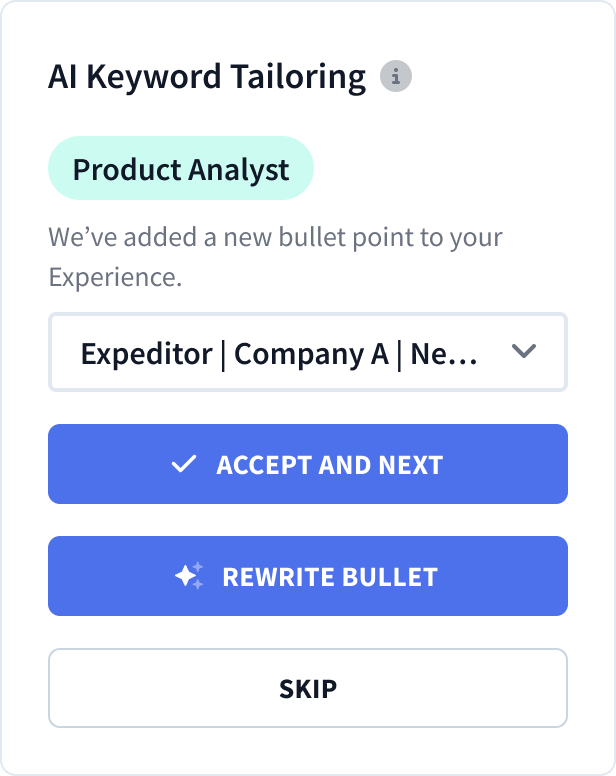
Automatic AI Resume Tailoring
Customize your resume with AI-guided precision.