Hard Skills Examples: What Actually Converts on a Resume in 2026 (Based on 1,200+ Resumes)
Hard skills are teachable, measurable abilities like Python, SQL, financial modeling, AutoCAD, or Spanish fluency that you can prove with a certification, portfolio, or work sample. The most useful hard skills examples on a 2026 resume are role-specific (Tableau for an analyst, not generic "data analysis") and recent. After writing over 1,200 resumes since 2019, here's which categories actually move callbacks and which read as filler.
Key Takeaway
- The hard skills examples that earn callbacks in 2026 are tool-specific and proven in the experience bullets, not listed in isolation.
- Soft skills don't belong in a skills section because they're unverifiable from a list, and recruiters skip past them.
- A standalone "AI Skills" section is becoming a liability among the hiring managers I've talked to recently, not the asset candidates assume.
What counts as a hard skill in 2026?
Hard skills are concrete capabilities you've learned through training, education, or hands-on work. They're verifiable in a way soft skills aren't. If you list Python on your resume, a hiring manager can hand you a screen and watch you debug a script. If you list "team collaboration," there's no equivalent test except in the room with you. That asymmetry is why the two categories get treated very differently by recruiters.
The boundary has gotten messier over the past several years as AI tools blur the line between "knows how to operate a software product" and "has actually built something with it." Listing ChatGPT or Claude as a skill in 2025 was already weak. In 2026, it's worse than weak, and I'll get into why below.
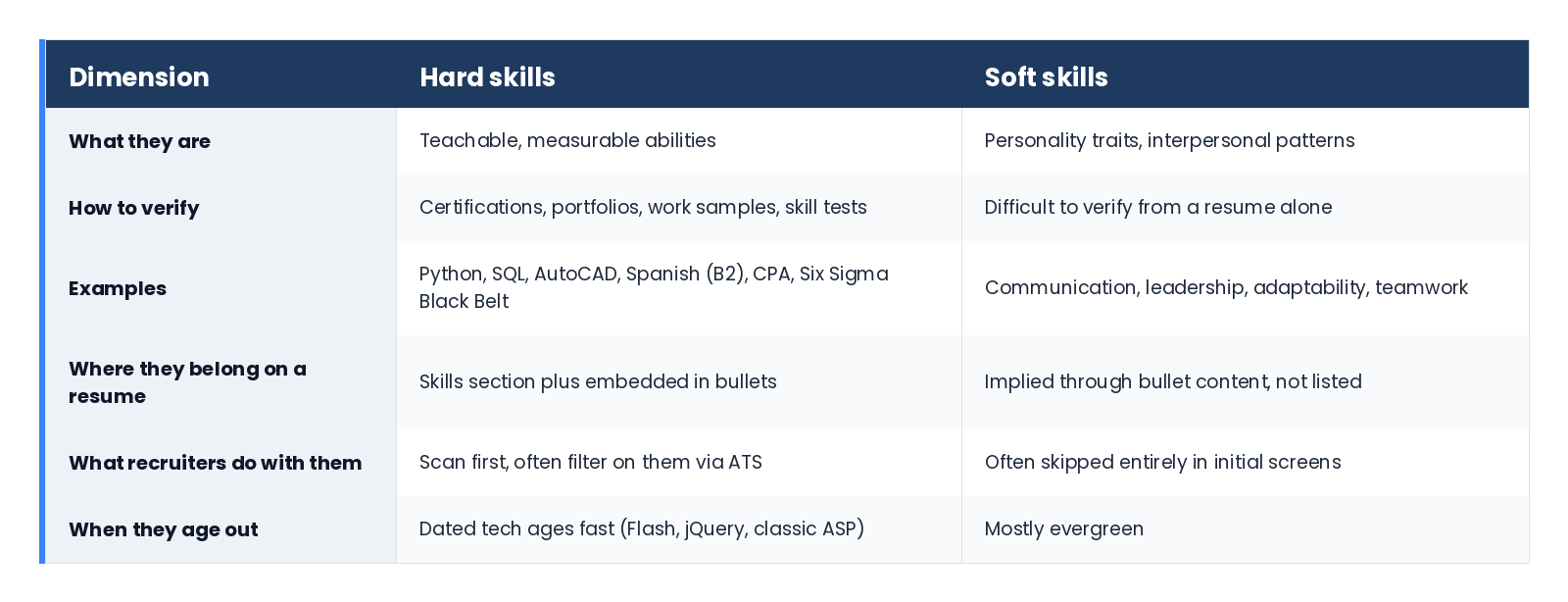
Here's the cleanest way to think about hard skills versus soft skills with concrete examples on each side:
Which hard skills examples actually convert to interviews?
This is the part of the article that took eight years of practice to write. After personally writing resumes for thousands of professionals across dozens of industries since 2019, a few patterns hold up consistently when I look at which resumes generated callbacks and which stalled. I'll break this down by career tier because the rules shift meaningfully as you move up.
Entry-level (0 to 3 years)
For new graduates and early-career candidates, the hard skills section carries more weight than it does for any other tier. The reason is simple: there's less work history to evaluate, so the skills section gets read closely. The examples that work are specific and verifiable, things like language fluency at a stated level ("Spanish, professional working proficiency"), software certifications (CompTIA A+, AWS Cloud Practitioner, Google Analytics), and tooling from coursework or internships (Excel with VLOOKUP and pivot tables, R or Python from a stats class, AutoCAD from an engineering capstone). What falls flat: vague labels like "Microsoft Office" without context, "data analysis" with no tool named, "social media" without a platform or metric.
Mid-career (4 to 9 years)
The skills section here is supporting evidence but it's not the main attraction; the bullets do most of the work. The pattern I see consistently: skills listed in the section have to appear, with context, somewhere in the experience bullets. A candidate listing Salesforce, HubSpot, and Marketo in the skills section but never mentioning what they built or operated in any of those tools loses credibility fast. The best mid-career resumes use the skills section as a quick ATS-friendly index of tools the bullets prove out.
Senior level (10 to 17 years)
Hard skills matter more in technical domains (software engineering, IT, data, engineering) than they do in operational or general management tracks. A senior software engineer absolutely needs a tight skills section organized by category. A senior marketing director generally does not, and a long list of tools can actually make them look more like an operator than a leader. For senior non-technical roles, hard skills work best when they're certifications (PMP, Six Sigma, CFA Level III) or specific platforms with strategic weight (NetSuite implementation lead, Workday HRIS migration), not a wall of tooling.
Executive (18+ years, VP and above)
Executive resumes almost never benefit from a long hard skills section. The ones that converted in my book of work treated hard skills as embedded credentials in the experience bullets. "Led the SAP S/4HANA migration across three business units, $14M program" reads better than "SAP S/4HANA" as a standalone line in a skills section. At the C-suite level, a hard skills section that runs more than three lines starts to take up valuable space that could be used for more important things. The only consistent exceptions are CIOs, CTOs, and CDOs, where the technical bench is part of the story.
The cross-tier pattern is simple: skills listed in isolation are increasingly meaningless. Anyone can write "Python" on a resume. The skills that help get callbacks are the ones the experience section already proved.
What are the most useful hard skills examples by industry?
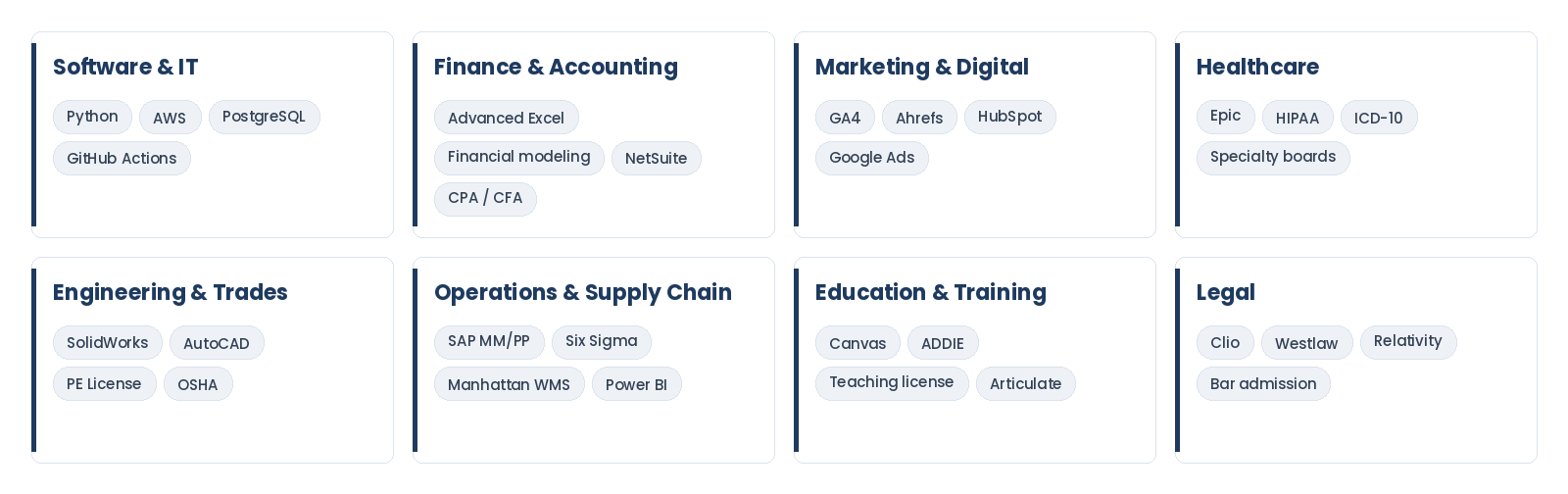
The right hard skills examples depend almost exclusively on the field you're in. Below are the categories that appear consistently on the resumes that convert in each industry, drawn from the same 1,200-resume sample:
- Software and IT: Programming languages (Python, Go, TypeScript, Rust), cloud platforms (AWS, GCP, Azure, with specific services like Lambda, BigQuery, EKS), CI/CD tooling (GitHub Actions, GitLab CI, Jenkins), databases (PostgreSQL, DynamoDB, Snowflake), and frameworks tied to your actual stack (React, Django, Spring Boot). Certifications carry real weight here, particularly the cloud certs (AWS Solutions Architect, GCP Professional Cloud Architect).
- Finance and accounting: Excel at an advanced level (named functions, pivot tables, Power Query, Power Pivot, VBA where relevant), financial modeling, ERP systems (NetSuite, SAP, Oracle), accounting standards (US GAAP, IFRS), tax software (CCH ProSystem fx, Lacerte), and Bloomberg Terminal or FactSet for capital markets roles. The CPA, CFA, and CIA designations function as their own credibility anchors.
- Marketing and digital: Analytics platforms (GA4, Mixpanel, Amplitude, Looker), SEO tools (Ahrefs, Semrush, Screaming Frog), ad platforms with managed budget context (Google Ads, Meta Ads Manager, LinkedIn Campaign Manager), email and marketing automation (HubSpot, Marketo, Klaviyo), and CMS or commerce platforms (Webflow, WordPress, Shopify, Contentful). For senior marketing roles, attribution modeling and lifecycle marketing methodology often outweigh tool lists.
- Healthcare: Clinical certifications (RN, BLS, ACLS, CCRN, specialty boards), EHR systems (Epic, Cerner, Meditech), HIPAA compliance experience, ICD-10 and CPT coding for billing-adjacent roles, and patient population specifics for nursing and physician resumes. For health-tech and clinical research, add CDISC standards, REDCap, and GCP compliance.
- Engineering and skilled trades: CAD and modeling tools (SolidWorks, AutoCAD, Revit, CATIA, ANSYS for simulation), engineering standards specific to the field (ASME, IEEE, NEC, CSA), PE licensure where applicable, OSHA certifications, and equipment-specific certifications for trades (welding tickets, electrical journeyman, refrigeration tickets). For environmental and civil work, add familiarity with regulatory frameworks like CSA Z768 or ASTM E1527.
- Operations and supply chain: ERP platforms (SAP MM/PP, Oracle, NetSuite), demand planning tools (Kinaxis, o9, Blue Yonder), Six Sigma and Lean certifications (Green Belt, Black Belt), warehouse and transportation management systems (Manhattan, JDA, SAP TM), and Power BI or Tableau for operational reporting.
- Education and training: Learning management systems (Canvas, Blackboard, Moodle, Cornerstone), curriculum design frameworks (Understanding by Design, ADDIE), state teaching licensure plus endorsements, special education certifications, and ed-tech tooling (Articulate, Camtasia, Kahoot, Nearpod) for instructional designers.
- Legal: Practice management software (Clio, MyCase, NetDocuments), e-discovery platforms (Relativity, Everlaw, Disco), legal research databases (Westlaw, Lexis), bar admissions by jurisdiction, and substantive specializations (M&A, employment, IP litigation, regulatory). For in-house counsel, add contract lifecycle management tools (Ironclad, Agiloft, ContractWorks).
You'll notice none of these lists include AI tools by name. That's not an oversight, and the next two sections explain why.
For a deeper taxonomy of role-specific competencies, the O*NET database is the most thorough public source.
What hard skills should students and career changers list?
If you don't have years of experience to anchor your hard skills, the section becomes more important, not less. The trick is making sure every skill listed has somewhere on the resume it gets demonstrated, even if that somewhere is a coursework project, a capstone, a personal portfolio, or a certification.
For students, lead with the technical work you've actually done. A computer science student should list the languages and frameworks used in coursework or projects (Python, Java, TypeScript, React) plus any tooling from internships (Git, Docker, AWS Free Tier services). Add language fluency at a stated level, certifications you've earned (CompTIA, AWS Cloud Practitioner, Google Career Certificates), and software relevant to the field. Avoid "Microsoft Office" as a standalone line, that's table stakes and recruiters know it.
For career changers, identify the transferable hard skills from your previous field that map to the new one. A teacher pivoting into instructional design already has curriculum design and LMS experience. An accountant pivoting into FP&A already has Excel and ERP fluency. Recent certifications signal commitment to the pivot (Google Data Analytics Certificate, AWS Cloud Practitioner, PMP, CSPO). Portfolio work matters more here than it does for traditional applicants, since you're asking the reader to bridge from your old field to the new one.
For both groups, the same rule from section two applies: a skill listed without anywhere on the resume to verify it is filler. Don't list it. Pulling from a clean, ATS resume template that bakes the skills section into a tested layout helps when you're starting from scratch.
Where do most resumes go wrong with hard skills?
Here's where I diverge from most of what you'll find online about hard skills examples. After enough years of doing this work, the failure patterns are predictable.
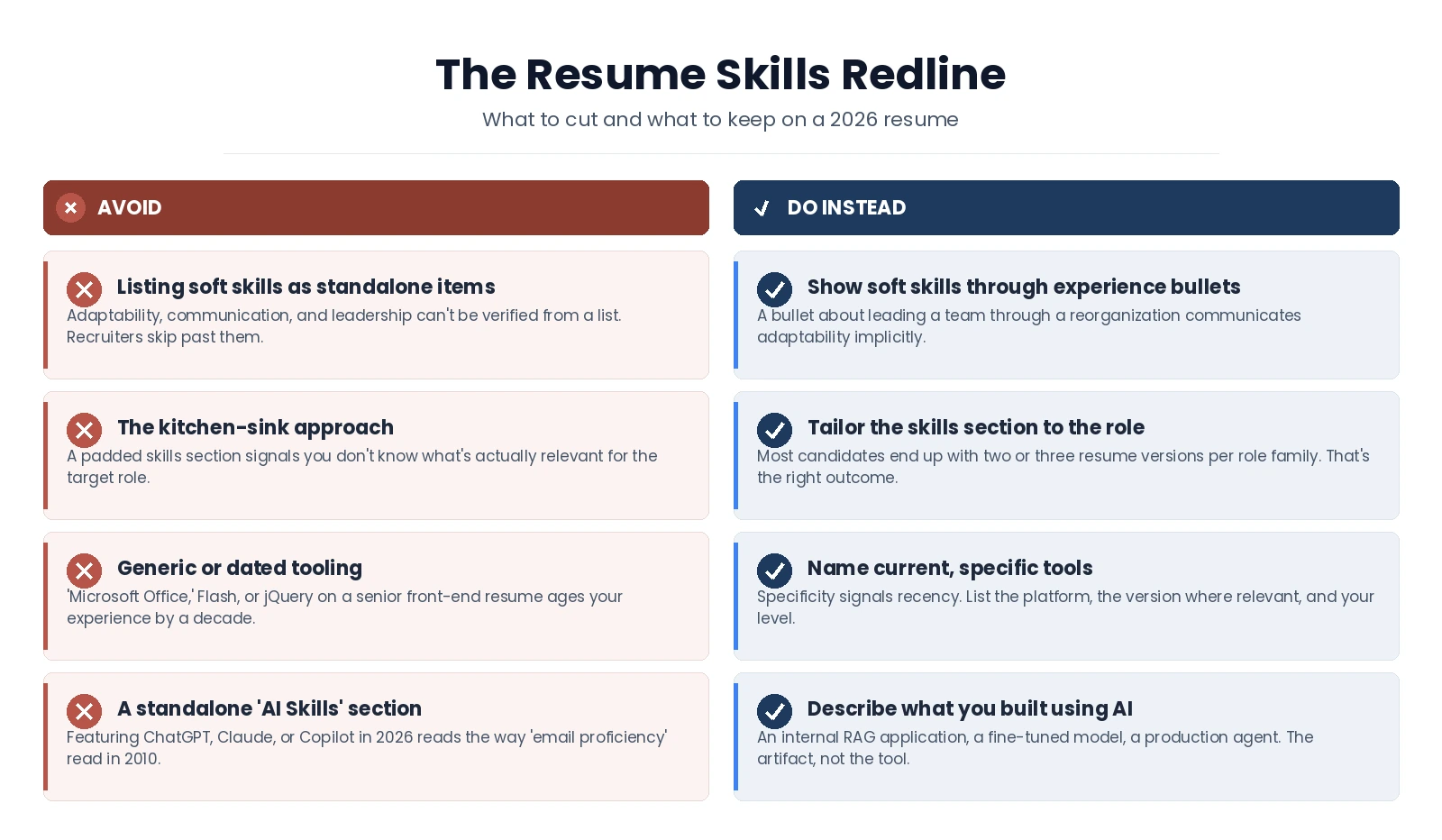
Listing soft skills as if they were hard skills
"Adaptability," "results-oriented," "team player," "strong communicator," "detail-oriented." None of these belong on a resume in a skills section, and they don't function as hard skills no matter how the candidate frames them. The reason is unverifiability. A recruiter looking at 20-plus resumes per requisition has no way to distinguish your claim of "adaptability" from the next candidate's. Soft skills are best demonstrated implicitly through the content in the work experience section. A bullet showing you led a team through a reorganization communicates "adaptability" without ever using the word. Save the line.
The kitchen sink approach
A long, padded skills section signals the opposite of what the candidate intends. It reads as "I don't know what's actually relevant, so here's everything." The strongest resumes I write keep the skills section tight and lean, only listing what the target role is actually asking for. This usually means the candidate ends up with two or three versions of the resume, each tailored to a different role family. That's the right outcome, not the wrong one.
Obsolete or unverifiable tech
Listing tools that haven't been industry-standard for five-plus years (think Flash, jQuery for senior front-end roles, classic ASP) signals that the candidate's experience is dated even when it isn't. Same goes for generic categories like "Microsoft Office" that don't say anything specific about proficiency.
Standalone "AI Skills" sections
This is the most recent pattern, and it's the one that's actively shifting hiring manager behavior in real time. Over the past several months, I've heard from multiple hiring managers, in product, engineering, and marketing roles, who are explicitly skipping or down-ranking resumes that lead with an "AI Skills" section or that read as AI-native. The concern they keep raising is the same one: candidates who lean heavily on AI tooling are presenting as weaker on critical thinking, judgment, and creative problem-solving, three areas that matter more, not less, in 2026.
That doesn't mean you should never mention AI tools. It means don't centerpiece them. ChatGPT, Claude, Copilot, and similar tools are increasingly assumed, the way Google search or Excel are assumed. Listing them as a featured hard skill in 2026 reads roughly the way "able to use email" would have read in 2010. If you genuinely built or shipped something using AI (an internal RAG application, a fine-tuned model, a production agent), describe what you built in the experience section, not what tools you typed prompts into. There's also a difference between using AI tooling and being an AI-native operator, which is what a more thoughtful comparison of AI resume writing tools walks through.
How should you actually format hard skills on a resume?
A few mechanical points that come up constantly in client work.
Group skills by category when the role is technical
For software developers, data engineers, IT professionals, and engineering roles, group your skills by category. A typical software developer's section might have Languages, Frameworks, Databases, Cloud, DevOps, and Tools as separate groupings. This makes the section scannable and signals that you understand how to organize a technical stack. For non-technical roles, a single bulleted list is fine, and categorizing it can feel forced.
Don't use proficiency bars
The little progress-bar visuals showing "Python 80%, Excel 95%" don't help. They're unverifiable, they look gimmicky on senior resumes, and many ATS parsers strip them out anyway. If you need to communicate proficiency, do it with a word ("Python (advanced), R (intermediate)") or, better, let the experience bullets do the work.
Keep the section the right size for the role
Six to ten skills for non-technical roles. Up to 20 to 25 for deeply technical ones, organized by category. For executive resumes, often nothing at all in a dedicated section, with hard skills embedded in the experience bullets instead.
Place it appropriately
For most professionals, the skills section sits below the summary and above the experience section. For technical roles where the skills section carries serious weight, some candidates put it directly below the summary or in a sidebar. For executives, embedded in the bullets is usually better than a standalone section.
Frequently asked questions
What's the difference between hard skills examples and soft skills examples?
Hard skills are teachable, measurable abilities you can prove with a credential, portfolio, or work sample (Python, CPA, AutoCAD, Spanish at B2). Soft skills are interpersonal patterns like communication, leadership, or adaptability that are difficult to verify from a resume alone. Hard skills belong in a skills section. Soft skills should be implied through the content of your work experience bullets, not listed as line items.
How many hard skills should you list on a resume?
For non-technical roles, six to ten focused hard skills examples is the right range. For deeply technical roles (software, IT, engineering, data), 15 to 25 grouped by category works. The skills you list should map to the target job posting and be demonstrable somewhere else on the resume. A skill listed without supporting evidence in the experience section reads as padding and gets discounted.
Are AI skills good hard skills examples to put on a resume in 2026?
Not as a featured category. Listing ChatGPT, Claude, or Copilot as a standalone hard skill in 2026 reads similar to listing "email" or "internet research" in 2010. Several hiring managers I've spoken to are actively down-ranking resumes with prominent AI skills sections. If you've built or shipped something with AI tooling, describe the project in your experience section instead of featuring the tool in your skills list.
What are good hard skills examples for students with no work experience?
Lead with the tools and languages you've actually used in coursework, capstones, internships, or personal projects (Python, R, AutoCAD, Excel with pivot tables and Power Query). Add language fluency at a stated level, software certifications you've earned (AWS Cloud Practitioner, CompTIA, Google Career Certificates), and any field-specific software. Skip "Microsoft Office" as a generic line. It's assumed at this point and signals nothing.
Should hard skills be listed by category on a resume?
Categorize for technical roles. A software developer's skills section reads cleaner when grouped into Languages, Frameworks, Databases, Cloud Platforms, and Tools. For non-technical roles like marketing, operations, finance, or general management, a single tight list is fine and categorization can feel forced. The test: if your skills naturally fall into three or more distinct buckets, group them. If they don't, don't.
About the author
Alex Khamis, CPRW, is the cofounder of Resumatic and the founder of Final Draft Resumes. He moderates r/resumes (1.2M+ members) and has personally written over 1,200 resumes across 50+ industries since 2019, including hundreds of senior and executive engagements. LinkedIn | About Resumatic
If you want a faster way to pressure-test the hard skills section on your current resume, Resumatic is free to start and the keyword analyzer flags generic phrasing and gap-checks your skills against any job posting you paste in. Most users have a tightened, ATS-aware draft in about 20 minutes. If you're navigating a senior or executive transition and want a credentialed second pair of eyes, that's where a human writer is still worth the spend.
Automatic AI Resume Tailoring
Customize your resume with AI-guided precision.