234 Resume Action Verbs for 2026 (Organized by the Claim You're Making)
Action verbs are the first word of every resume bullet, and the strongest ones match the claim the bullet is making: led, built, grew, saved, fixed, analyzed, persuaded, ran, or improved. Below are 234 verbs organized by those nine claims, plus the verbs that now read as AI tells and should come off your resume in 2026.
Key Takeaway
- Pick the verb by the claim your bullet makes, not by scrolling an alphabetical list until something sounds impressive.
- Pair every verb with a quantified outcome, because the verb sets up the claim and the number proves it.
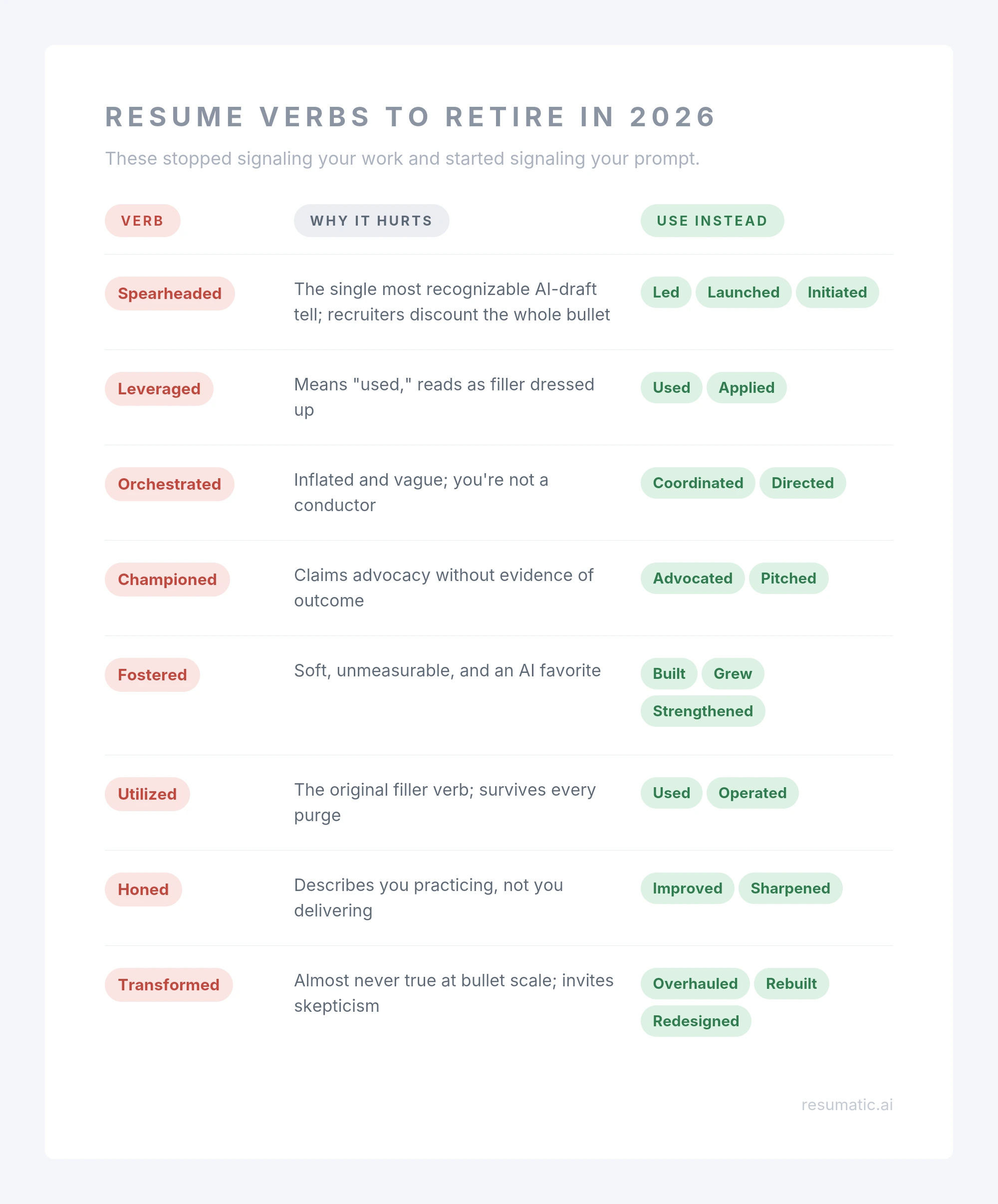
- Retire the AI-fatigued verbs ("spearheaded," "leveraged," "orchestrated"): recruiters now read them as ChatGPT output, not as your work.
Why do action verbs matter on a resume?
Recruiters spend somewhere around six seconds on the first pass of a resume, and in that window they're not reading sentences, they're reading the left edge of your bullets. The first word of each bullet is what survives a skim, which means the verb carries a disproportionate share of the work: it tells the reader what kind of contribution you made before they've decided whether to read the rest of the line.
That's the entire case for action verbs, and it's also why the standard advice ("use strong verbs!") misses the point. A verb isn't strong in the abstract. "Directed" is a strong verb if you directed something and a liability if you coordinated calendars for the person who did. The verb is a claim, and the rest of this article is organized around that idea.
How should you choose an action verb?
Start from the accomplishment, not the thesaurus. Before you pick a word, name the claim the bullet is making. In practice nearly every resume bullet makes one of nine claims: you led something, you built something, you grew a number, you cut cost or time, you fixed a problem, you analyzed something and drove a decision, you persuaded someone, you ran something, or you made other people better.
Once you've named the claim, the verb almost picks itself, and the bullet has a natural shape: verb, then what you did it to, then how, then the quantified result.
Here's the difference in practice. The before is the kind of bullet I see daily on r/resumes; the after is the same fact restated as a claim.
Before: Responsible for managing social media accounts and helping to increase engagement.
After: Grew Instagram engagement 64% in six months by shifting the content calendar from product posts to customer stories.
Nothing was added except honesty about the claim. "Responsible for" makes no claim at all, while "grew" commits you to a number, and committing to the number is what makes the bullet readable in six seconds.
Which action verbs should you use? (234 verbs by claim)
The lists below are organized by the nine claims, because that's how you actually write a bullet: you know what you accomplished and you need the word that matches it. Most ranking lists, including the university career center PDFs, organize by skill category ("leadership verbs," "communication verbs"), which forces you to guess which category your accomplishment belongs to before you've articulated it. Start from the claim instead.
The full list is also available as a free, no-email-required PDF: Download the 234-verb PDF organized by claim.
- You led something (people, teams, functions, initiatives): Led, Directed, Managed, Headed, Oversaw, Supervised, Chaired, Coordinated, Guided, Steered, Mobilized, Delegated, Aligned, Unified, Convened, Presided, Marshaled, Captained, Staffed, Recruited, Sponsored, Restructured, Reorganized, Appointed, Facilitated, Governed.
- You built something new (products, programs, systems, content): Built, Created, Designed, Developed, Launched, Founded, Established, Engineered, Architected, Authored, Drafted, Produced, Programmed, Coded, Devised, Formulated, Initiated, Instituted, Introduced, Invented, Originated, Piloted, Prototyped, Composed, Constructed, Assembled.
- You grew a number (revenue, users, output, performance): Grew, Increased, Expanded, Scaled, Accelerated, Doubled, Tripled, Raised, Generated, Delivered, Captured, Secured, Won, Closed, Converted, Exceeded, Surpassed, Outperformed, Attained, Lifted, Drove, Monetized, Boosted, Broadened, Multiplied, Outpaced.
- You cut cost or time (efficiency, savings, simplification): Reduced, Cut, Decreased, Lowered, Trimmed, Eliminated, Consolidated, Streamlined, Automated, Simplified, Standardized, Shortened, Compressed, Saved, Conserved, Minimized, Renegotiated, Refinanced, Halved, Curtailed, Recouped, Offset, Deprecated, Retired, Merged, Centralized.
- You fixed a problem (turnarounds, recoveries, troubleshooting): Resolved, Repaired, Restored, Recovered, Remediated, Corrected, Diagnosed, Debugged, Troubleshot, Stabilized, Salvaged, Revived, Reconciled, Rectified, Mitigated, Contained, De-escalated, Overhauled, Reversed, Untangled, Rebuilt, Reengineered, Remedied, Averted, Preempted, Neutralized.
- You analyzed something and drove a decision (research, data, insight): Analyzed, Assessed, Evaluated, Audited, Investigated, Researched, Examined, Measured, Quantified, Modeled, Forecasted, Projected, Benchmarked, Mapped, Identified, Tested, Validated, Verified, Interpreted, Synthesized, Prioritized, Recommended, Calculated, Estimated, Surveyed, Appraised.
- You persuaded someone (sales, influence, communication): Negotiated, Persuaded, Pitched, Presented, Promoted, Marketed, Sold, Upsold, Cross-sold, Influenced, Advocated, Lobbied, Briefed, Publicized, Campaigned, Positioned, Branded, Edited, Translated, Demonstrated, Convinced, Mediated, Arbitrated, Fundraised, Solicited, Wrote.
- You ran something (operations, process, compliance): Administered, Operated, Executed, Implemented, Maintained, Monitored, Scheduled, Planned, Organized, Processed, Tracked, Documented, Cataloged, Inventoried, Procured, Sourced, Dispatched, Routed, Enforced, Inspected, Certified, Safeguarded, Archived, Budgeted, Allocated, Calibrated.
- You made other people better (training, service, retention): Trained, Taught, Coached, Mentored, Onboarded, Tutored, Educated, Instructed, Advised, Counseled, Supported, Served, Upskilled, Cross-trained, Reviewed, Critiqued, Fielded, Triaged, Retained, Renewed, Reengaged, Strengthened, Deepened, Cultivated, Liaised, Partnered.
One verb can carry different claims in different bullets, and that's fine. "Negotiated" sits under persuasion, but if the outcome was a 30% cost reduction, "renegotiated" under cost-cutting makes the claim sharper. When a verb could go two ways, follow the number.
Which resume verbs should you retire in 2026?
This is the section the university PDFs won't give you, because their lists predate the thing that changed: most resumes are now drafted, at least partially, by AI, and AI drafts have a vocabulary. Moderating r/resumes, I can usually spot a ChatGPT-drafted resume before reading a full line, because the same handful of verbs cluster at the top of every bullet. "Spearheaded" appearing once is a word choice. "Spearheaded" appearing three times above "leveraged" and "orchestrated" is a fingerprint, and recruiters who screen hundreds of resumes a week have learned the same pattern faster than anyone.
The problem isn't that these are bad words. It's that they've stopped signaling your work and started signaling your prompt.
Alongside the AI tells, the perennial filler still applies: "responsible for" isn't a verb and tells the reader what you were assigned rather than what you did, and "assisted with," "helped," "worked on," "participated in," and "was tasked with" all share the same flaw. They describe proximity to work instead of work. If you genuinely played a supporting role, say what the support consisted of ("Drafted the analysis the VP presented to the board") rather than labeling yourself as help.
How many times can you repeat the same action verb?
Twice on a one-page resume is the practical ceiling, and never twice within the same role. The fix isn't grabbing a random synonym, it's checking whether both bullets are really making the same claim. If you've opened two bullets with "Managed," odds are one of them is actually a growth claim or a fix-it claim wearing a leadership verb, and reclassifying it does more for the resume than swapping in "supervised" ever will. Variety should come from the variety of your claims, not from a thesaurus pass.
Do action verbs help you pass ATS?
Mostly no, and this myth costs people real effort. Applicant tracking systems parse and match keywords, which are overwhelmingly nouns and noun phrases: job titles, tools, certifications, skills, the things that live in the skills section and the posting itself. No mainstream ATS scores verb strength, and a resume doesn't get auto-rejected for opening a bullet with "helped."
Verbs are for the human pass. The ATS gets you into the recruiter's queue on nouns; the verbs decide what the recruiter believes about you in the six seconds after that. Optimize both layers, but don't confuse them: stuffing "spearheaded" into every line does nothing for the ATS and actively hurts you with the human.
Frequently asked questions
Q: What's the best action verb to use on a resume?
A: There's no universal best verb, because the right verb depends on the claim the bullet makes. "Led" is the best verb for a leadership claim, "grew" for a growth claim, "reduced" for a savings claim. The verbs to avoid are universal, though: "spearheaded," "leveraged," and "utilized" now read as AI-generated filler to most recruiters.
Q: How many action verbs should a resume have?
A: Every bullet should open with one, so a typical one-page resume carries 12 to 20 action verbs. Don't repeat a verb more than twice across the page or twice within one role. If you keep reaching for the same verb, the bullets are probably making the same claim and one of them should be reframed or cut.
Q: Should every resume bullet start with an action verb?
A: Yes. Use present tense for your current role ("Manage a 14-person support team") and past tense for previous roles ("Managed"). The one place verbs take a back seat is your summary or resume objective, which is written in fragments or first-person-implied prose rather than verb-led bullets.
Q: What can I say instead of "responsible for" on a resume?
A: Replace it with the verb describing what you actually did with the responsibility. "Responsible for monthly reporting" becomes "Produced monthly P&L reports for three business units." If the honest answer is that you maintained something rather than changed it, "maintained," "administered," and "operated" are legitimate verbs, and they're stronger than "responsible for" because they're claims.
Q: Do action verbs still matter if AI wrote my resume?
A: More than before. AI drafts default to the same small verb set, so an unedited draft makes you look like every other applicant who used the same tool. Treat the AI output as a first pass, then swap the fatigued verbs for ones matching your actual claims and attach real numbers. The verbs are where you put your fingerprints back on the document.
About the author
Alex Khamis, CPRW, is the cofounder of Resumatic and the founder of Final Draft Resumes. He moderates r/resumes (1.2M+ members) and has personally written 1,200+ resumes since 2019, which is where the verb patterns in this article come from: thousands of bullets reviewed, rewritten, and screened against what recruiters actually respond to. LinkedIn.
If you want help putting these into practice, Resumatic is free to start and the AI bullet rewriter is built around the same verb-plus-outcome structure this article uses, so the drafts you get back start from the claim, not the cliche.
Automatic AI Resume Tailoring
Customize your resume with AI-guided precision.