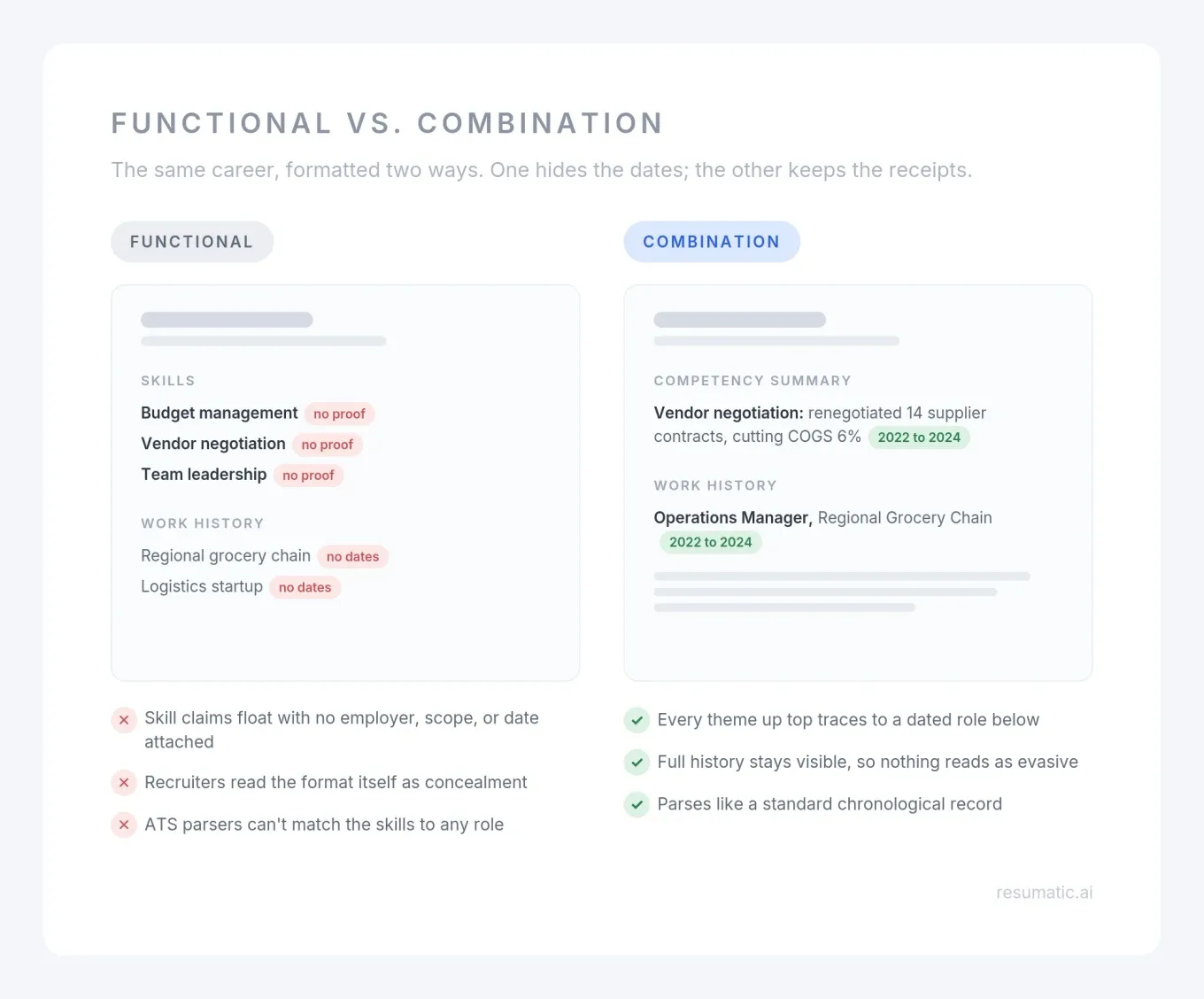
A reverse-chronological resume, with your work history listed newest first, is the right format for the large majority of job seekers in 2026. The functional format, which groups skills into themes and minimizes dates, is widely read by recruiters as an attempt to hide something. The combination format, a skills summary up top with a full dated history below, is the honest option for career changers.
What are the three resume formats and how do they differ?
Every resume format is an answer to one question: what do you want the reader to see first? The reverse-chronological format answers with your most recent job. The functional format answers with your skills, grouped into themes like "Leadership" or "Project Management," while your actual work history gets compressed into a bare list of employers at the bottom, often without dates. The combination format (you'll also see it called hybrid) splits the difference: a substantial skills or competency summary at the top, followed by a complete reverse-chronological work history with dates intact.
Here's how the three compare on the dimensions that actually matter in a hiring process:
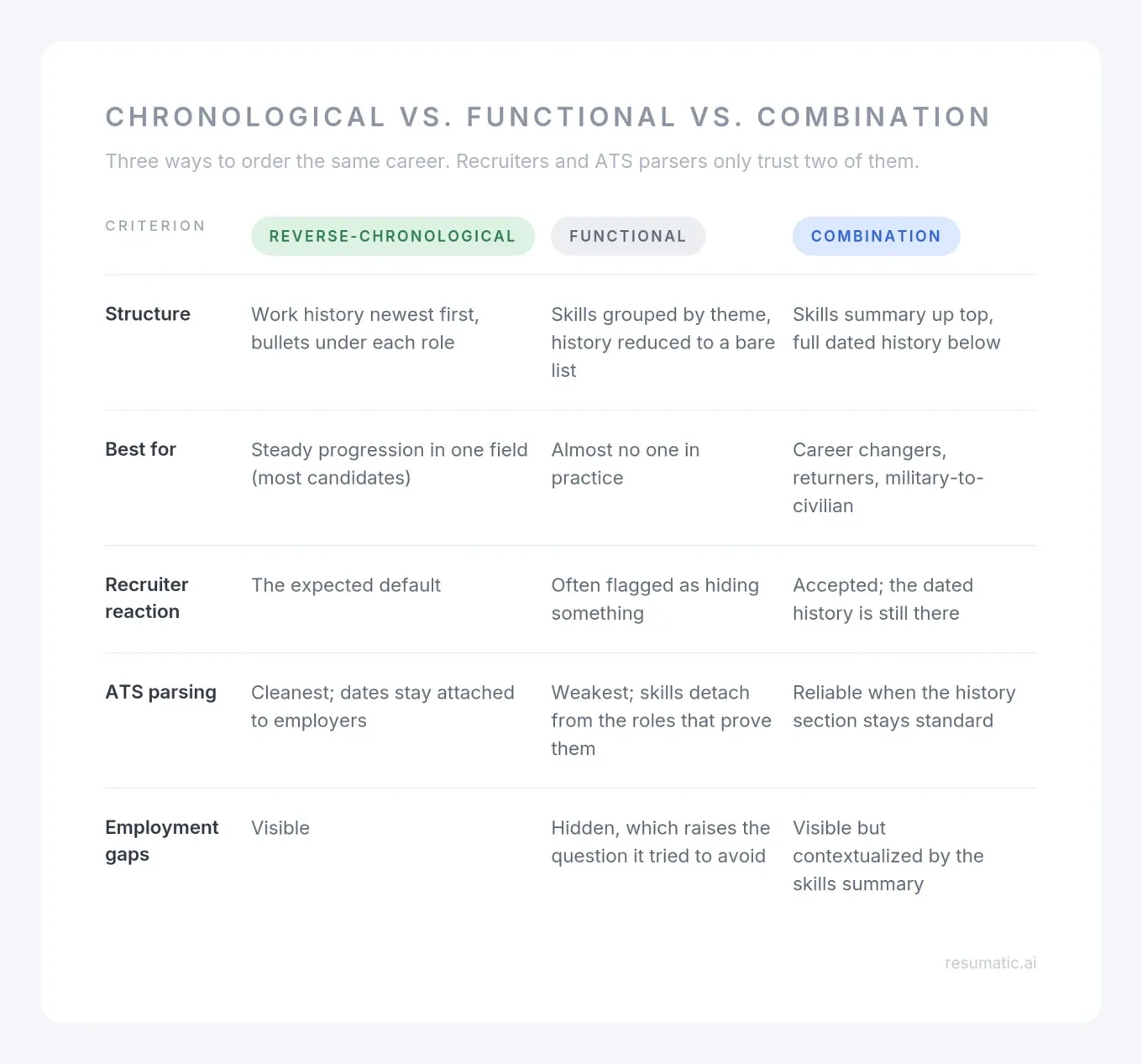
The rest of this piece is about why that middle column looks so bleak, and what to do instead if your work history doesn't tell a tidy story.
Why is reverse-chronological the right format for most people?
Because it's the format the entire hiring apparatus is built around. A recruiter screening a requisition spends a handful of seconds per resume, and that scan follows a predictable path: current title, current employer, dates, previous title, and only then the bullets. The reverse-chronological format puts the answers exactly where that scan expects to find them, which is why it's been the default for decades and why nothing about AI screening has changed it.
ATS parsers follow the same logic. They're trained to associate a job title, an employer, a date range, and a block of bullets as one unit. When your resume keeps those units intact, the parsed record that a recruiter sees inside the ATS looks like your actual career. When it doesn't, you're trusting a parser to reassemble a puzzle you deliberately scrambled, and parsers are not good at that.
If your career is a reasonably continuous line, even one with a few short tenures or a modest gap, reverse-chronological is the format. Most of the work then shifts to what goes inside it, which is a question of content rather than format. That's covered in our guide on how to write a resume that gets interviews, along with how long your resume should be for your experience level.
When does a functional resume actually backfire?
Almost every time it meets an experienced reader, and I say that as someone who has watched the reaction from both sides. Moderating r/resumes, a community of over 1.2 million members, I see the same exchange play out on a loop: someone posts a functional resume hoping to soften a gap or a scattered history, and the recruiters and hiring managers in the thread tell them, with varying degrees of patience, that the format itself was the first thing they noticed. The format was designed to de-emphasize work history, everyone in hiring knows that's what it's for, and so its presence announces the exact problem it was meant to conceal.
In my own practice, across more than 1,200 client resumes since 2019, I can count the true functional resumes I've delivered on one hand. The clients who asked for one almost always had a real, solvable problem underneath: a two-year caregiving gap, a string of short contracts, a pivot between industries. In every one of those cases there was a better answer than deleting the dates.
There's also a mechanical cost. A functional resume separates skill claims from the roles that prove them, so "budget management" floats on the page with no employer, no scope, and no date attached. A recruiter can't verify it, and an ATS parser can't index it against a position. Purdue's Online Writing Lab, which publishes one of the more careful treatments of the format, frames the functional resume as a special-case tool, and even the sample they provide keeps more structure than most functional resumes in the wild.
If there's a residual use case, it's narrow: someone whose work history is genuinely irrelevant to the target and who has substantial provable skills from outside employment, which in practice describes very few people. If you're tempted by the functional format, the honest first step is naming the problem you're trying to hide. The next section is the better fix for nearly all of them.
Who should actually use a combination resume?
The people the functional format was supposedly invented for. Career changers, parents returning after a multi-year gap, military members translating service into civilian terms, and consultants or freelancers consolidating fragmented project work all share the same need: the most relevant evidence isn't sitting in the most recent job title. The combination format solves that by reordering emphasis instead of deleting information.
The build is straightforward. The top third of the page carries a competency summary: three to five skill themes, each backed by one or two concrete, dated proof points pulled from your actual history ("Vendor negotiation: renegotiated 14 supplier contracts at a regional grocery chain, 2022 to 2024, cutting COGS 6%"). Below that sits a complete reverse-chronological work history, dates included, with shorter bullet sets since the summary already carried the headline evidence. The reader gets your argument first and your receipts second, and nothing about the document reads as evasive.
The discipline is keeping the summary honest. Every theme in the top section has to trace to something dated in the bottom section. The moment a skill appears up top with no anchor below, you've rebuilt a functional resume with extra steps, and you inherit all of its credibility problems.
How do you choose the right format for your situation?
Work through your actual situation rather than your anxiety about it. A steady progression in one field, even with a layoff or a short stint in the middle, takes a reverse-chronological format, and the gap gets a one-line explanation rather than a structural cover-up. A deliberate career change takes a combination format, with the skills summary doing the translation work between your old field and the new one. A return from a multi-year break takes a combination format too, usually with the break acknowledged plainly in a single line, because a named gap reads as confidence and an unexplained one reads as a question mark.
Early-career candidates are the one group that bends the rules slightly: with one or two roles, education and projects can sit above experience, but the underlying skeleton is still chronological. What no situation calls for is the purely functional layout, and if a template gallery or an older career book is steering you toward one, check the publication date.
How do ATS systems parse each format?
An ATS builds a structured candidate record from your document: employers, titles, date ranges, and the text associated with each. Reverse-chronological resumes parse cleanly because the format mirrors the record the system is trying to build. Combination resumes parse nearly as well, provided the history section follows standard conventions (employer, title, dates on consistent lines), because parsers generally treat the skills summary as supplementary text and index the history normally.
Functional resumes parse worst, and the failure is structural rather than cosmetic. With skills detached from employment, the parser either assigns your experience to the wrong roles or drops the undated employer list into a low-confidence field a recruiter may never open. Candidates often blame keyword matching for the silence that follows, but a resume the system couldn't reconstruct never made it to the keyword stage. The fonts-and-columns side of parsing is its own topic, covered in our guide to making your resume ATS-friendly; format choice sits upstream of all of it.