How Far Back Should My Resume Go? 2026 Guide
The most popular answer to "how far back should my resume go" is also the one that gets people into trouble.
Keep it to 10 years. Or 15. Or one page. Or two. Tidy rules that sound helpful right up until you try to apply one to an actual career.
The question isn't how old your oldest job entry should be. The question is what timeline helps a recruiter say, quickly, "yes, this person fits." If an old role helps that story, keep it. If it muddies the story, cut it, compress it, or move it into the background.
A lot of resume advice treats dates as the main issue. They aren't. Relevance is the issue. Reader fatigue is the issue. Keyword density is the issue. And, quietly, age bias can be the issue too.
So let's stop treating the 10-year rule as scripture and start treating your resume as what it is: a focused argument built for one target job.
Key Takeaways
Your resume should go back only as far as your experience still strengthens your case for the job you are targeting. For most candidates that is 10 to 15 years, but the real cutoff is relevance, not a date.
- The standard benchmark is 10 to 15 years of work history, and many hiring managers treat 10 years as the default. It is a guideline, not a rule.
- Career stage changes the answer. Under 5 years of experience: include everything. Mid-career: roughly 10 years, often three to five jobs. Senior leadership: recent leadership roles in detail, earlier work summarized.
- Career changers are often better off showing only the last five years, so unrelated history does not confuse the hiring manager.
- In fast-moving fields like AI, software, and robotics, the useful window tightens to about 5 to 8 years, because retired tools and platforms make current skills look stale.
- Applicant tracking systems weight recent data most heavily, so a long timeline buries your strongest keywords under expired titles and legacy tools.
- Old roles do not need to be deleted. Compress them into an "Earlier Career" section with company names and titles only, so they stay on the page without stealing attention.
- Experience older than 20 years is rarely relevant and can expose you to age discrimination.
- The filter for every entry: does this improve my odds for this specific role? If yes, keep it. If not, cut it or compress it.
So How Far Back Should Your Resume Really Go
Go back only as far as your experience still strengthens your case for this job.
That usually lands somewhere in the recent stretch of your career, but "recent" isn't a fixed number. If you're applying for a mid-level operations role, your first retail job is considered ancient history. If you're moving into customer success and that same service-heavy role shows you can calm angry customers without making things worse, it suddenly matters again.
This is where strict rules fall apart - and this is something I've noticed as someone that's been writing resumes since 2019 - it's that people want rules to follow, but in resume writing, there are no black and white rules, only shades of grey.
Your resume works like a movie trailer, not a box set. It shows the scenes that make someone want the full story. Dump every role, every task, every side road onto the page and you're asking the recruiter to do the editing for you. They won't. They'll move on.
Your resume doesn't need to prove you've always worked hard. It needs to prove you fit this role now.
That's also why format matters. If your background is messy, nonlinear, or split across industries, it helps to understand the trade-offs between structures like chronological and functional formats. This guide on chronological vs functional resume choices is useful if you're trying to decide how to present older work without letting it dominate the page.
So yes, there's a common benchmark. But the benchmark is just a starting point. The actual job is sharper than that. Shape the timeline around relevance, not nostalgia.
The 10 Year Rule Is a Guideline Not a Law
The 10-year rule didn't appear out of nowhere. It exists because resumes got bloated, recruiters got busier, and older experience often stopped pulling its weight.
The broad consensus is pretty clear. Hiring managers generally expect no more than 10 to 15 years of work experience on a resume, and many cite 10 years as the standard according to this summary of hiring guidance citing CareerBuilder. The logic is practical. Recent work usually says more about your current value than roles from before the early 2000s, especially in fields shaped by rapid technology shifts.
That's sensible. It's just not universal.
Why the rule exists
The logic holds up. Recent work says more about your current value than roles from before the early 2000s, especially in fields reshaped by technology. Old jobs aren't bad because they're old. They're bad when they crowd out stronger evidence.
Recruiters scan for a few things first:
- Current fit that matches the open role
- Progression that makes sense at a glance
- Language that mirrors the job description
- Signals of recency so skills don't look stale
If an older role helps one of those, fine. If it eats space without helping, it's dead weight.
What the rule gets wrong
The myth is that every candidate should chop everything before a fixed date. That's too mechanical.
A recruiter doesn't reject a resume because a role is old. A recruiter loses interest when the page feels unfocused. There's a difference. A role from long ago can still earn its keep if it does one of these jobs:
- Explains your foundation in a field you still work in
- Supports a pivot by showing transferable experience
- Adds credibility because the employer or title still carries weight
- Clarifies continuity when your recent path otherwise looks confusing
Practical rule: Every line on your resume should answer the reader's silent question, which is "why is this here?"
The better question isn't "is this older than 10 years?" It's "does this help me get an interview?"
How Recruiters and ATS Actually Read Your Resume

If you want to know how far back your resume should go, stop thinking like the writer and start thinking like the readers. Plural. Because your resume usually has two readers, and neither one is sitting down with tea and a highlighter.
The first reader is software. The second is a tired human.
What the ATS is doing
For about 90% of job candidates, a 10 to 15 year history is considered optimal because it aligns with ATS parsing windows that prioritize recent data, according to this ATS-focused breakdown. Go much further back and you risk making the document longer, noisier, and less weighted toward your recent achievements.
That doesn't mean the ATS hates old jobs on principle. It means the system is built to parse structure and match relevance. If your most useful keywords are buried under a stack of expired tools, retired platforms, or old job titles, you're making the machine work harder than it needs to.
The ATS isn't an all-knowing gatekeeper. It's a matching engine that wants clean inputs, recognizable titles, and obvious alignment with the role. Bury your best keywords under a stack of expired tools and retired platforms and you're making it work harder than it needs to.
If you work in a highly technical field, the details matter even more. I like how Trackside Careers breaks down writing technical resumes for F1, because it shows how specialized resumes need precision, not autobiography. That same principle holds whether you're aiming at motorsport, software, robotics, or data roles.
For a practical look at what these systems tend to reward and reject, this guide to an ATS resume checker is a strong companion.
What the recruiter is doing
Now the human part.
Recruiters usually scan before they read. They're not admiring your career journey. They're pattern-matching. They want to know, quickly:
- Does this person look close enough to the brief
- Are the most relevant roles easy to find
- Is the recent experience stronger than the old experience
- Will the hiring manager understand this story in one pass
That's why a dense, overstuffed resume backfires. Too much history turns your best evidence into wallpaper.
What works and what doesn't
Here is the trade-off.
Works well
- Front-loading relevant recent roles with strong bullets
- Compressing older positions into short entries
- Using job-description language without sounding robotic
- Removing stale detail that no longer supports your target role
Usually fails
- Listing every job equally as if all eras matter the same
- Giving outdated roles full bullet treatment while recent roles get less space
- Stuffing in legacy tools that make you look frozen in time
- Letting chronology override relevance
Recruiters forgive a missing old role far faster than they forgive a cluttered resume.
Your timeline shouldn't be complete. It should be legible.
Tailoring Your Timeline for Different Career Scenarios

There's no single right answer here, and anyone who gives you one is selling simplicity. The cutoff moves depending on where you are in your career and what kind of move you're making.
According to Forbes coverage of resume timing guidance, the usual 10 to 15 year benchmark shifts by career level. If you have less than 5 years of experience, include your entire work history. For mid-level roles, a 10-year history is often the sweet spot, often covering three to five jobs. In fast-moving tech fields like AI and robotics, some experts argue the useful window can tighten to 5 to 8 years so the resume doesn't showcase outdated skills.
That's not arbitrary. It's about signal quality.
Early career and recent graduates
If you've been working for less than 5 years, don't over-edit. You need substance on the page. That means your internships, part-time jobs, contract work, campus roles, and volunteer projects may all deserve space if they show responsibility or transferable skills.
The mistake here is acting too senior too soon. I've seen early-career candidates cut useful material because they're trying to imitate executive resumes. Bad move. If you only have a short work history, breadth helps.
What matters is framing. A campus job isn't "just a student job" if it shows customer communication, scheduling, conflict handling, or process discipline.
Mid-career professionals
This is where the 10-year rule actually earns its reputation. You have enough history to be selective and too much to include everything without making a mess.
A good mid-career resume usually has a clear center of gravity. The last decade carries the detail. Older experience, if kept at all, gets compressed. You want the recruiter to see momentum, not sediment.
If you're customizing for specific openings, this guide on how to tailor your resume to a job description is worth reading. Tailoring isn't cosmetic. It changes what belongs in your timeline.
Senior leaders and long careers
If you've been at this a long time, your challenge is managing volume without looking stuck in the past, as opposed to a lack of experience.
Your resume should emphasize:
- Strategic scope over old operational detail
- Leadership progression instead of every historic responsibility
- Business impact from recent roles
- Selective legacy context only when it still helps your case
You're not hiding your depth. You're packaging it.
Whenever I get a four-page executive resume, I'm typically removing detail from older roles that no longer serves its purpose (this is especially true for tech leaders).
Career changers and fast-moving tech
Here, the standard rule often breaks hardest.
A career changer may be better off showing only the most relevant recent stretch, especially if older industry history would distract from the new target. The same goes for people in AI, software, robotics, and similar areas. In those environments, old experience can age badly. A long timeline full of retired systems may read less like wisdom and more like drift.
Shorter isn't always better. Cleaner is. Your timeline should fit the story you need the recruiter to believe.
That's the distinction. Your resume timeline should fit the story you need the recruiter to believe.
What to Do with Old Irrelevant Roles or Gaps

Once you accept that not every old job deserves a full entry, the next problem shows up fast. What do you do with the leftovers?
You don't pretend they never happened. You just stop giving them front-row seats.
According to Zety's guidance on older work history, experience older than 20 years is rarely relevant and can inadvertently expose you to age discrimination. One practical fix is creating a separate Extended Chronology section that lists only company names and titles, without pulling attention away from recent work.
How to compress old experience without making it weird
A lot of people think trimming old roles creates suspicious gaps. Usually, it doesn't. Not if you handle it cleanly.
Here's a before-and-after idea.
Too much detail
- Camp Counselor, Pine Ridge Camp
Managed activities, supervised groups, handled scheduling, worked with parents - Sales Associate, Mall Retailer
Opened and closed store, assisted customers, tracked inventory, trained new hires
If those roles are old and unrelated, they don't need the full bullet treatment. They can become this:
Earlier Career
- Camp Counselor, Pine Ridge Camp
- Sales Associate, Mall Retailer
That's enough. You're acknowledging the work without letting it steal oxygen.
What to do when there's a gap
Employment gaps feel bigger to the candidate than they do to the recruiter, at least when handled plainly. The danger isn't the gap itself. It's the fog around it.
A smart approach is:
- Name the period if it needs explanation
- Keep the explanation brief and calm
- Pivot back to readiness and current relevance
- Support the narrative in your cover letter if needed
If you want practical examples, I like Underdog's piece on navigating employment breaks because it treats gaps as something to frame, not something to panic about. And if you need wording help, these employment gap cover letter examples can help you explain the break without over-explaining your life story.
Old experience should sit in the background unless it actively helps you win the role.
That's the test.
A simple structure that works
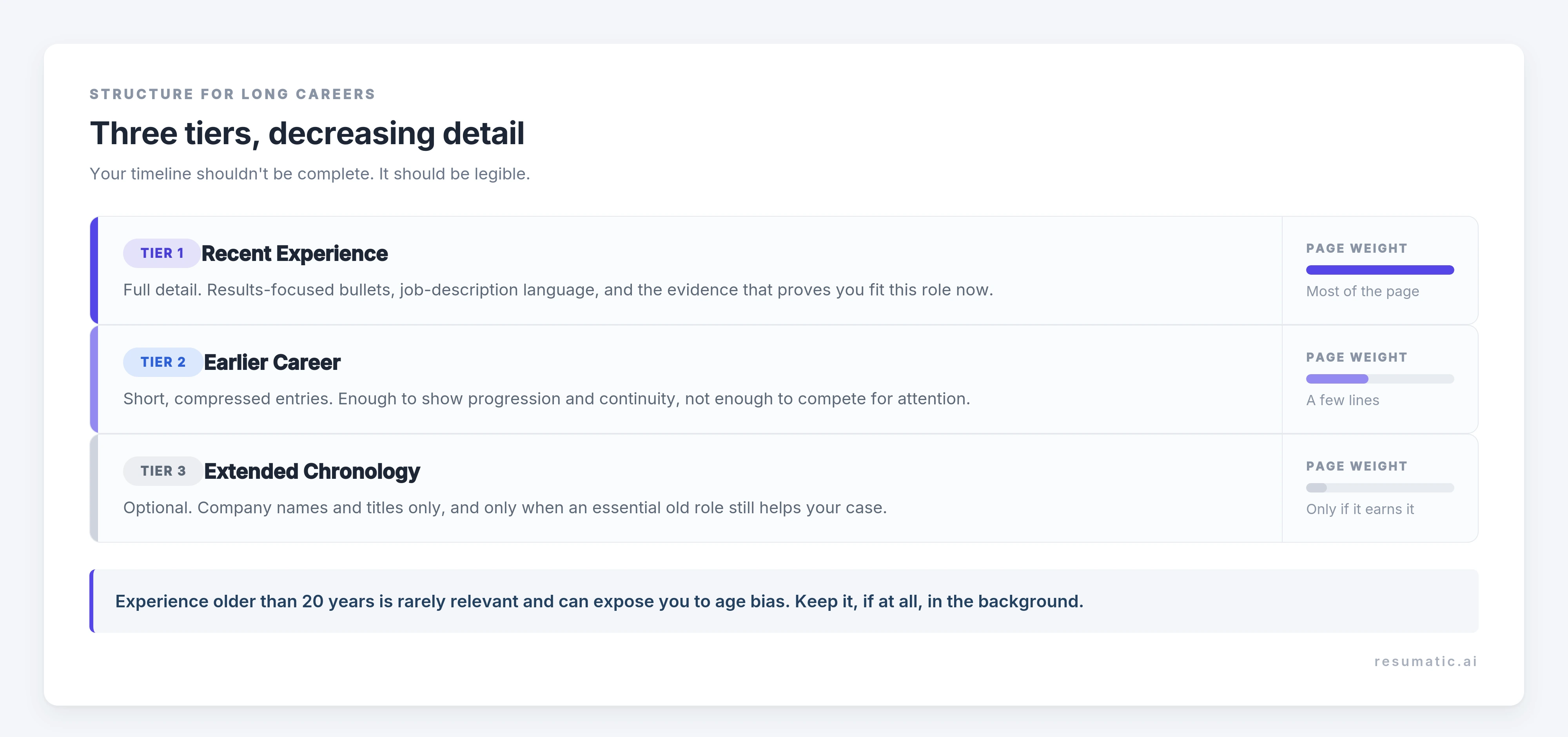
For long careers, this pattern is usually clean and modern:
- Recent Experience with full detail and results-focused bullets
- Earlier Career with short, compressed entries
- Extended Chronology only if essential old roles still matter
Done right, it removes clutter without creating mystery. That's the sweet spot.
Pruning Your Work History in Minutes with Resumatic
Editing your timeline is easy in theory and annoying in practice.
The hard part isn't knowing that an old role should probably go. The hard part is maintaining different resume versions without turning your desktop into a graveyard of files named Final, Final2, Final-Use-This-One, and Please-Final. That's where tools start earning their keep.
Why version control matters
Resume advice often assumes there's one master answer. There isn't. You may need one version for a role in your current field, another for a pivot, and another for a highly technical application where the wording needs to be tighter and more keyword-aligned.
That matters even more because Indeed's guidance on resume history exceptions points out a critical exception. Career changers are often advised to list only the last five years so unrelated history doesn't confuse hiring managers. On the other hand, if you've held the same job for 15+ years, that full timeline can work in your favor because it signals stability.
Those are two very different editing decisions. A basic Word doc makes both harder than they need to be.
What helps in real use
A useful resume tool should let you:
- Toggle older roles on or off depending on the job
- Reorder entries without wrecking formatting
- Keep one master career history while exporting targeted versions
- Rewrite bullets quickly so each version reflects the target role
That's the practical win. Not fancy AI for its own sake. Just less friction between strategy and execution.
If you want to experiment with multiple customized versions without rebuilding from scratch each time, an AI resume agent can make that process a lot faster.
The bigger point is this. Resume pruning isn't clerical work. It's positioning. The easier it is to reshape your timeline, the more likely you are to do it well.
Your Resume Is Not a Transcript
The cleanest answer to how far back your resume should go is also the least satisfying if you wanted a hard rule.
Go back far enough to support your case. Stop before the extra history starts stealing attention.
The standard benchmark exists for a reason and works fine as a default. But a default isn't a strategy. Your resume has to account for recruiter attention, ATS behavior, your career stage, and the story the document needs to tell. If older experience sharpens that story, keep it in some form. If it blurs the story, trim it without guilt.
A resume isn't a record of every paid hour of your life. It's a selective argument, and a good one feels obvious when you read it. Clear direction, strong evidence, no detours.
The best resumes don't tell your whole story. They tell the right story for the room you want to enter.
Use that as your filter. Every job, every bullet, every date gets one question: does this improve my odds for this role? If yes, it stays. If not, it goes quiet.
The best resumes don't tell your whole story. They tell the right story for the room you want to enter.
If you're stuck, use that line as your filter. Every job, every bullet, every date gets one question: does this improve my odds for this role? If yes, it stays. If not, it goes quiet.
If you want a faster way to build, trim, and tailor different resume versions without fighting formatting, Resumatic makes that process much easier. It helps you manage a full career history, create ATS-friendly versions for different roles, and refine wording quickly when you need a sharper story for the job you actually want.
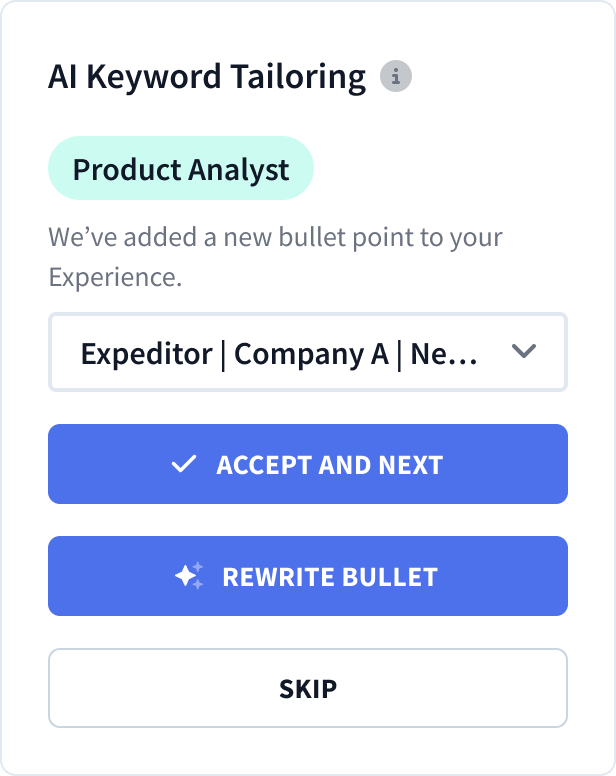
Automatic AI Resume Tailoring
Customize your resume with AI-guided precision.