8 Synonyms for Contribute to Use on Your Resume in 2026
When I replace contribute on a resume, I do not look for the most impressive synonym. I look for the most accurate one. In my experience, strengthened and advised work well when the point is impact, facilitated works when the point is coordination, supplied works when the point is enablement, and submitted works when the point is process. Contribute is broad, so it usually needs a more exact verb to sound credible.
TL;DR: I replace contribute based on the type of work involved. Use advised for judgment, facilitated for coordination, supplied for ongoing support, submitted for formal process, and strengthened for durable improvements.
I see contribute used often because it feels safe. The problem is that it rarely tells a recruiter what the person actually did. Major thesaurus sources group it across several meanings, including giving resources, helping cause an outcome, and adding to a discussion. That range is useful in general English, but not on a resume. When I recommend synonyms for contribute, I match the verb to the kind of work involved, whether that is funding, teamwork, ops support, or business results. On a resume, the best replacement is usually the one that makes the claim easier to verify. For a quick example of how resume phrasing changes with experience level, CV writing tips for first-time job seekers can help you see how action verbs are used in practice.
Which synonym should you use instead of contribute?
When I help clients decide what to use instead of contribute, I start with one question: what kind of contribution are you describing? If you gave resources, I use a donation or supply verb. If you influenced a decision, I use an advisory or facilitation verb. If you completed a formal process, a procedural verb like submitted is usually cleaner than contributed, because it tells the reader what happened without overstating the work.
The dictionary evidence points in the same direction. Thesaurus.com lists 109 related words, Merriam-Webster lists 56, and Cambridge lists 57 for contribute, which shows how many different semantic groups the word covers (Thesaurus.com's entry for contribute). That breadth helps in everyday writing, but on a resume it can blur responsibility. Recruiters read quickly. A vague verb forces them to infer your role from the rest of the bullet.
I use a simple filter here. If the result is the point, I choose a verb that implies causation, such as facilitated, strengthened, or enabled. If the work was supportive, I choose assisted or supplied. If it was formal, I choose submitted or presented. The goal is not to sound ornate. The goal is to make each bullet answer, in the first few words, what you did and why it mattered.
Practical rule: if the bullet still makes sense after you replace the verb with “did work on,” the verb is too soft.
What are the best resume synonyms for contribute?
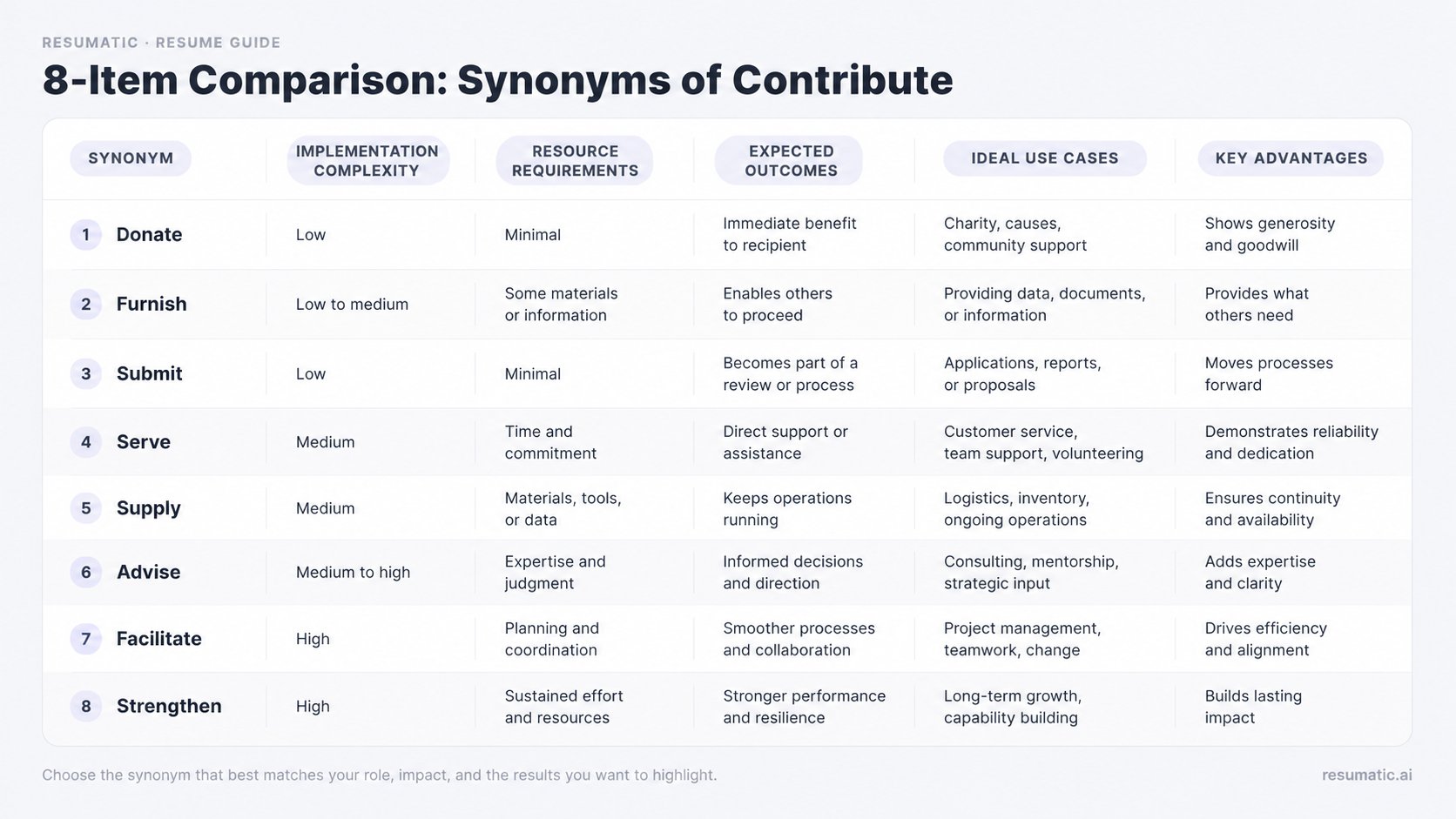
When I build a list of synonyms for contribute for resume use, I focus on verbs that match both the task and the type of value created. In resume writing, that usually means verbs that are specific enough for a hiring manager, but common enough to survive ATS parsing. Merriam-Webster groups contribute with donation and resource-sharing words such as donate, provide, present, furnish, bestow, and confer, while WordReference separates the term into job-relevant senses like participate, donate, and supply (Merriam-Webster's thesaurus entry for contribute; WordHippo's breakdown of contribute to).
This is the working set I recommend most often:
- Donate for charitable, volunteer, and pro bono work
- Furnish for formal provision of materials, documentation, or info
- Submit for reports, applications, proposals, and other deliverables
- Serve for support, client work, and stakeholder-facing roles
- Supply for ongoing resource provision or operational enablement
- Advise for strategic recommendations and expert guidance
- Facilitate for coordination, collaboration, and barrier removal
- Strengthen for durable improvements to systems, processes, or capabilities
I also pay attention to tone. Some of these verbs sound current and direct. Others sound more formal or slightly dated. That is not a problem if the context fits, but it is why I do not recommend mechanical swaps. A legal or compliance resume can carry submitted or furnished comfortably. A startup resume usually reads better with built, enabled, launched, or strengthened, if the facts support those verbs. That is also why a tool such as the AI resume builder from Resumatic can be useful when you want the verb choice to stay aligned with the rest of the bullet.
When does donate work better than contributed?
I use donate when the value given was actually given away, usually in a volunteer, nonprofit, education, healthcare, or community context. It works because it makes the type of support clear without turning the bullet into a commercial claim. If you donated time, money, expertise, or materials, I would usually say that directly, then pair it with the beneficiary and the result.
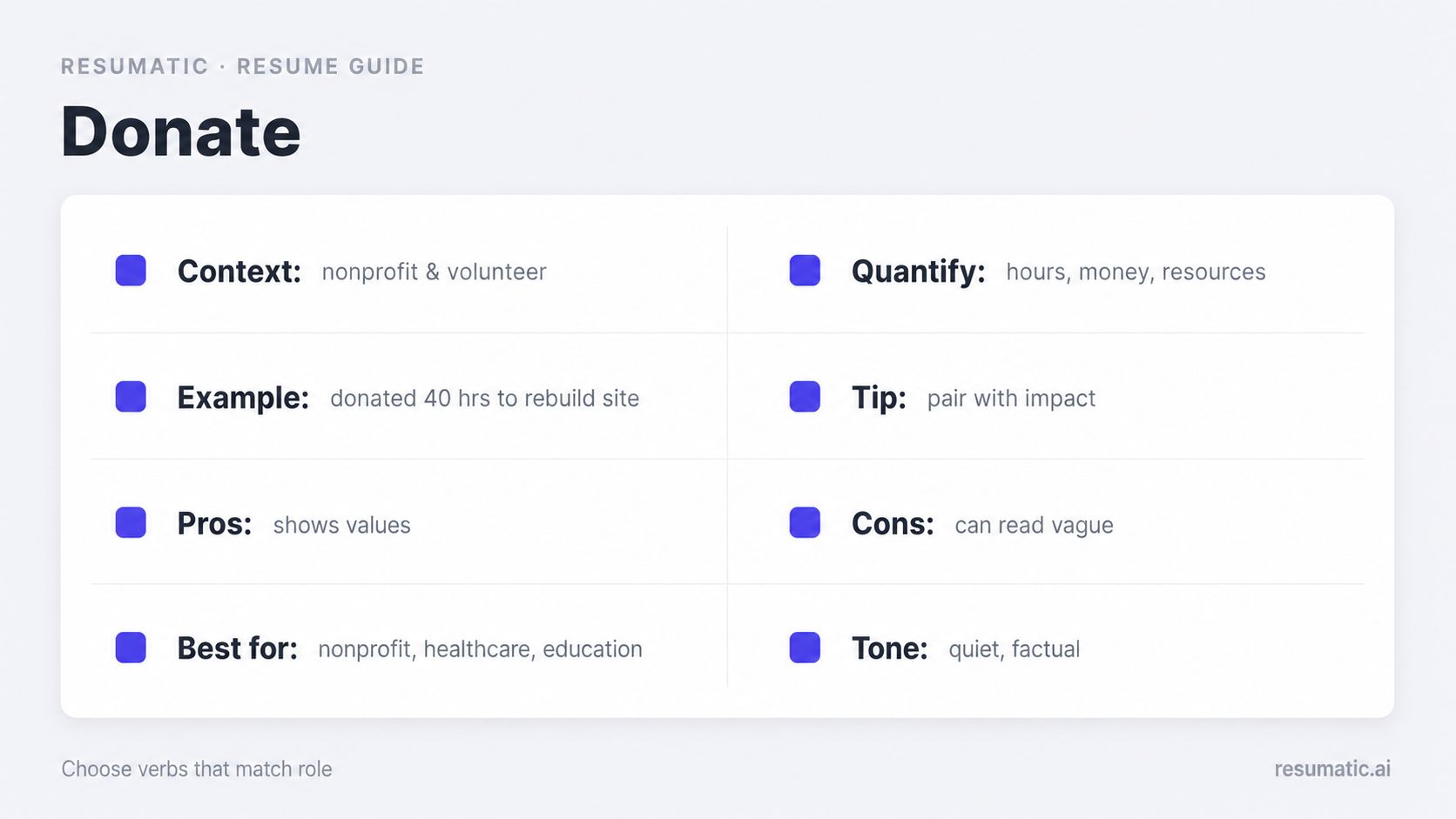
A bullet like “donated 40 hours” is still thin. I would rather write something like “Donated 200 pro bono development hours to rebuild digital infrastructure for a regional food bank,” because it names the asset, the scale of support, and the purpose. In nonprofit settings, that kind of phrasing can show mission fit without turning the resume into a personal statement.
I would still use it carefully. In private-sector roles, donate can sound off if the context is commercial. If you were building a client project, you probably provided, supplied, or facilitated something rather than donating it. The distinction matters because hiring managers read verbs as signals about ownership. A donated effort implies voluntary contribution. A supplied effort implies operational responsibility.
Best use case: volunteer sections, charitable projects, and pro bono services where the giving itself is the point.
When is furnish the right choice, and when does it sound dated?
I use furnish when someone provided something needed, usually in a more formal or complete sense than provide. It can work well when I am describing documentation, specs, materials, or other resources that someone else depended on to do their job. A line like “furnished detailed technical specifications to the engineering team” sounds more deliberate than “provided specs,” because furnish suggests that the package was complete and usable.
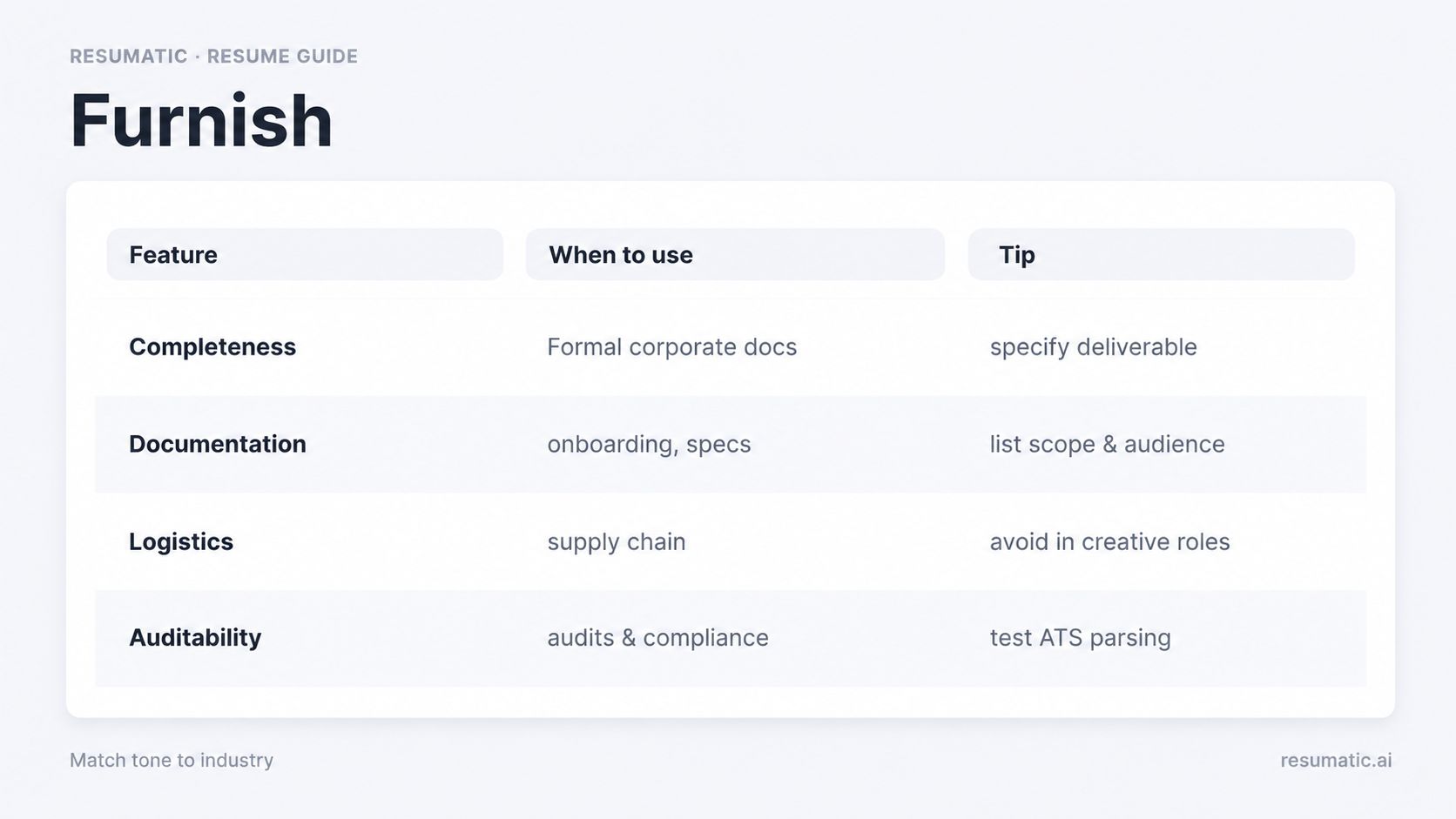
That said, I think it can read a little dated if the rest of the resume uses current product or startup language. In manufacturing, logistics, professional services, or formal corporate settings, that is usually fine. In a fast-moving tech role, it may feel too ceremonial unless the role itself is document-heavy or process-heavy. This is one of those cases where context matters more than the synonym list.
A good test is whether the word matches the delivery mode. If you assembled onboarding packs, compliance docs, or ops reference materials, furnish can work. If you shipped a product feature, aligned stakeholders, or ran a sprint review, I would usually use delivered, enabled, or facilitated instead. For broader wording support, Resumatic's resume action verbs guide is a practical reference when you're deciding whether a verb fits the job family.
Why does submit work, even if it sounds plain?
I do not mind submit being plain, because it is precise. It fits proposals, reports, applications, filings, and deliverables that had to be formally handed over for review or approval. In regulated environments, legal teams, compliance work, client services, and PM roles, that precision is often more valuable than style.
The limitation is that submitted by itself does not tell the reader much about merit. “Submitted quarterly reports” sounds like clerical completion. “Submitted quarterly compliance reports to regulatory bodies on schedule with zero deficiencies” is much stronger because it shows both reliability and quality. I apply the same logic to proposals. A proposal can be routine, or it can trigger revenue. The verb alone does not tell the reader which one it was.
If a bullet is mainly about process completion, submitted is fine. If it is about persuasion, approval, or strategic influence, I would look at presented, delivered, or secured instead. The point is not to inflate the work. It is to choose a verb that matches the actual mechanism. Resumatic's resume skills guide can also help when you're pairing a procedural verb with skills that make the bullet feel specific rather than generic.
When should you use serve instead of contribute?
I use serve when support is the core of the role, especially in hospitality, client services, internal support, and stakeholder-facing jobs. It is broad, which is both useful and limiting. “Served the marketing team” is too vague to do much. “Served as technical liaison to 12 enterprise clients” is clearer because it names the audience and the function.
That distinction matters because serve can flatten responsibility if the rest of the bullet is weak. It can describe customer interactions, committee work, cross-functional coordination, or ongoing support, yet none of those meanings tells the reader what changed because of you. I usually want the bullet to anchor the action to an outcome, such as reduced processing time, stronger satisfaction, or smoother handoffs.
For customer-facing work, served can still be very natural. In a restaurant, hotel, call center, or customer success team, it fits the job language. In knowledge work, it often needs help. If I am describing internal enablement, supported, enabled, or facilitated may be stronger because they sound more active without claiming strategy the person did not own. In short, I use serve when the job is service-centered, not as a default replacement for every weak team bullet.
If the sentence describes who you helped but not what changed, the verb is still doing too little.
Why is supply stronger than provide in operations-heavy roles?
I like supply when I am describing ongoing provision, especially in ops, logistics, infrastructure, tech support, or other settings where people depend on continuity. It implies a system, not a one-time handoff, which is why it often sounds more intentional than provide. “Supplied the engineering team with real-time performance metrics” suggests an ongoing mechanism that kept work moving.
That makes it a good fit when the work involved maintaining dashboards, distributing alerts, delivering recurring reports, or keeping teams stocked with resources. It is less persuasive for strategic, creative, or one-off work, because the word naturally points toward logistics. In those cases, provided, delivered, or enabled often sound less mechanical.
The strongest supply bullets show continuity. If you built a recurring reporting pipeline, supported a sales team with updated intel, or kept production teams supplied with needed materials, the verb reinforces the operational rhythm of the role. That can also help in ATS settings, because the word is clear and unambiguous. The downside is that it can feel formal in roles where the human, advisory, or creative element matters more than the resource transfer itself.
When does advise do more work than contribute?
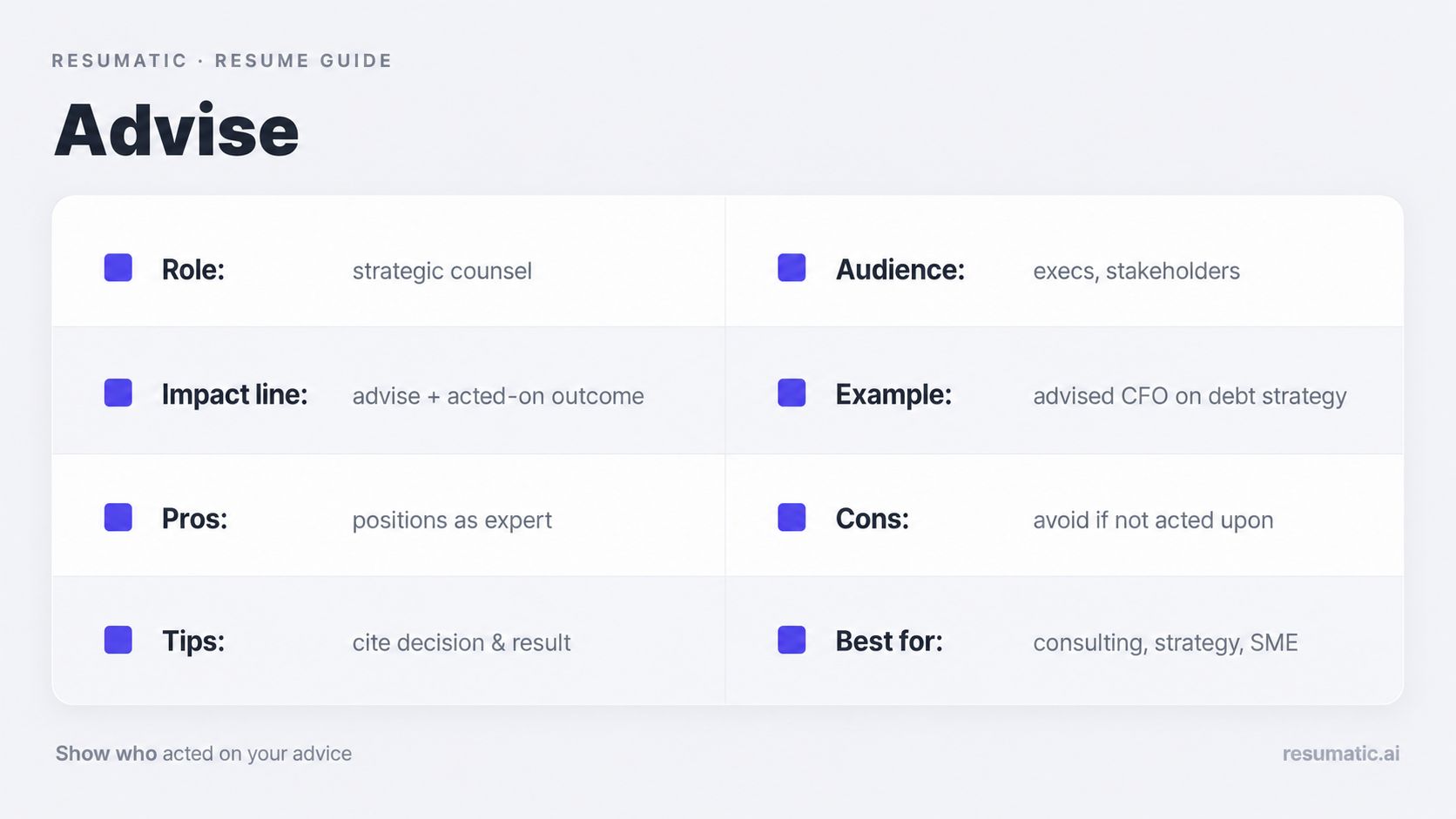
I use advise when the value came from judgment rather than execution. It signals that decision-makers relied on your expertise, which is why it fits consulting, strategy, finance, risk, leadership, and mentoring work well. “Advised executive leadership on market entry strategy” places the candidate closer to decision-making than “contributed to market entry strategy.”
The catch is that advise can overstate the role if the person was not actually shaping decisions. If someone made casual suggestions in a meeting, I would not use it. I reserve it for cases where the evidence supports real influence and the outcome changed because of that input. That is what keeps the resume credible.
A good advisory bullet usually has three parts: who was advised, what the advice covered, and what changed. If the bullet leaves out the audience or the outcome, it can sound vague or inflated. Used well, though, advise tells a much cleaner story than a generic contribution verb because it emphasizes expertise, not attendance.
For people who need to separate real influence from ordinary participation, how to list skills on your resume to get noticed fast is a useful companion piece. It helps you make sure the verb and the skill language reinforce the same level of responsibility.
Why is facilitate often the best collaboration verb?
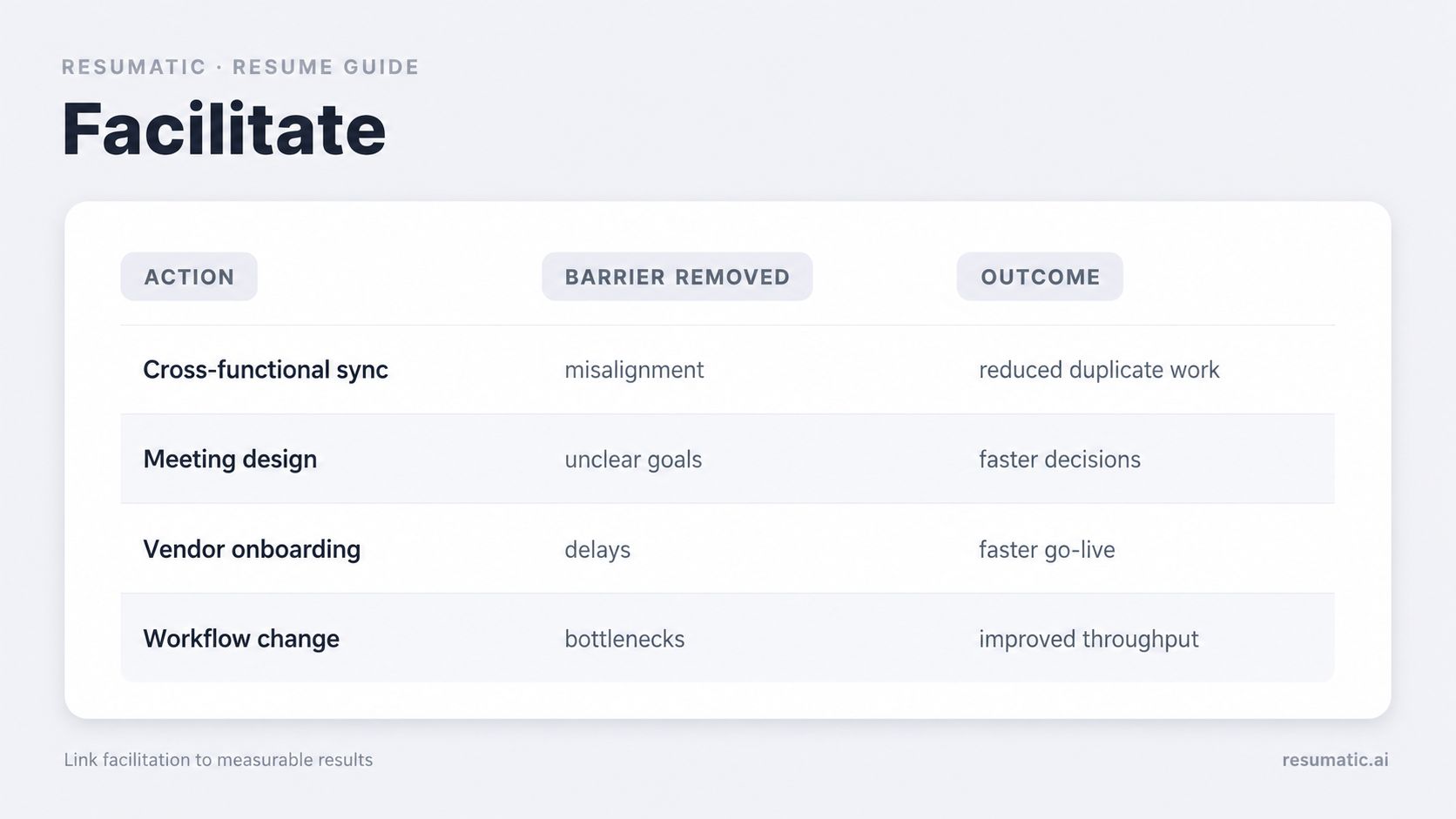
I use facilitate when the work involved removing friction, coordinating people, or making progress easier. It is especially useful in product, ops, PM, and leadership roles, because it describes the work of enabling others without claiming sole ownership of the result. That distinction matters on resumes, where collaborative work can otherwise sound diluted.
A weak version looks like “facilitated weekly meetings.” A stronger version looks like “facilitated cross-departmental product roadmap alignment, reducing duplicate feature work and accelerating release cycles.” The difference is not just style. The second version shows the barrier removed and the business result that followed.
I also find facilitate useful when the role involved orchestration across teams that did not report to the person directly. It lets the candidate show influence without pretending to have formal authority. That is useful in matrixed orgs, change management work, vendor coordination, and internal transformation projects. If the outcome depended on making the process smoother, facilitated is usually more accurate than led and more precise than contributed.
Why does strengthen often beat improved on a resume?
I use strengthen when the change was durable, structural, or meant to last beyond the immediate task. It works for systems, processes, teams, customer relationships, and tech infrastructure. Compared with improved, it suggests resilience and depth, not just a temporary uplift.
That is why it fits bullets about mentorship programs, security controls, vendor processes, and operational readiness. If someone strengthened a team's capability, I want the reader to understand that the org became more capable of handling future work, not just current work. The verb points toward capacity-building.
The best use is when the result is embedded in the org. A stronger process, a better-trained team, a more reliable system, or a more durable client relationship all fit the word well. It is less convincing when the change was minor, short-lived, or hard to verify. In those cases, improved may be more natural, even if it is less distinctive. I choose the word that matches the shape of the change, not the word that sounds bigger.
Which synonym should you avoid in some cases?
I do not think every synonym is an upgrade. In some cases, contributed is still the most accurate word, especially when the work was modest or the achievement clearly belonged to a team. Overstating the role with led, drove, or advised can hurt credibility much faster than a plain verb.
I also think ATS context matters. Semantic precision matters, but so does matching the JD. A resume for compliance work may benefit from submitted, filed, or prepared, while a product role may reward facilitated, enabled, or strengthened. There is no single best synonym across every industry, which is exactly why generic lists tend to fall short.
The framework I use is simple. Match the verb to the mechanism, attach the result, then check whether the sentence still sounds like something a candidate could say out loud to a hiring manager. If it does not, the verb is probably doing too much work. If it does, the choice is usually sound.
8-Item Comparison: Synonyms of Contribute
How Can You Choose the Right Verb Every Time?
When I choose a synonym for contribute, I am not trying to find the most impressive-sounding option. I am trying to find the most accurate one. The best verb is the one that forces a specific action and connects it to a measurable result. Before I write or revise a bullet point, I ask what exactly the person did and what changed because of it. That answer usually leads to a better verb than contributed and a clearer bullet for the recruiter.
This is also why the issue is more strategic than it first appears. The Cambridge and Merriam-Webster splits show that contribute covers separate meanings, so the right synonym depends on whether the person donated resources, supported a team, supplied materials, advised decision-makers, or facilitated an outcome (Cambridge Thesaurus entry for contribute; Merriam-Webster's contributor senses). If you want your resume to read cleanly under ATS screening and still sound natural to a human reader, that distinction is worth making every time. For a broader vocabulary reference, build real speaking confidence can help you keep the wording natural while you sharpen the verb choice.
If you are revising a resume now, use Resumatic to test whether your bullets stay specific after you replace contributed with a stronger verb. Its ATS-friendly builder can help you compare wording, target job descriptions, and keep the sentence aligned with the role instead of with a generic synonym list. Visit Resumatic and rewrite one bullet today with a verb that matches the actual impact you want to show.

Automatic AI Resume Tailoring
Customize your resume with AI-guided precision.