Is ChatGPT Good at Reviewing Resumes? A CPRW's Honest Test
ChatGPT gives a genuinely useful resume review when prompted well, but it has structural blind spots that prompt engineering doesn't fix. I tested it on a real client resume using a recruiter-persona prompt, and the model nailed the core diagnosis but missed three things: a three-month tenure red flag, the verification risk of rewriting a job title, and the redundancy already on the page.
Key Takeaway
- ChatGPT is genuinely capable on the diagnostic pass for resume review, especially with a recruiter-persona prompt that includes the target job description.
- It still has structural blind spots prompt engineering doesn't fix: tenure red flags, title-change verification risk, and the instinct to add new sections instead of consolidating existing redundancy.
- Pair ChatGPT for the mechanical pass with either a structured AI review or a human CPRW for high-stakes searches, since each tier closes gaps the others leave open.
Does ChatGPT actually review resumes well?
Yes, more than I expected, with a meaningful caveat. ChatGPT is competent at the kind of resume feedback you'd get from an experienced editor who has read a lot of resumes. It catches verb weakness, identifies positioning problems, flags generic summaries, and points out when a bullet is unmeasured. With a recruiter-persona prompt and the target job description pasted in, the diagnostic accuracy is genuinely good.
What it does poorly is the part that actually decides callbacks. Recruiters spend somewhere between six and ten seconds on a resume before deciding whether to keep reading, and that decision hinges on positioning, narrative arc, and a handful of pattern-recognition cues that are mostly invisible to anyone who hasn't screened resumes professionally. ChatGPT, having read about resumes rather than screened them, occasionally fills the gap with plausible-sounding advice that points the wrong direction or, worse, exposes the candidate to verification risk.
I tested this directly. I gave ChatGPT a real client resume, anonymized, using the strongest prompt I'd recommend to any user (recruiter persona, target role and seniority, target job description pasted in, structured output requested). The candidate was an Executive Assistant at a major tech company looking to pivot into governance and compliance roles. I had already reviewed the same resume myself and had clear feedback on what needed to change. Then I compared notes.
The pattern that emerged is consistent enough to be useful as a heuristic. ChatGPT is reliable on diagnostic work, capable of producing rewrites that read well, and occasionally hands out advice that, if followed, either fails to address the real problem or actively introduces new ones. The next two sections cover exactly where it succeeded and where it failed.
What does ChatGPT get right when reviewing a resume?
I have to be honest here, because ChatGPT's review of the resume was better than I expected. The model accurately diagnosed the central problem in one shot: the candidate read as Executive Assistant first and governance professional second, which was the opposite of how she wanted to be perceived in the market she was applying to. Repositioning the resume around governance is the strategic move, and ChatGPT got there without my prompting it to nudge in that direction.
A few specific places it landed well on this resume:
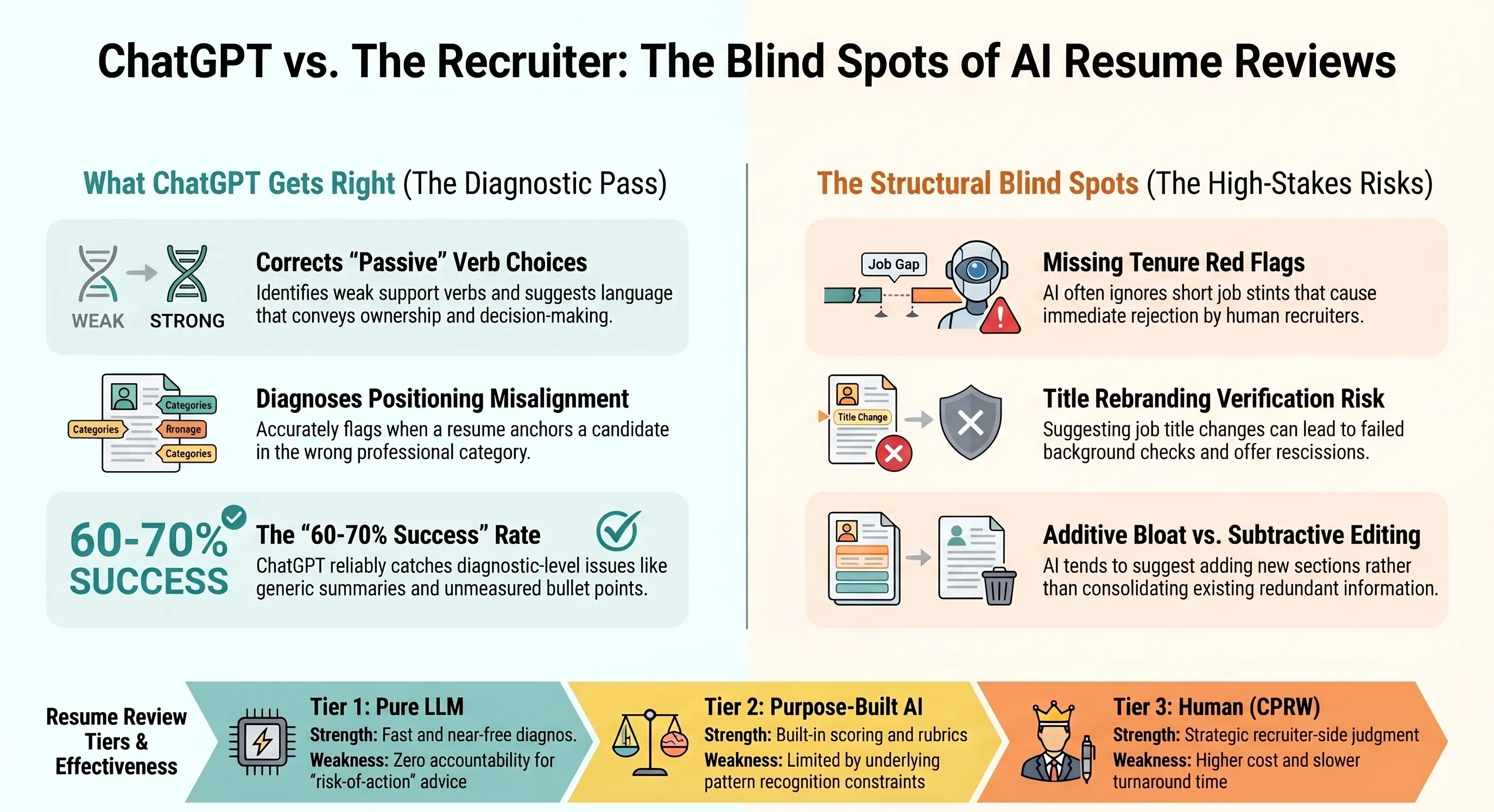
The verb problem. The resume leaned heavily on support verbs like "provided," "facilitated," and "delivered strategic administrative support." Those verbs anchor a resume in EA territory whether the candidate intends them to or not. ChatGPT flagged this immediately and suggested replacing them with verbs that carry ownership and decision-making weight. That's the correct edit, and most candidates miss it on their own.
The summary critique. The original summary read like a thousand other summaries: generic, full of qualifiers, no clear functional identity. ChatGPT's read was that the summary didn't establish what the candidate actually was, which is exactly right. The suggested rewrite wasn't perfect, but the diagnosis was directionally correct, and giving the candidate a clearer professional category to occupy is the right framing for a pivot resume.
The job title anchoring. ChatGPT noticed that the title at the most recent employer ("Executive Administrative Assistant | Governance & Risk Oversight") anchored the entire document in EA territory, regardless of what the bullets said about governance work. That's a sharp observation and one I'd flag in my own review. The instinct to surface that as a positioning problem is the right call.
I'd estimate ChatGPT caught roughly 60 to 70% of the diagnostic-level feedback I would have given on this resume. For a free tool with a careful prompt, that's a real result. The problem isn't what's in that 60 to 70%. The problem is what's in the missing 30 to 40%, because that's where the highest-stakes errors live.
What does ChatGPT consistently get wrong?
What ChatGPT missed wasn't a few small edits. It was three structural problems any CPRW would have flagged in the first read, two of which carry real downside risk if the candidate followed the advice without question.
It missed the tenure red flag entirely. The candidate's most recent role on the resume was three months long. That's the first thing a recruiter notices, the first thing they ask about in an interview, and one of the most common reasons resumes get screened out before the candidate even knows they're being considered. ChatGPT called this section "currently one of the strongest sections" and never once flagged the tenure issue. Not in passing, not as a footnote, not in any "things to address" list.
This is not a language problem. No amount of bullet rewriting fixes a three-month stint at the top of a resume. The candidate needs to address it directly, whether through a "Contract" tag in the title line, a context line clarifying scope (project-based engagement, contract-to-perm, advisory role), or a deliberate framing decision in the cover letter. ChatGPT not seeing this means a candidate following its advice would polish the language on a section that's actively hurting their callback rate. That's worse than no review at all in some ways, because it creates false confidence.
It recommended a title change that introduces verification risk. ChatGPT suggested rebranding "Executive Administrative Assistant | Governance & Risk Oversight" to "Executive Operations Coordinator." It mentioned "if defensible" once, briefly, then spent several paragraphs encouraging the change and showing how to position around the new title.
This is actively bad advice. The employer called the candidate an EA. Changing the job title on a resume creates real misrepresentation exposure: it will fail a routine background check, it can be grounds for offer rescission even after acceptance, and in some industries it's grounds for termination if discovered post-hire. The correct play is a parenthetical descriptor under the real title, a stronger reframing through the bullets themselves, or a Functional Highlights section that surfaces the governance work without altering the title. ChatGPT mentioned the verification risk so glancingly that a candidate skimming the output would miss it entirely.
This is the kind of error that doesn't show up in a methodology paper measuring "review quality" but matters enormously in practice. A model that gives advice with low-frequency but high-magnitude downside is a different category of risk than one that gives mediocre but safe advice.
It added bloat instead of fixing the redundancy already there. The resume had two overlapping skills sections ("Core Competencies" and "Technical Skills") that duplicated each other. The right move was to consolidate them into one cleaner skills block. ChatGPT's recommendation was to add a third list, a "Governance & Operations Highlights" section near the top, plus convert the existing skills section into a two-column format.
That's the wrong instinct. The resume's problem wasn't that it lacked highlight blocks. The resume's problem was that it had too many overlapping ones competing for attention. Adding more structure to a resume that already has too much structure compounds the issue. A recruiter scanning for six seconds will see fragmentation, not clarity. The smarter edit was the subtractive one ChatGPT didn't make.
The pattern across all three failures is consistent. ChatGPT is good at additive thinking (here's what to add, here's what to write more clearly, here's what to expand). It's weaker at subtractive thinking (here's what to cut, here's what's actively hurting you, here's where you've over-invested). And it's borderline blind to risk-of-action thinking (here's where the suggested change creates downstream exposure that wasn't there before). For most resumes those gaps are tolerable. For the ones where they matter, they matter a lot.
What prompts give the best ChatGPT resume reviews?
The default prompt most people use ("Please review my resume") gets you the worst possible output, because the model has no constraint, no role, and no audience to optimize for. The single biggest lever for better feedback is forcing the model into a specific reviewer role with a specific brief. The prompts below are listed roughly in the order I'd run them, and using two or three of them together catches more than any single prompt run alone. None of them fully closes the structural blind spots from the test above, but they substantially improve everything else.
- Force a recruiter persona, not an editor persona. Try: "You are a senior recruiter at a [industry] firm screening resumes for a [specific role] at the [specific seniority] level. Tell me which sections you'd skim past in the first six seconds and which would make you keep reading." ChatGPT defaults to editor mode, which optimizes for clarity. Recruiter mode optimizes for callback probability, which is what you actually want.
- Paste the target job description and ask for gap analysis, not general feedback. "Here's the resume and here's the job posting. Tell me which qualifications from the JD aren't reflected anywhere in the resume, and which bullets in the resume don't connect to anything the JD cares about." This forces specificity and surfaces alignment issues most candidates miss.
- Ask what to remove, not what to add. ChatGPT's default mode is generative, so it wants to suggest additions. The more useful question is "What three to five lines should I cut from this resume to make it stronger?" The cuts are usually obvious once the model is forced to pick. This is also the prompt most likely to surface the redundancy issue from the test above.
- Demand specific rewrites, not directional notes. "Don't tell me to make a bullet 'more impactful.' Show me the exact rewrite you would make and explain why it's better." This eliminates the vague directional feedback that's the most common failure mode of LLM resume review.
- Ask the model to predict rejection. "If this resume got rejected for a senior [role] position, what would the most likely reason be?" The framing inverts the usual flattering review tone and surfaces real weaknesses, including the kind of structural issues ChatGPT otherwise misses.
- Force constraints around dead phrases. "Review this resume but don't use the words 'leverage,' 'results-driven,' 'detail-oriented,' 'team player,' or 'proficient in' anywhere in your feedback or in any bullet rewrites you propose." Without this, the model regresses to generic resume vocabulary that died about a decade ago.
- Run it twice, once as recruiter and once as hiring manager. The two roles read resumes differently. Recruiters scan for qualification fit and obvious disqualifiers. Hiring managers read for evidence of judgment, ownership, and scale. Comparing the two passes surfaces issues that one-pass review misses.
- Ask about the first three lines specifically. "Read only the first three lines of this resume. What does a recruiter learn about the candidate from those lines? Is that what they need to learn for this role?" The opening of a resume does most of the work, and most ChatGPT reviews skim past it to get to the body.
- Use a structured output format. Ask for feedback in a fixed structure: Strengths, Weaknesses, Three things to cut, Three things to rewrite, with the rewrites included inline. Structured outputs are dramatically more useful than the wall-of-text default.
- Provide the candidate's career goal explicitly. "I'm trying to move from [current role] to [target role]. Review the resume against that pivot." Without this context, ChatGPT optimizes for the candidate's last role, which is exactly wrong if they're trying to make a transition.
The single prompt that consistently produces the best review is a combination of #1 (recruiter persona), #2 (paste the JD), and #9 (structured output). Set up that prompt once as a template and reuse it across resumes; the quality jump versus the default is significant. Just don't expect it to catch the structural issues from the previous section, because those require recruiter-side judgment rather than pattern recognition.
When should you trust AI review, and when should you bring in a human?
The decision comes down to stakes, complexity, and whether you need diagnostic feedback or strategic judgment. Pure LLM review is enough for a first-pass clarity check, especially if you've already polished the resume and just need another set of eyes. It's risky when the resume needs strategic repositioning, when the candidate is in a high-stakes search, or when the consequences of bad advice are large.
The comparison most articles make ("ChatGPT vs human writer") skips the middle of the spectrum, which is misleading. There are actually three distinct review tiers worth understanding:
Tier 1: Pure LLM review. Tools like ChatGPT and Claude, prompted by the user. Fast, free or near-free, decent diagnostic accuracy with a careful prompt, no human accountability, no ground-truth check on industry conventions or risk-of-action issues like the title-change example above.
Tier 2: Purpose-built AI review with structured scoring. Tools like Resumatic's agent review, where the AI is constrained to specific resume-review criteria, scores the resume against those criteria, and integrates the feedback directly into a builder where you can act on it. The LLM substrate is similar to Tier 1, but the prompt engineering, the scoring rubric, and the editing workflow are built in.
Tier 3: Human CPRW review on demand. A credentialed resume writer reviewing the resume directly. This is the only tier that catches the kind of structural and risk-of-action issues from the test above, because it requires actual recruiter-side judgment rather than pattern recognition from training data. ChatGPT cannot offer this. No pure AI tool can.
Most candidates default to Tier 1 because it's free. The honest answer is that Tier 1 is enough for many situations, but the situations where it's not enough tend to be the highest-stakes ones, which is the worst place to find out your tool wasn't up to the job.
How does Resumatic compare to ChatGPT for resume review?
Full disclosure: I cofounded Resumatic, so anything I say about it should be read with that in mind. The reason I'm including this section is that the gap the test above surfaced (ChatGPT being good at additive thinking, weak at subtractive and risk-of-action thinking) is exactly the gap Resumatic's two-tier review system was built to close, and it would be dishonest to write 2,000 words about ChatGPT's resume review limitations without acknowledging that. There's a Resumatic vs ChatGPT side-by-side page on the site for the full feature-level breakdown; what follows is the high-level version.
Resumatic has two review mechanisms, and they're meant to be used together rather than as alternatives.
The AI agent review runs inside the builder. The user requests a review, the AI scores the resume across multiple dimensions, and the feedback comes back as structured notes attached directly to the relevant sections. The benefit over ChatGPT isn't that the underlying model is fundamentally better. The benefit is that the prompt engineering, the scoring rubric, and the editing workflow are built in, so the user doesn't have to engineer a recruiter-persona prompt every time, paste a JD manually, and translate the feedback back into edits across a separate document.
The human CPRW review on demand is the part of Resumatic that ChatGPT structurally cannot match. The user requests a review through the same builder interface, and a credentialed CPRW returns commentary on the summary, the experience, the skills section, section ordering, length, formatting choices like font sizes and page length, and alignment to the target role if one is provided. Sometimes that commentary includes specific rewrites or edits. The notes show up in the builder UI as side notes alongside the resume, and as bolded inline notes within the resume itself, so the user can act on them in the same place they're drafting.
Pricing is straightforward. The Pro plan ($29 per month) includes one human CPRW review per month at no additional cost. Free plan users, or Pro users who want an additional review beyond the monthly one, can purchase one for $19. In both cases the review is triggered on the user's request rather than running automatically, which means it's there when you actually want a credentialed second opinion rather than being a default service you have to opt out of.
Where this matters in practice is exactly the kind of resume from the test above. A three-month tenure with structural implications, a title that creates verification risk if rewritten, and skills section redundancy that needs subtractive editing are all things a CPRW catches in the first read and an LLM struggles with regardless of prompting. Having the AI review and the human review available in the same product means the user can start fast, escalate when they hit the limits of what AI can do, and not have to context-switch between three different tools to get a deployment-ready resume.
Where Resumatic isn't the right answer: you're navigating a $300K+ executive transition where the strategic narrative needs more than a review, you want a full ground-up rewrite with multi-round revisions and a discovery call rather than written feedback, or you're in a heavily regulated field where a CV-style document with unusual conventions is required. For those cases I'd point you at Final Draft Resumes (the boutique service I run for senior clients) before pointing you at any AI tool. The strategic work that goes into a $300K+ resume is different in kind from what a one-off review handles well, whether the review is AI or human.
Frequently asked questions
Q: Can ChatGPT actually review my resume?
A: Yes, and better than most articles online give it credit for, especially when you prompt it with a recruiter persona, paste in the target job description, and ask for structured output. Where it falls short is on issues that require recruiter-side judgment rather than pattern recognition: tenure red flags, title-change verification risk, and subtractive edits to remove existing redundancy. Use it for the diagnostic pass, but don't rely on it as your only review for high-stakes searches.
Q: What's the best prompt to use for a ChatGPT resume review?
A: The single highest-leverage prompt forces a recruiter persona and includes the target job description: "You're a senior recruiter at a [industry] firm screening for a [role] at the [seniority] level. Here's the resume and here's the job posting. Give me feedback in this structure: three things to cut, three things to rewrite (with the rewrites included), and the most likely reason this resume would be rejected." Run that template across resumes consistently for cleaner output.
Q: Will ChatGPT make my resume ATS-friendly?
A: Partially. ChatGPT understands the basics, like avoiding tables, sticking to standard section headings, and using readable fonts. It's less reliable on the specifics of how individual ATS systems parse content, the keyword density patterns that move resumes through screens, and the quirks of platforms like Workday and Greenhouse. For the structural pass it's fine. For the keyword and parsing pass, a tool built for ATS-friendly resume formatting handles it more reliably.
Q: Should I use ChatGPT to write my resume from scratch?
A: Generally no, especially if you don't already have a strong resume to start from. ChatGPT is much better at reviewing and rewriting existing content than at generating accurate resume content from a description of your background, because the model fills gaps with plausible-sounding fabrications. If you ask it to write bullets about your last role, it will invent metrics, exaggerate scope, and suggest accomplishments you didn't have. Use it for editing, not for drafting from zero.
Q: When is a human CPRW review worth paying for?
A: When the cost of bad advice is higher than the price of the review. That tends to mean executive transitions, career pivots into new industries, returning from career breaks, niche fields with unusual conventions (federal, academic, legal, life sciences research), or any situation where a structural issue (a short tenure, an employment gap, a title mismatch) needs a judgment call rather than a language edit. A professional resume review by a CPRW handles those cases in a way no AI tool currently can.
About the author
Alex Khamis, CPRW, is the cofounder of Resumatic and the founder of Final Draft Resumes, and has been writing for a combined 20 years, both as a Certified Resume Writer and a technical writer in the engineering space. LinkedIn | About Resumatic
If you've been running your resume through ChatGPT and want a tool that combines a built-in AI review with the option to escalate to a human CPRW review when it matters, Resumatic is free to start. The Pro plan ($29 a month) includes one CPRW review per month, and individual reviews are $19 if you'd rather pay per use. For $300K+ executive searches where the work is closer to a strategic rewrite than a review, I'd point you at Final Draft Resumes for a discovery call before pointing you at any AI tool.
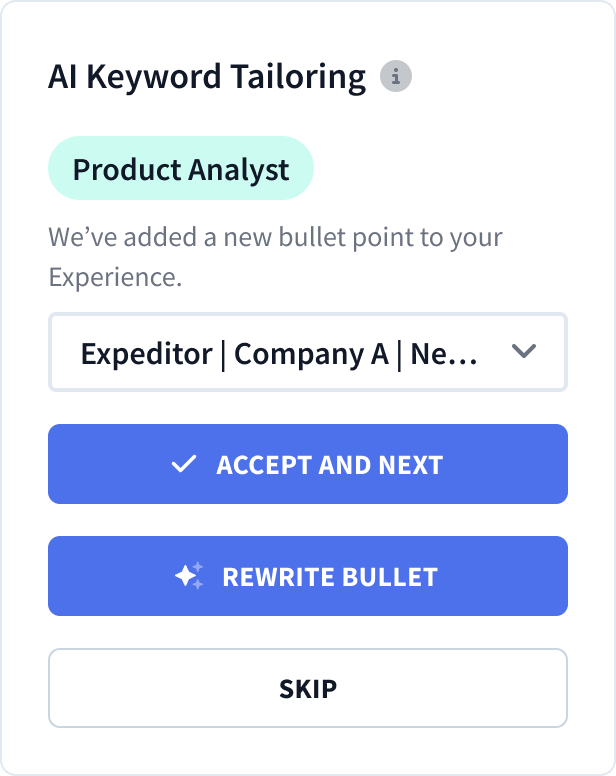
Automatic AI Resume Tailoring
Customize your resume with AI-guided precision.