ChatGPT Resume Prompts: Which Ones Actually Work in 2026 (Graded by a CPRW)
ChatGPT resume prompts can save 20 to 30 minutes if you pick the right ones, but most prompts circulating online produce text that reads fluent and says nothing concrete. The difference between a useful prompt and a useless one is whether it asks ChatGPT to observe or to generate. Below are five of the most popular prompts graded against a real resume, the failure modes, and the fixes.
Key Takeaway
- Observation prompts (audit, critique, identify weak spots) consistently outperform generation prompts (rewrite, format, tailor).
- ChatGPT can't invent numbers or scope that aren't already in your resume, so any prompt asking for "metrics" will either preserve what's already there or pad with adjectives that sound impressive but say nothing.
- Of the five prompts I tested, two are usable, one is net neutral, and two can actively damage your candidacy if you don't catch the fabrications before submitting.
What separates a useful ChatGPT resume prompt from a useless one?
The single dimension that predicts whether a prompt produces usable output is whether it asks ChatGPT to observe or to generate.
Observation prompts (audit my resume, critique this bullet, identify weak spots) work because they ask the model to do something it's good at, which is pattern recognition over text you've already supplied.
Generation prompts (rewrite this section, write me a summary, tailor this to a JD) push the model to invent content that isn't in the source, and that's where hallucinations and corporate filler creep in.
Below are nine criteria that separate the prompts worth keeping in your workflow from the ones that waste your time.
- Asks for observation, not generation. A prompt like "audit this resume and identify the 8 weakest bullets" earns its keep. "Make my summary stand out" pushes the model into invention.
- Constrains the output. Strong prompts include a hard limit (identify 5 issues, list 3 changes) and a forbidden behavior (do not invent metrics). Without constraints, ChatGPT defaults to padding.
- Includes your actual source resume as context. Prompts that operate on your real resume content outperform prompts that ask ChatGPT to write something from scratch using only your job title and years of experience.
- Names a target role specifically. "Tech company" is too vague. "People analytics role at a 500 to 2,000 employee SaaS firm" gives the model enough information to make tradeoffs.
- Asks for reasoning, not just output. When the prompt requests reasoning ("explain why each change improves the bullet"), you can evaluate the suggestion. Output without reasoning forces you to either accept it blindly or rewrite it yourself.
- Treats numbers as off-limits unless supplied. The strongest prompts include the line "use only details from the source resume. Do not invent metrics, scope, or job titles."
- Returns suggestions, not finished artifacts. "List 5 structural changes" beats "rewrite my resume." The first transfers a lesson you can apply to the next resume; the second produces a one-shot artifact you can't iterate on.
- Doesn't ask ChatGPT to evaluate fit. Asking "is this resume good?" or "will this get me hired?" gets you flattery. ChatGPT has no real signal on actual hiring outcomes.
- Is short and specific. Long prompts stacked with vague descriptors (more compelling, engaging, impactful, polished, professional) confuse the model. Short prompts with concrete constraints win.
Which ChatGPT resume prompts actually work, and which ones fail?
I tested five of the most commonly recommended ChatGPT resume prompts against the same redacted source resume: a 14-year IO psychologist targeting tech and credentialing roles. Each prompt ran in a fresh chat with no prior context, using the same source material. The results:
Prompt 3 (the audit) was the standout. It correctly identified that the candidate's experience read as "high-performing IC who owns a lot" rather than senior leadership, flagged a factual error in the education section (a university location that was wrong), and named a specific pattern in the bullets where methods were listed without outcomes. None of this required invention. The model was working with what was already on the page.
Prompts 1, 2, and 4 hit the same wall from different angles. Each asked ChatGPT to generate content that wasn't in the source. Prompt 1 produced three summary options, all of which inflated the candidate's client base ("Fortune 500 and high-growth organizations" when the source only listed Fortune 500). Prompt 2 was instructed to "include numbers or metrics wherever possible" and produced bullets like this one: "Identified and resolved major data integrity issues, including unusable performance metrics and inconsistent datasets, enabling defensible analyses and preserving project timelines across client engagements." That's 24 words and not a single new number.
Prompt 5 is the most interesting case, and it gets its own section below.
Why does ChatGPT keep producing resumes that sound impressive but say nothing?
The fabrication pattern is structural. When you ask ChatGPT to make your resume "more impactful" or "include metrics," the model has two options: invent the numbers, or pad with adjectives that mimic specificity. Both options produce output that reads professional and says nothing concrete.
This is the same dynamic a recent r/careerguidance thread captured from the recruiter side. The poster described reviewing resumes where ChatGPT had cleaned up the language but stripped out the actual signal: user counts, what changed, what broke, what improved. Their one-line summary was that the polished version "reads better but tells me less." That's the corporate-filler failure mode, named precisely.

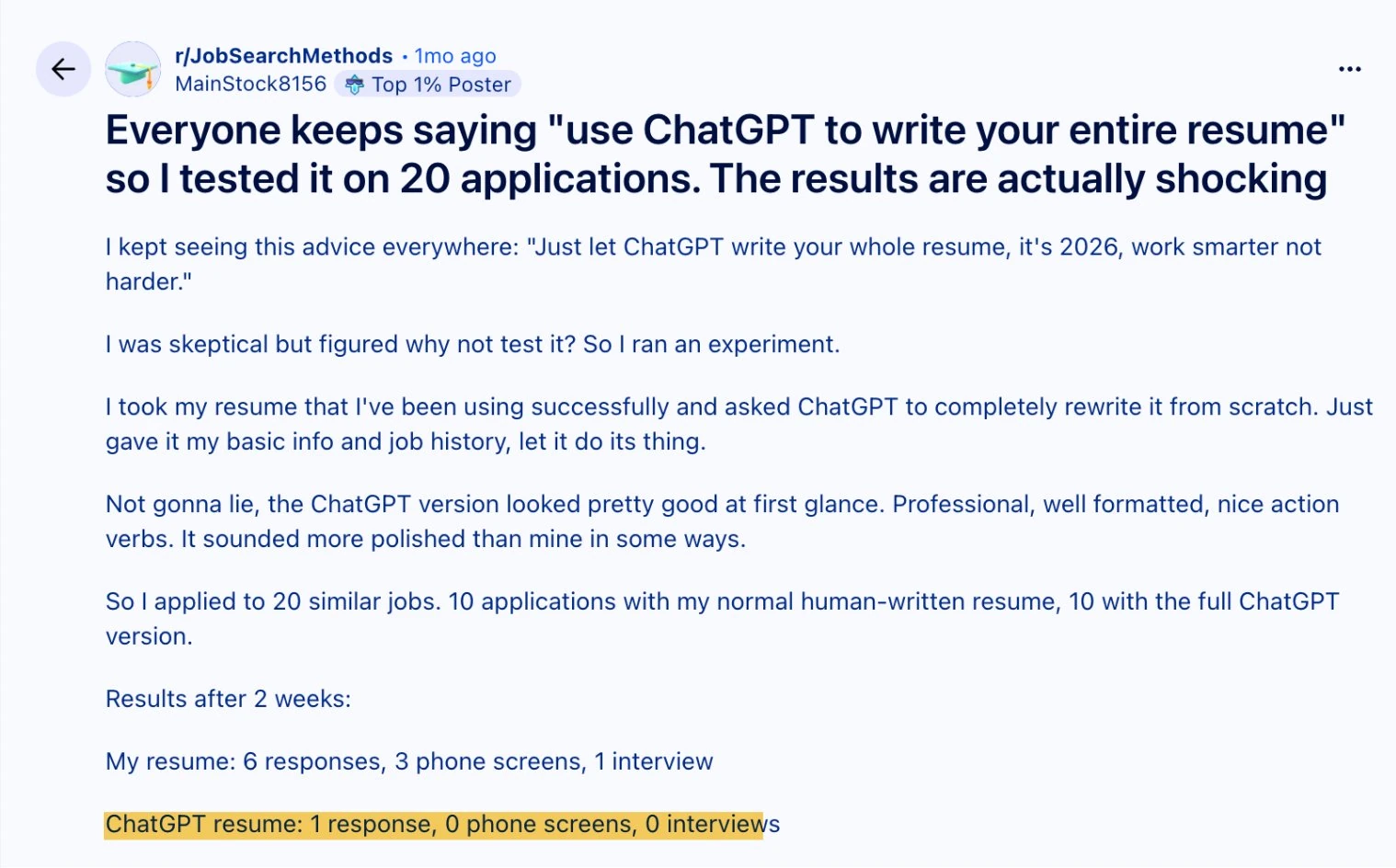
The same pattern was tested at the application level in r/JobSearchMethods. A user ran a 20-application split test: 10 applications submitted with their normal human-written resume, 10 with a full ChatGPT rewrite. After two weeks, the human-written resume produced 6 responses, 3 phone screens, and 1 interview. The ChatGPT resume produced 1 response, 0 phone screens, and 0 interviews. That's one data point, not a study, but the direction is consistent with what I see when CPRW clients send me ChatGPT-rewritten drafts to fix.
Here is the actual source resume summary I tested the prompts against, before any ChatGPT involvement:
14 years of experience across HR tech SaaS, a global licensure and credentialing leader, a major U.S. utility, and boutique consulting. Built validated assessments, structured interviews, and people analytics linking results to outcomes for Fortune 500 and national employers in areas including healthcare, retail, finance, and manufacturing.
Here is what Prompt 1 produced as its "balanced, strongest" rewrite:
Industrial-Organizational Psychologist with 14 years of experience designing validated assessments, structured selection systems, and people analytics solutions across HR tech, certification, and enterprise environments. Expertise in psychometrics, job analysis, validation research, and data-driven hiring optimization, with a track record of improving retention, hiring quality, and decision consistency for Fortune 500 and high-growth organizations.
Read those two paragraphs back to back. The ChatGPT version reads smoother, but it has quietly inflated the candidate's client base (Fortune 500 became "Fortune 500 and high-growth organizations"), inserted an unsubstantiated outcome ("improving decision consistency"), and replaced a specific industry list (healthcare, retail, finance, manufacturing) with the generic "enterprise environments." Every change made it less accurate and more impressive-sounding. That's the trade you keep making with generation prompts.
What's the best ChatGPT prompt for tailoring a resume to a specific job posting?
This is the prompt most people want, and it's also the most dangerous one in the set.
I ran Prompt 5 ("Based on this job description, rewrite or restructure my work history to align with the core skills and qualifications they're looking for") against a federal aviation I/O psychologist JD. The candidate's actual experience is assessment work at a recruiting SaaS firm. ChatGPT's rewrite transformed the Company A description from this:
Leads job analyses and criterion-validity studies for high-volume hiring at an 800-person recruiting SaaS firm.
Into this:
Lead workforce impact evaluation for high-volume hiring modernization initiatives, integrating behavioral science, validation evidence, and operational constraints into adoption decisions for Fortune 500 employers.
The rewrite would score well in an ATS keyword scan against the JD. The candidate would also collapse 20 minutes into the interview the first time a hiring manager asked about specific modernization programs they'd led. They haven't led any. The original work was hiring assessment, not aviation modernization. The rewrite reads as misrepresentation, not tailoring.
The fix is to flip the prompt from "rewrite my resume to align" into "show me where I do and don't align, and let me decide." A better version:
Here is my resume and a job description I'm targeting. Don't rewrite anything. Instead: list the 5 most important keywords or concepts from the JD that already appear somewhere in my resume. Then list the 3 most important JD concepts that don't appear in my resume, and tell me whether I have unrelated experience that could legitimately bridge the gap.
That version produces a gap analysis you can act on. The original produces a fabrication you can submit.
When should you skip ChatGPT resume prompts entirely?
.webp)
There are three situations where no prompt fixes the underlying problem.
The first is when your source resume is thin. ChatGPT can't add experience you don't have. If your bullets read vague because the underlying work was vague, polishing the language won't create signal where there isn't any. You need to dig up actual numbers, scope, and outcomes from your own memory, old performance reviews, or project closeout documents. That's a notebook exercise, not a prompt exercise.
The second is when you're navigating a senior transition where the resume needs strategic positioning rather than just better wording. A CFO moving from a $400M private company to a $2B PE-backed role needs choices made about which board reporting to lead with, how to position the previous CEO relationship, and which transactions to feature. ChatGPT doesn't have the industry context to make those calls.
The third is when ATS compatibility, design, and formatting matter together. ChatGPT outputs are plain text in a chat window. Translating that into a properly formatted, ATS-safe document with consistent typography is its own job. A purpose-built tool like Resumatic handles the formatting automatically. If you're going to use AI for resume work, doing it inside a tool that already understands ATS structure beats copying ChatGPT output into a Word template and praying.
If you've tried prompts and the output still reads like filler, the Resumatic vs ChatGPT comparison walks through the structural differences between general-purpose AI and a tool designed specifically for resumes. The resume examples library is also useful if you want to see what good looks like before you start prompting.
Frequently asked questions
Q: What's the single best ChatGPT prompt for improving my resume?
A: "Audit my resume and identify the 8 specific issues that are weakening it most. For each issue, give one example from my resume and one suggested fix. Don't rewrite anything." This prompt outperformed every generation prompt I tested because it leverages ChatGPT's pattern-recognition strength and avoids its weakest area, which is inventing content the model doesn't have.
Q: Can ChatGPT add metrics or numbers to my resume bullets?
A: No. ChatGPT can't invent numbers that aren't in your source material. When prompts ask for metrics that don't exist, the model either preserves the existing numbers (which is fine) or pads with adjectives that sound quantitative but aren't (substantial improvements, significant impact). If you need real numbers, dig them up from old performance reviews, project closeout documents, or your own notes.
Q: Will recruiters know if I used ChatGPT to write my resume?
A: Often, yes. The most reliable AI tells are em dashes throughout the document, phrases like "leveraged cross-functional collaboration to drive impact," and uniform sentence rhythm across every bullet. Experienced recruiters describe ChatGPT resumes as reading smoother but containing less actual information than human-written ones, and once you're trained to spot the pattern, it's hard to miss.
Q: What's a safer way to tailor a resume to a job description using ChatGPT?
A: Don't ask ChatGPT to rewrite your resume to match the JD. Instead, ask it to compare the two and surface the gaps: "Which 5 important JD keywords already appear in my resume? Which 3 don't appear, and do I have related experience that could legitimately bridge the gap?" That gives you a tailoring map you can act on without fabricating experience you don't have.
Q: Is ChatGPT better than a human resume writer?
A: For mid-career professionals with a solid existing resume who need editing help and ATS-aware language, ChatGPT prompts can save real time. For executive transitions, career pivots, or anyone whose resume needs strategic positioning rather than wordsmithing, a CPRW or senior recruiter beats any prompt. They're different tools for different problems, and the trick is knowing which problem you actually have.
About the author
Alex Khamis, CPRW, is the cofounder of Resumatic and the founder of Final Draft Resumes. He moderates r/resumes (1.2M+ members) and has spent over a decade working with hiring managers, recruiters, and ATS systems to understand what gets resumes through. About Resumatic
If you've tried ChatGPT prompts and the output still reads like filler, Resumatic is free to start and the AI Resume Agent handles the specificity problem automatically. Most users have a finished first draft in about 20 minutes, with the ATS formatting built in so you're not pasting ChatGPT output into a Word template at midnight.
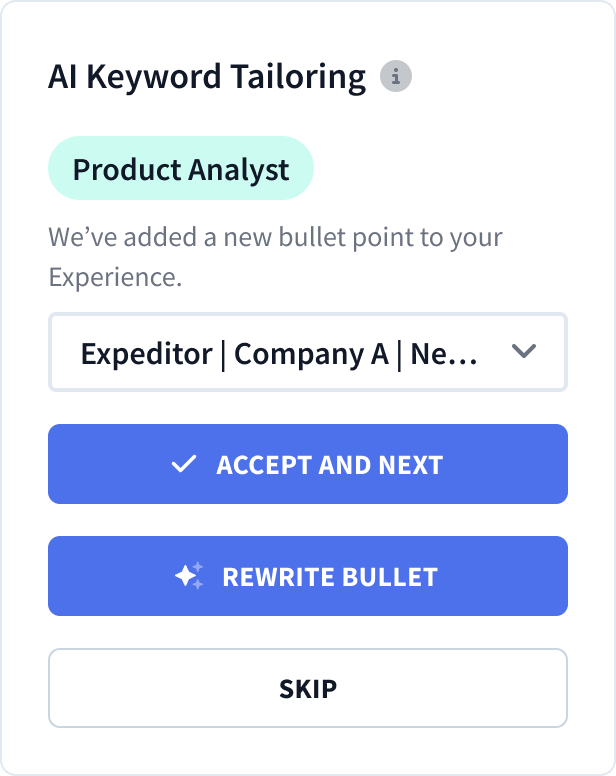
Automatic AI Resume Tailoring
Customize your resume with AI-guided precision.