Top 8 Common Interview Questions and Answers for 2026
The surprising part is that the most common interview questions aren't broad icebreakers at all, they're structured tests of relevance, judgment, and communication. In data and analytics hiring, foundational statistical concepts alone account for about 40% of interview questions, according to a 2025 analysis of more than 1,000 interviews published in a statistics interview question dataset on GitHub. That pattern reflects a wider truth across roles: the best answers are concise, evidence-backed, suited to the seniority, and consistent with the story your ATS resume already tells.
How should I answer tell me about yourself?

Most candidates answer this like autobiography. Interviewers want positioning. A good response is a short professional narrative that starts with where you are, moves through the experience that makes you relevant, and ends with why this role makes sense now.
If you're early-career, relevance matters more than breadth. If you're senior, selectivity matters more than chronology. The mistake is the same in both cases: listing roles without making a case.
What a strong answer sounds like
A backend engineer might say they have spent the last several years building payment or API infrastructure, then point to one concrete result, then explain why the company's current systems challenge is a fit. A recent graduate should do the same, only with internships, contract work, academic projects, or a campus leadership example that maps directly to the job.
A career changer needs a bridge sentence, not an apology. Something like: "I spent years in consulting translating messy business problems into structured analysis, then moved into Python-based modeling work because I wanted to own both the analysis and the implementation."
Practical rule: If your answer could be reused unchanged for five different companies, it isn't ready.
What changes by role and seniority
- Recent graduate: Lead with academic training plus one applied example, such as a finance capstone, internship dashboard, or research assistantship.
- Mid-level professional: Lead with your current role, one relevant achievement, and the type of problem you want to solve next.
- Senior candidate: Lead with scope, team impact, and decision-making range, not a list of employers.
- Career changer: Lead with the transferable asset first, then the new domain skill second.
For common interview questions and answers, this one sets the tone because it proves whether you understand the role. A company hiring for growth wants evidence of speed, experimentation, and commercial judgment. An enterprise team often responds better to reliability, process discipline, and stakeholder alignment.
What works, what doesn't
What works is a response that sounds natural but has clear architecture. Draft it at the same level of precision as a resume summary that establishes fit quickly, then practice until it no longer sounds drafted.
What doesn't work is starting with your hometown, explaining your entire degree history, or saying you're "passionate about opportunities." That's filler, and interviewers hear it all day.
A contrarian note: don't force the polished 90-second monologue if the interviewer is clearly moving fast. In some screening calls, a crisp 30-second version is better because it invites follow-up and feels less rehearsed.
How do I talk about my greatest strengths without sounding generic?

The right answer names two or three strengths that the role needs, then proves each one with a short example. "I'm a hard worker" is useless. "I translate technical findings into decisions non-technical leaders can act on" is useful if you can defend it.
In data roles, communication isn't a soft extra. A 2025 industry report says 78% of hiring managers consider the ability to explain statistical insights clearly as equally important as technical accuracy, and 82% of data science job descriptions explicitly list tools such as Python, R, SQL, and Tableau as required skills, based on a 2025 interview analysis published on YouTube. That's a good reminder that your strongest answer often combines a technical capability with a communication behavior.
Pick strengths that survive scrutiny
A data analyst might say their strength is turning messy reporting requests into repeatable dashboards and executive-ready narratives. A project manager might talk about identifying delivery risk early and creating workable trade-offs before timelines slip. A sales candidate might focus on qualification discipline instead of charisma.
The best proof is specific and recent. Mention a project, a decision, a stakeholder group, or repeat feedback you've received. Don't choose three versions of the same strength, such as communication, presentation, and stakeholder management. That sounds padded.
A practical way to build the answer
- Match the job description: Pull the core capabilities from the posting, then choose strengths that map directly to them.
- Use one example each: Keep each proof point short, concrete, and rooted in real work.
- Balance technical and interpersonal value: Employers hire outcomes, but they also hire people who can move work across teams.
- Keep overlap low: Distinct strengths are more credible than a pile of adjacent buzzwords.
If you need help identifying strengths that belong on the page and in the interview, compare your answer to the best skills to put on a resume for ATS and recruiters. Your spoken strengths shouldn't surprise someone who has just read your resume.
One honest limitation that most guides ignore: if you're junior, don't oversell strategic strengths you haven't earned yet. It is better to say you're strong at execution, analysis, or learning velocity than to claim executive presence after one internship.
How do I answer why do you want this job?
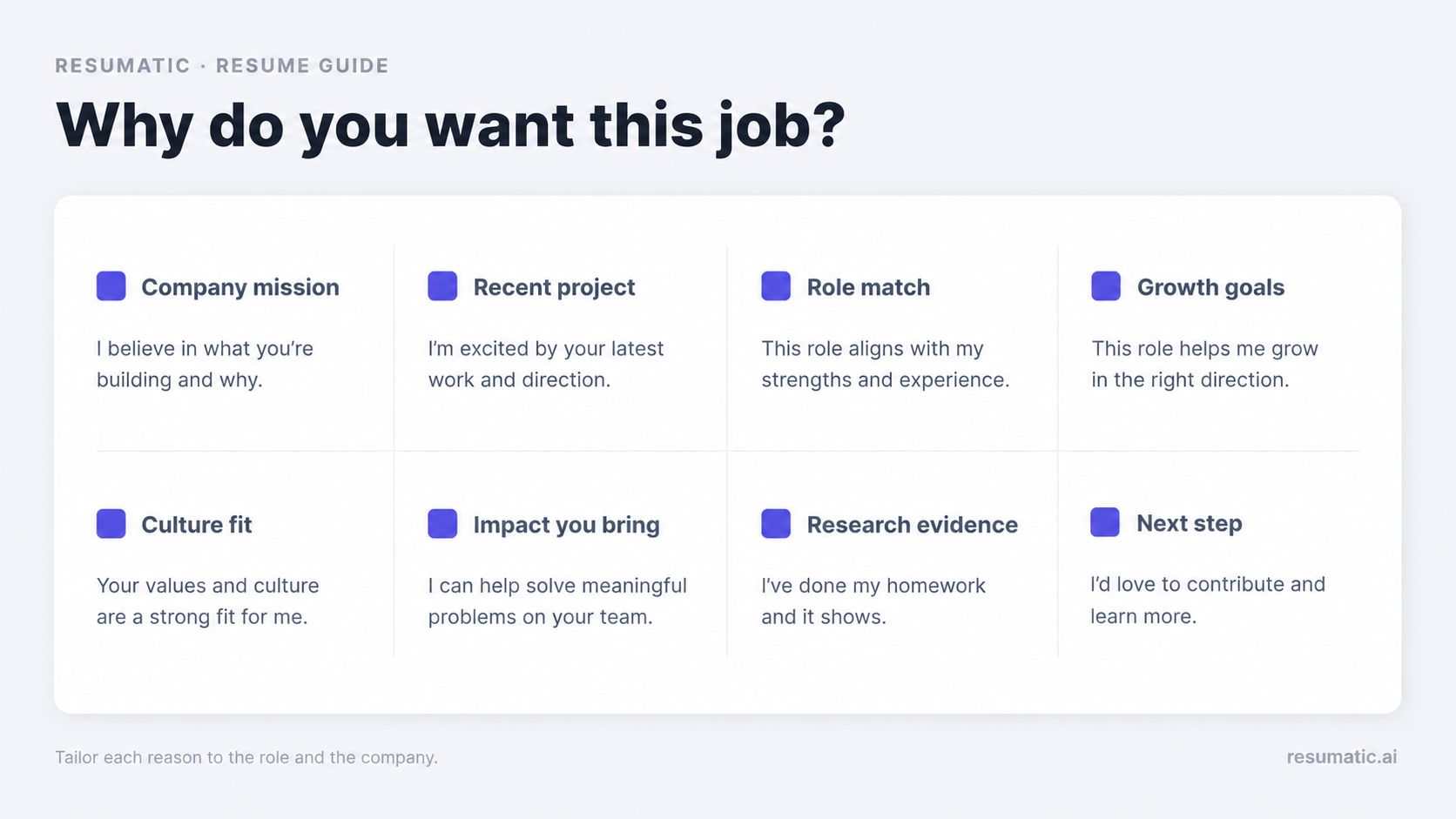
This question isn't asking whether you need a paycheck. It is checking whether you've made a reasoned choice. The strongest answer sits at the intersection of company context, role challenge, and personal direction.
A weak answer talks about growth in the abstract. A strong one says, in effect, "I understand what you're building, I understand the problem this role is meant to solve, and that problem fits the work I want to keep doing."
The three-part structure that holds up
Start with something specific about the company or team that is relevant. Move to the problem set in the role. Close by explaining why that problem fits your background and next step.
That might sound like this for a fintech role: you're interested in the company's move toward real-time decisioning because you've worked on payment systems and want deeper exposure to reliability at scale. For a nonprofit, it may be mission plus infrastructure complexity. For an internal move, it could be a better match between your strengths and the team's operating style.
The safest answer is not the strongest one. Specificity creates risk, but it also creates credibility.
Where candidates usually get this wrong
- They praise the brand, not the work: Liking the company isn't enough if you can't explain the role.
- They mention perks too early: Flexibility matters, but it shouldn't be your headline.
- They recycle cover letter language: Spoken answers need to sound chosen, not copied.
- They criticize the current employer: That raises doubts about your judgment.
A useful prep step is comparing your interview answer with the argument in a cover letter that explains why this company and this role fit. The language shouldn't be identical, but the logic should match.
The contrarian note here is simple: don't pretend deep enthusiasm where none exists. If the role is mainly attractive because it gives you a needed industry pivot or a cleaner scope, say that in professional terms. Thoughtful realism is often more persuasive than performative passion.
How do I answer a challenge or conflict question with STAR?

Many otherwise strong candidates lose control of the interview at this stage. They either tell a vague story with no stakes, or they dump every detail and bury the decision-making. STAR works because it forces order, but the "A" matters most. Interviewers care less about what happened to you than about what you did.
For technical and analytics roles, that expectation has become stricter. A 2026 benchmark from DataInterview says 92% of hiring teams treat fluency in hypothesis testing, confidence intervals, linear regression, and experiment design as essential skills, and candidates who practice explaining concepts out loud, apply formulas in context, and solve real analysis problems achieve a 41% higher pass rate on statistical screening rounds, according to DataInterview's 2026 statistics interview benchmarking. That same discipline helps with behavioral answers because it trains you to explain process, not just outcomes.
What to include in the story
Choose a real challenge with stakes. Technical debt, stakeholder conflict, scope creep, missed requirements, or a broken reporting pipeline all work. Explain the setup briefly, define your responsibility, then spend most of the answer on diagnosis, trade-offs, and actions.
If the challenge involved other people, don't turn it into a blame story. Good interview answers show ownership and judgment, even when the problem started elsewhere.
What good action looks like
- You framed the problem clearly: What was failing, who it affected, and why it mattered.
- You made a decision: You chose an approach, tested it, or changed course.
- You managed trade-offs: Speed versus quality, scope versus deadline, accuracy versus interpretability.
- You closed the loop: The result changed a process, relationship, or business decision.
Candidates often ask whether conflict stories need a happy ending. No. They need an honest ending. A story where you prevented larger damage, surfaced a hard truth early, or learned to change your process can be stronger than a polished victory lap.
If you're trying to align this with your application materials, make sure the examples echo the same problem-solving skills highlighted on your resume. Otherwise the interview feels disconnected from the written record.
How should I answer what are your weaknesses?

The only bad universal strategy here is pretending you don't have one. Interviewers aren't looking for self-damage. They're looking for judgment, honesty, and evidence that you can improve.
A credible weakness is real, manageable, and not fatal to the role. Public speaking can be fine for a back-end engineer if you can show progress. Weak organization is a much worse choice for a project manager because it cuts into the core of the job.
A good answer has three parts
Name the issue plainly. Explain what it looked like in work. Then spend most of the answer on what you've changed and what has improved.
For example, an engineer might admit they used to avoid presenting work to broader groups, then explain they started taking internal demos or technical talks and can now communicate more clearly across the organization. A new manager might admit they initially over-owned problems instead of coaching through them, then describe how they changed one-on-ones and delegation habits.
What not to do
- Don't disguise a strength: "I care too much" is transparent and doesn't help.
- Don't confess a deal-breaker: If the role depends on constant client interaction, "I dislike talking to people" is not recoverable.
- Don't leave out the remedy: Self-awareness without action sounds static.
- Don't make it theatrical: You don't need a redemption arc, just a believable growth pattern.
One under-discussed point: some common interview questions and answers are easier to script than this one, and over-rehearsal shows immediately. If your weakness answer sounds suspiciously polished, interviewers may assume it's borrowed.
Also, salary conversations sometimes get mixed into "development" or "fit" discussions, especially late in the process. Newer negotiation guidance warns against naming a number too early because 70% of candidates undercut their earnings by doing so, and recommends a three-step deflection built around openness to the best-fit package, asking for the employer's range, and only naming a figure if it aligns, based on recent salary expectation guidance discussed on YouTube. That's separate from weakness questions, but the underlying principle is the same: answer the actual concern without volunteering unnecessary damage.
How do I answer why should we hire you instead of other candidates?
This question is blunt, but it isn't an invitation to boast. It is your chance to make the hiring case in one paragraph. The best answer names the intersection of three things: what the company needs, what you reliably do well, and what combination of experience makes that useful now.
For a product-minded data scientist, that distinction might be a track record of turning analysis into shipped decisions rather than optimizing for elegant models in isolation. For an engineering manager, it might be the ability to make credible technical calls while still coaching people well. For a salesperson, it could be domain familiarity plus an existing understanding of the segment's buying process.
The useful frame
A strong structure is: "Based on what you've described, this role needs X. My background is strongest in X and Y. That combination matters because it lets me contribute quickly in Z."
That keeps the answer anchored in employer value rather than self-promotion. It also helps senior candidates avoid the trap of listing every qualification they've ever had.
If your answer depends on implying other candidates are weaker, you haven't identified your own edge clearly enough.
What changes by seniority
- Junior candidates: Differentiate on learning speed, execution quality, and relevant project work.
- Mid-level candidates: Differentiate on pattern recognition and independent ownership.
- Senior candidates: Differentiate on judgment, prioritization, and the ability to raise the quality of others' work.
- Career changers: Differentiate on the uncommon mix, not on pretending the change didn't happen.
One thing competing articles rarely say plainly: sometimes you shouldn't answer this as if you're obviously the best person in the market. That's not your burden. Your job is to make a credible case that you're the right fit for this specific role and timing. Calm specificity beats inflated certainty.
How do I answer where do you see yourself in five years?
Most interviewers don't expect prophecy. They want direction. They are trying to see whether your goals are coherent, whether this role can support them, and whether you're likely to treat the job as a short stop on the way to something unrelated.
A good answer names the kind of capability you want to build, then connects it to the role. Titles are acceptable, but skills and scope are usually more convincing. "I want to be a stronger distributed systems lead" or "I want to become a senior analyst who can own experiment design and stakeholder communication" says more than "I want to be successful."
How to make it believable
For an engineer, the answer might be staff-level technical depth and mentoring responsibility. For an aspiring manager, it might be people leadership after more experience owning difficult projects. For a career changer, it might be depth in the new field rather than rapid title acceleration.
The useful balance is ambition without impatience. You want to sound purposeful, not restless. If the company can't plausibly support the path you describe, the mismatch becomes obvious.
When uncertainty is the better answer
There is a version of this question where partial uncertainty is more credible than certainty. If you're exploring whether management is the right path, say that. Explain what signals you're watching for and what this role would teach you. That sounds mature, not indecisive.
What doesn't work is saying you expect to be in the interviewer's job quickly, or describing a path that makes the current role sound like a temporary compromise.
What questions should I ask at the end of an interview?
Candidates often waste the last five minutes on generic questions that could have been answered by skimming the company's website. This is your chance to test fit, show seriousness, and get information you'll need if the process moves forward.
The best questions are specific enough to require the interviewer's perspective. Ask about constraints, priorities, trade-offs, and what tends to go wrong. Those answers tell you more than a polished culture pitch.
Questions that usually lead somewhere useful
- About success: What would distinguish a strong first six months from an average one?
- About constraints: What is the hardest trade-off this team is dealing with right now?
- About collaboration: Where do projects typically slow down across teams?
- About evaluation: How do you decide whether someone in this role is ready for more scope?
- About fit: What tends to surprise new hires, for better or worse?
If you're preparing a full bank, this roundup of the best questions to ask at the end of an interview is a useful companion because it helps you avoid soft, generic prompts.
What not to ask too early
Compensation, benefits, and vacation details matter, but timing matters too. Unless the interviewer opens that door, pushing on those topics in an early round can make the conversation feel transactional. That doesn't mean you should be passive. It means you should sequence your questions properly.
A contrarian note here: don't ask a question just to prove you're thoughtful. If the interviewer has already answered it clearly, asking anyway doesn't show preparation, it shows performance.
8-Point Interview Questions & Answers Comparison

Putting It All Together
The best answers to common interview questions and answers don't exist in isolation. They work because they reinforce a single, credible professional story across your resume, screening calls, technical rounds, and final interviews. When that story is aligned, the interviewer doesn't have to do the work of connecting your background, strengths, decisions, and goals. You've already done it for them.
That matters even more in structured hiring environments. For ATS-driven recruiting, interview banks built around exactly 8 competency-based questions with 5-point rubrics increase score calibration accuracy by 34% compared with unstructured prompts, according to a 2026 analysis from StrategyBrain on ATS interview design. In practice, that means vague charm goes less far than candidates expect, and tight role-specific evidence goes farther.
The same pattern shows up in process questions. Indeed has highlighted "How did you do that?" as an underrated interview question because it reveals planning, resourcefulness, and execution detail, not just outcomes, in its guidance on underrated interview questions that expose process. That is exactly why scripted, polished summaries often collapse under follow-up. If you can't explain how the result happened, the original answer won't hold.
For technical candidates, preparation also needs to include the mechanics behind the methods you mention. If you talk about testing, experiments, or statistical rigor, you should be ready to explain that sample size depends on four explicit factors: statistical power, significance level alpha, effect size, and variability measured as standard deviation, as outlined in Adaface's guide to statistics interview questions. Interviewers use details like that to separate true working knowledge from memorized terminology.
One practical way to prepare is to build your answer bank around the same signals your resume emphasizes. If your resume claims stakeholder communication, operational rigor, and analytics depth, your stories should prove those same traits in spoken form. If your resume is designed for a product analyst role but your interview answers drift toward general business operations, the mismatch creates doubt even when each answer sounds reasonable on its own.
This is also where role and seniority should shape your examples. A recent graduate should lean on coursework, internships, campus leadership, and contract work, but still answer with professional clarity. A mid-career professional should emphasize independent ownership and repeatable outcomes. A senior candidate should focus less on personal heroics and more on prioritization, decision quality, and how they improved the output of a team. The underlying frameworks are the same, but the proof changes.
There's also a point where more preparation stops helping. If every answer sounds polished to the syllable, interviewers start listening for the script instead of the substance. The goal isn't to memorize eight perfect speeches. It is to know your own evidence so well that you can adapt it under pressure, shorten it when needed, expand it when asked, and stay consistent across rounds.
Now practice these sample answers alongside your ATS-optimized resume built in Resumatic to ensure consistent narratives in both written and verbal form. Use Resumatic's AI tools to refine your bullet points, align keywords, and simulate interview prompts so that your answers flow naturally and reinforce the value you'll bring to the role. Consider signing up for Resumatic's free plan to sync your interview prep with a polished, customized resume.
FAQ
How long should my interview answers be?
Most strong answers are short enough to stay controlled and long enough to prove relevance. For opening questions, aim for a compact narrative. For behavioral questions, spend most of your time on actions and decisions, not setup. If the interviewer wants more detail, they'll ask.
Should I use the same examples in my resume and interview?
Yes, but not in copy-paste form. The resume should present the result clearly, while the interview should explain context, trade-offs, and how you approached the work. Reusing the same core examples builds consistency, which makes your candidacy easier to trust.
How do I prepare for common interview questions and answers if I'm changing careers?
Focus on transferable evidence first, then connect it to the new role with one clear bridge. Show how prior work built relevant judgment, communication, analysis, or execution skills, and pair that with proof that you've already started doing the new kind of work through projects, coursework, or contract experience.
What if I don't have measurable achievements?
Use concrete outcomes even when you don't have formal metrics. You can describe process improvements, decision support, reduced manual work, fewer handoff errors, or faster reporting cycles qualitatively. Specificity still matters. The point is to show what changed because of your work.
Should I answer salary expectation questions early?
Usually not. Early disclosure can weaken your position and shift attention away from fit. A better approach is to show interest in the role, ask for the employer's range, and only share a number if it aligns. That keeps the discussion professional without sounding evasive.
If you want one place to align your resume language, ATS keywords, and interview stories, Resumatic is a practical place to start, especially if you want a free plan that helps you tailor documents and practice a more consistent narrative before interviews.
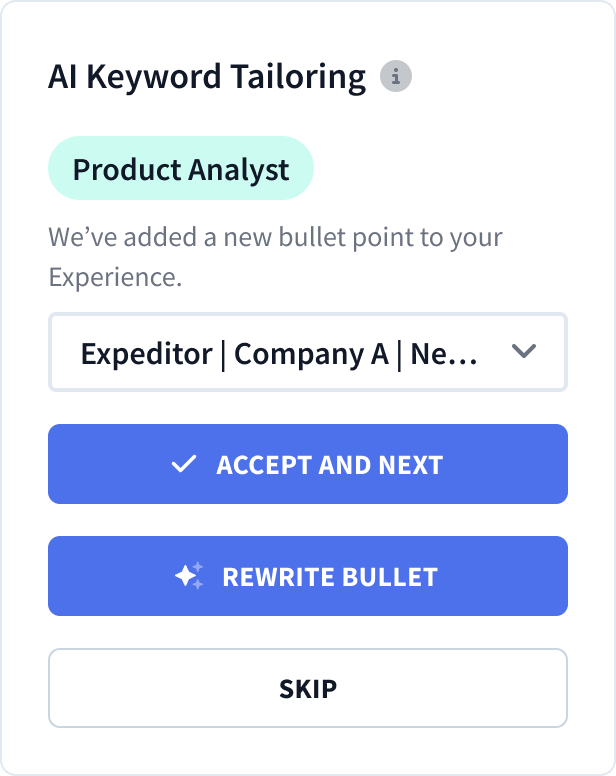
Automatic AI Resume Tailoring
Customize your resume with AI-guided precision.