Technical Interview Questions: Top Strategies for 2026
Technical interview questions usually test how you think, not whether you can recite a memorized answer. Strong case-study answers follow Clarify, Assume, Plan, Execute, Review, and that same pattern shows up when you're solving coding questions under pressure, because interviewers want to see whether you can define the problem, state constraints, choose a data structure, and justify the trade-off with a clean explanation.
Who this guide is for
This guide is for software engineering candidates, data candidates, and product-adjacent candidates preparing for technical screens that include coding, problem solving, and trade-off discussion. It is most useful for interview loops that expect you to think out loud, explain constraints, and justify implementation choices. It is less relevant for roles where the process is mostly tool-specific troubleshooting or take-home delivery.
How this guide was reviewed
The advice below reflects common technical screen patterns described by major interview prep and hiring resources, plus practical expectations candidates regularly face in coding interviews. External references are included throughout, and the article should be reviewed periodically as hiring loops evolve.
TLDR
- Interviewers care most about your reasoning, communication, and trade-off awareness.
- The most useful prep focuses on patterns, not memorized answers.
- The core question types in this guide cover hash maps, linked lists, sliding windows, trees, heaps, graphs, dynamic programming, and grid traversal.
- For each problem, explain the invariant, name the data structure, and justify why it fits the constraints.
- If you get stuck, clarify the prompt, start with a simple solution, and improve it out loud.
What Are Interviewers Really Testing With These Questions?
They're testing whether you can turn an ambiguous prompt into a workable plan without freezing, because the key signal is the reasoning trail, not the final line of code. Guidance for technical interviews consistently points to problem-solving steps, trade-offs, and clear communication, while candidates are often expected to think aloud, ask clarifying questions, and explain why a solution fits the constraints rather than just naming the textbook pattern (Indeed's guidance on technical interview uncertainty, Coursera's interview troubleshooting advice).
That view is consistent across several interview prep sources. HackerRank's overview of technical interviews emphasizes that screens often test more than syntax alone, including reasoning, communication, and practical judgment about tools and trade-offs (HackerRank's note on technical interview scope). Built In's representative interview coverage points in the same direction, showing that candidates are often evaluated on how they structure their answer as much as on the final solution itself (Built In's representative technical interview questions).
That's why the best preparation is pattern-based. A question like Two Sum is really about using memory to buy speed, Word Ladder is a shortest-path problem hiding inside a string prompt, and Number of Islands is a grid traversal problem dressed up as a map. The interviewer is watching for the moment you recognize the category, then checking whether you can explain the mechanics cleanly enough that another engineer would trust your judgment.
Practical rule: the stronger your answer sounds like a design decision, the more likely it is to score well. A hurried solution that lands on the right output can still look weak if you can't explain the constraints, the invariant, or the trade-off that led you there.
For engineers, data roles, and product-adjacent roles, the scope is broader than coding puzzles alone. Modern technical screens can include system design, architecture, tooling, database reasoning, and stakeholder communication, so the smartest candidates train for the category of question, not just the platform they expect to see it on (HackerRank's note on technical interview scope, Built In's representative technical interview questions).

1. Two Sum
Two Sum is the warm-up that tells an interviewer whether you instinctively reach for the right tool, because the problem rewards the switch from nested loops to a hash map as soon as you notice that you only need to remember what you've already seen. The core move is simple, but the reason it matters is deeper, since it shows that you understand how to trade space for time instead of mechanically brute-forcing every pair.
The best answer starts with a concrete example, not code. Walk through a small array, say you're scanning values left to right, and explain that the hash map lets you check whether the complement already exists before you add the current number to the structure, which turns a quadratic search into a single pass. If the interviewer pushes on constraints, ask whether the array is sorted, whether duplicate values matter, and whether they want the first pair or any valid pair, because those details change how you frame the solution.
What the interviewer is really checking
The answer they want is not “I know hash maps.” They want to hear that you know why a hash map is better than a nested loop here, and that you can defend that choice under follow-up questions.
A strong resume discussion here sounds like this: you solved problems where brute force was acceptable for a draft, then you optimized the path that mattered most. That's the same kind of thinking you should show on your resume when you describe performance improvements or pipeline fixes, because it proves you don't stop at a working prototype. If you want to frame that kind of work clearly, this guide to presenting problem-solving skills on a resume is directly relevant.
In real systems, the same pattern shows up in fraud checks where one value needs to match another, or in deduping logic where you're looking for a previously observed signal. The interview version is smaller, but the mental model is the same, you're storing history to make the next decision faster.
2. Reverse a Linked List
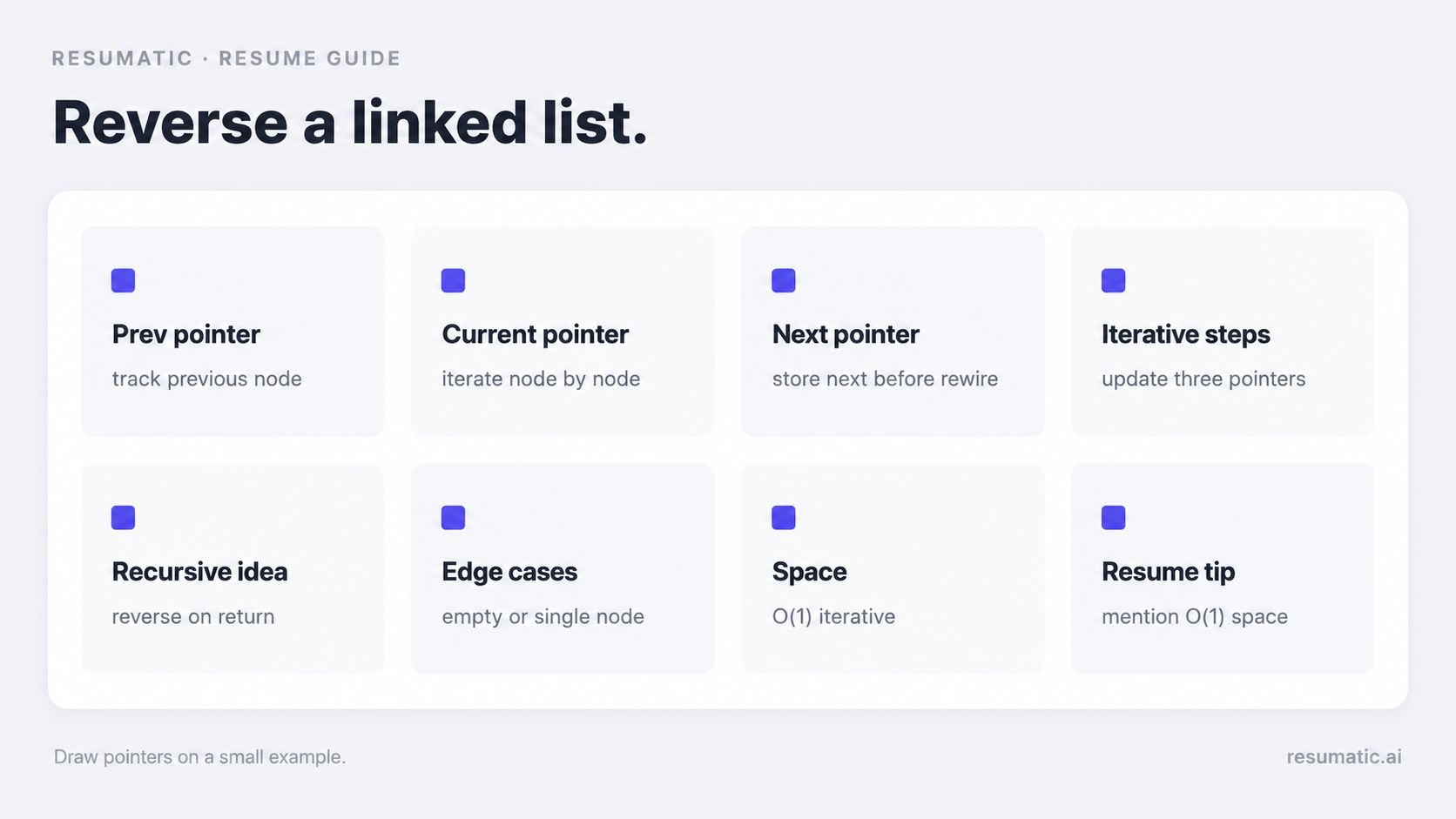
Reversing a linked list is a pointer discipline test disguised as a simple mutation problem, and interviewers use it because it quickly shows whether you understand how nodes connect, what happens to a reference when you reassign it, and how to avoid losing the rest of the list mid-operation. The task sounds basic, but the implementation breaks down fast if you don't reason carefully about the current node, the next node, and the previous node.
The cleanest explanation is visual. Draw three or four nodes, show the direction of each pointer before and after the first reassignment, then explain why you need a temporary variable to preserve the original next node before you change the arrow. That small detail reveals a lot, because candidates who can narrate the pointer movement usually understand the memory model well enough to avoid the classic “I lost the rest of the list” mistake.
Why interviewers like this problem
It's not just about getting the tail to become the head. It's also a quick read on whether you can compare iterative and recursive approaches without overcomplicating the answer, because a recursive version can be elegant while the iterative version is usually safer on stack usage and easier to justify in production. If you choose the iterative path, say so plainly and explain that you prefer fewer hidden costs when the operational need is simple reversal.
This question maps well to browser history, undo stacks, and any place where a chain has to be walked back in reverse order. If you've worked on code review comments, debugging tools, or state transitions, use that vocabulary on your resume too, because it shows you understand both the algorithm and its practical analog.
3. Longest Substring Without Repeating Characters
Longest Substring Without Repeating Characters is where many candidates first meet the sliding window pattern, and the reason it matters is that the problem punishes brute force while rewarding a maintained invariant. You're not just scanning characters, you're expanding and contracting a window so that it always represents the longest valid segment seen so far.
Start with the invariant, not the code. Say that the current window must contain unique characters, then explain how the right pointer advances until a duplicate appears, while the left pointer moves just enough to restore uniqueness, and why a hash map is useful when you need to remember where the last copy of each character lived. That answer shows pattern recognition, but it also shows that you can reason about state rather than merely count characters.
A useful way to explain it is with a string like abcabcbb, because the duplicate shows up early and the window movement becomes visible. If you begin by solving the easy version where all characters are unique, then add the duplicate-handling logic, the interviewer can see how you're decomposing the problem instead of guessing.
Trade-off worth saying out loud: a set can tell you whether a character is present, but a hash map tells you where it last appeared, which makes the contraction step more precise and usually easier to defend.
That distinction matters on the job too, especially in log analysis, session validation, or token parsing, where the exact position of a repeated event changes the answer. If you're translating that skill onto a resume, the point isn't “I know sliding windows,” it's “I can maintain state across a stream and choose the right representation for recovery or adjustment.” For a resume-friendly way to frame that, the skills to include in 2026 guide helps you think in terms of demonstrable capability rather than buzzwords.

4. Binary Tree Level Order Traversal
Binary Tree Level Order Traversal is really a breadth-first search question, and interviewers like it because it shows whether you choose BFS when the structure of the answer is level-based. Candidates often reach for depth-first recursion out of habit, but that can make the output structure feel forced, while a queue matches the problem naturally.
The best answer distinguishes BFS from DFS in plain language. BFS uses a queue and processes nodes level by level, while DFS goes as deep as possible before backing up, so if you need a list of rows, BFS usually makes the result easier to build. Once you've said that, code the iterative version and show how each queue snapshot corresponds to one level of the tree.
Why the queue matters more than the recursion here
The queue isn't a cosmetic choice, it expresses the level boundary directly, which makes the code easier to reason about and the explanation easier to follow. If you finish early, mention time and space trade-offs, then connect the discussion back to real systems where level-by-level reasoning matters, such as hierarchy rendering or B-tree traversal.
If you're planning interview prep more broadly, it helps to use a structured approach rather than random problem solving, and this interview preparation guide without wasted time is a useful companion for organizing that work. For this question, though, the main signal is simple, the interviewer wants to see you match the traversal method to the shape of the output.
5. Merge K Sorted Lists
Merge K Sorted Lists is one of the clearest examples of an interview question with multiple valid strategies, and that's exactly why it shows up in stronger technical screens. You can brute force it, you can use a min-heap, or you can merge pairs through divide-and-conquer, and the interviewer is checking whether you can justify one approach instead of pretending there's only one path.
A thoughtful answer starts by comparing the options out loud. Brute force is easy to describe but wasteful, a heap gives you the smallest current node each time, and divide-and-conquer leans on the simpler subproblem of merging two sorted lists, which is often the cleanest place to begin if you need to scaffold your reasoning. If you're under pressure, there's nothing wrong with picking the path you can explain most clearly, because clarity usually matters more than trying to optimize every detail in the first minute.
The heap version also tests precision, since you need to be explicit about what goes into the heap and why. If you store only values, you lose context, so you usually need the node reference and enough metadata to know which list it came from, because the interviewer wants to see that you're thinking about correctness, not just ordering.
Practical rule: when a problem has more than one viable solution, say which one you'd ship first and which one you'd teach first. Those aren't always the same answer.
That distinction is useful in backend systems, database merge operations, and log aggregation, where “cleanest to reason about” and “best under scale” can point to different methods. If you're shaping a resume for engineering work, it helps to describe the design choice, not just the outcome, and this software engineer resume guide for 2025 gives good context for that kind of framing.
6. Word Ladder
Word Ladder looks like a string manipulation problem until you realize it's a graph shortest-path question, and that is the whole point of asking it. Interviewers want to see whether you can abstract away the surface form and identify the underlying structure, because that's a much better signal than rote pattern matching.
Once you say it's a graph, the rest of the answer becomes much more stable. The words are nodes, one-letter differences are edges, and the shortest transformation sequence is the path you're trying to find, which means BFS is the natural fit because it explores by distance. If you drift toward DFS, the interviewer will usually wait to see if you correct yourself, since DFS may find a path but doesn't guarantee the shortest one without extra work.
The neighbor-generation discussion matters too. You can check every word in the list and compare letters, which is simple and easy to explain, or you can generate one-letter variations and test membership in the dictionary, which is often cleaner once you've internalized the structure. If you're unsure, start with the slower version and explain that you'd improve it if time allowed, because an interview reward for correctness plus reasoning is usually better than an unfinished optimization.
The real skill this exposes
This question also shows whether you can generalize from one domain to another. Autocorrect, recommendation chains, and “degrees of separation” style reasoning all look different on the surface, but they share the same shortest-path logic underneath. A strong candidate says that plainly, then uses BFS with a visited set to show control over revisits and path length.
For job seekers, this is the same kind of abstraction you want to show on your resume, because the best bullets don't just say you built a feature, they show you understood the system beneath it. If you're moving into a new role, the software engineer jobs guide for 2025 is a useful complement to that thinking.
7. Longest Increasing Subsequence
Longest Increasing Subsequence is where interviewers start separating people who can solve a problem from people who can explain why one solution is a stronger fit than another. The obvious dynamic programming approach is fine, but the more subtle improvement using binary search on an auxiliary structure is what turns the question into a real test of algorithmic maturity.
A good answer begins with the basic DP framing. Say that dp[i] represents the length of the longest increasing subsequence ending at position i, then explain how each position depends on earlier positions with smaller values. That gets you a correct, interview-acceptable solution, and it also proves you can build from a straightforward model before chasing the faster one.
If you have time, describe the optimization conceptually rather than forcing a half-remembered implementation. The clever version maintains a structure that keeps the smallest possible tail for subsequences of each length, then uses binary search to place each number in the right spot, which reduces the time cost while making reconstruction of the actual sequence harder.
This is one of those cases where the faster method is not automatically the better interview answer if you can't explain it cleanly. A correct O(n²) solution with solid reasoning beats a broken optimization every time.
The practical uses aren't abstract. Sequence alignment, version dependency chains, and trading trend analysis all ask for the same kind of ordered progression logic. On a resume, that translates well when you describe work involving trend detection, ranking logic, or constraint-based optimization, because you're showing that you can reason across a sequence, not just write loops.
8. Number of Islands
Number of Islands is the grid version of connected components, and interviewers use it to see whether you can extend graph thinking into two dimensions without getting lost in coordinates. You're counting separate clusters of land, which means the task is to traverse each island exactly once and mark it so you don't count it again.
The clean answer is to choose DFS or BFS explicitly, then stick with that choice. DFS is often the easiest to write recursively, while BFS can be easier to control iteratively when recursion depth is a concern, so the better choice depends on how large and dense the grid might be. The important part is consistency in the neighbor loop, because every cell should check up, down, left, and right in the same way.
Marking visited cells early matters a lot. If you wait until after recursion, you'll revisit the same nodes and inflate the count, which is the kind of bug that disappears in small examples and shows up immediately in a live interview if you don't trace it carefully. A small whiteboard sketch usually helps here, because the interviewer can see you checking boundaries instead of guessing through the grid.
Why this problem still matters in practice
It maps cleanly to image segmentation, mapping systems, and any domain where adjacency defines a region. If you can explain the traversal clearly, you're also showing that you can handle spatial data without overfitting to one language or one template.
Comparison of 8 Technical Interview Questions

What Strong Candidates Do Differently In Live Interviews
The biggest difference is not raw recall. It is visible decision-making. Strong candidates make the interviewer's job easy by exposing their reasoning step by step, so the conversation feels collaborative instead of opaque.
A few behaviors show up again and again in good interviews:
- They clarify constraints early. They ask about input size, expected output, duplicate handling, edge cases, and whether optimization matters immediately.
- They state the invariant before coding. That keeps the solution anchored and makes debugging easier when the interviewer pushes on correctness.
- They compare at least two approaches. Even a brief contrast between brute force and an optimized version signals judgment.
- They test edge cases out loud. Empty input, one element, duplicates, null roots, disconnected graphs, and boundary cells are all useful signals of engineering discipline.
- They recover cleanly when stuck. Instead of going silent, they restate the goal, simplify the problem, and build upward from the most defensible version.
This is one of the most practical E-E-A-T signals you can add to an article like this, because it reflects what interviewers actually observe in a live screen. Candidates are rarely judged only on the final answer. They are judged on whether another engineer would trust them to reason through ambiguity in real time.
How Should You Practice Beyond These Examples?
The point isn't to memorize the ten problems most developers practice and hope the interview matches them. The biggest win comes from learning to recognize patterns, then explaining why a pattern applies, which data structure supports it, and what trade-off you're accepting when you choose it. Technical interview questions reward people who can classify a problem quickly, then defend the solution clearly under follow-up pressure.
A practical workflow is boring in the best way. Pick one pattern at a time, solve a small cluster of problems from LeetCode, then explain each solution out loud as if you're teaching it to another engineer, because silent practice doesn't train interview communication. Use company-specific reports from Glassdoor or Blind to tune the mix, since interviewers at different companies emphasize different depths and follow-up styles.
A few sources are worth keeping open as reference points while you practice. LeetCode gives you the problem set, while company and salary data on Glassdoor helps you understand interview expectations and role context at a practical level. For a broader view of technical role expectations, the technical question types for coders article is a helpful secondary reference, and if you're preparing for engineering interviews specifically, the 2025 guide to hiring engineers gives useful context on how teams frame these screens.
The honest limitation is that some candidates don't need a deep algorithm refresh at all. If your role is closer to platform support, implementation, or highly domain-specific work, you may get more value from system design, troubleshooting narratives, or product judgment than from grinding hard graph problems. The better fit depends on the role, and the smartest prep plan is the one that matches the interview loop you're facing.
FAQ
How do I answer a technical interview question when I don't know the exact solution?
Pause, restate the problem, ask clarifying questions, and think out loud about the constraints you do understand. Interviewers usually care more about your reasoning process than whether your first attempt is perfect, especially when they've thrown a curveball on purpose. A calm, structured partial answer is usually stronger than guessing.
Should I always start with a brute-force solution?
Not always, but it's often useful when the brute-force method reveals the pattern or gives you a correctness baseline. If the brute-force approach is obviously too slow, say that directly and move to the optimization you think fits the structure. The goal is to show judgment, not ritual.
What's the biggest mistake candidates make with technical interview questions?
They solve without explaining their thought process and only talk after they've already built the answer. That hides their reasoning, makes it hard for the interviewer to follow, and creates the impression that they're not collaborating. The answer can be imperfect if the thought process is strong, but a correct solution without commentary often still feels weak.
How should I prepare if my role is product-adjacent or data-focused rather than pure coding?
Still review core patterns like BFS, sliding window, and basic dynamic programming, but spend more time on trade-offs, data reasoning, and explaining decisions to non-technical stakeholders. Those roles often include system design, analytics framing, and business context, so a narrow coding-only prep plan usually misses the actual loop.
What should I put on my resume if I want technical interview questions to go better?
Frame experience around problems you solved, the constraints you handled, and the decisions you made under uncertainty. Resume bullets that show optimization, debugging, or architectural judgment give you better raw material for interview follow-ups than generic action verbs. The interviewer can then connect your background to the reasoning they're probing.
If you want help turning your interview practice into a resume that reflects real problem-solving, build it in Resumatic and use your strongest technical examples, not vague labels, so the same judgment you show in interviews is visible on the page.
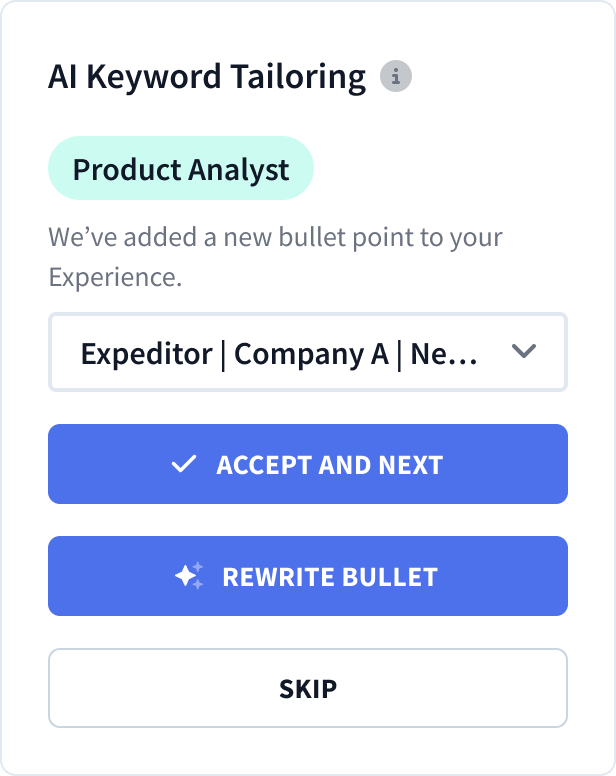
Automatic AI Resume Tailoring
Customize your resume with AI-guided precision.