Why Am I Not Getting Interviews? Fix It in 2026
If you're not getting interviews, the cause is usually one of two things, and neither is the one you're worried about. Either your resume is technically fine but never makes the argument for you, or the posting you applied to received 200 or more applications and yours was never opened. Using AI to write and tailor it doesn't fix either problem. Here's how to tell which one you're facing.
Key takeaway
- Almost every job seeker who reaches me has already been applying for months, and many have already run their resume through AI, so the resume being "AI-optimized" tells you nothing about whether it works.
- AI writes resumes that pass a checklist and fail a human, because it lists tasks with numbers attached instead of connecting what you did to why the result happened.
- Some of your silence isn't about you at all, and knowing which part is yours to fix is the difference between improving and spiraling.
Why isn't my resume getting interviews even though I used AI to write it?
I want to start with the thing that makes this article different from most of what you'll find on this question, because I think it's the part that actually matters.
Every single client who comes across my desk is someone who has been applying and not getting interviews. That's the whole population. Nobody hires a resume writer because things are going great. What's changed over the past two years is that a growing share of those people arrive having already used AI to write the resume, and a lot of them used AI to tailor it for each posting too. They did the thing the internet told them to do. It still didn't work.
That's an awkward thing for a company that sells an AI resume builder to say out loud, so let me say it plainly: using AI to write a resume doesn't make you good at resume writing. It makes you fast at producing resume-shaped text. Those are not the same skill, and the gap between them is where most people are losing.
When I open an AI-written resume, I tend to see the same four failures. Not sometimes. Almost every time.
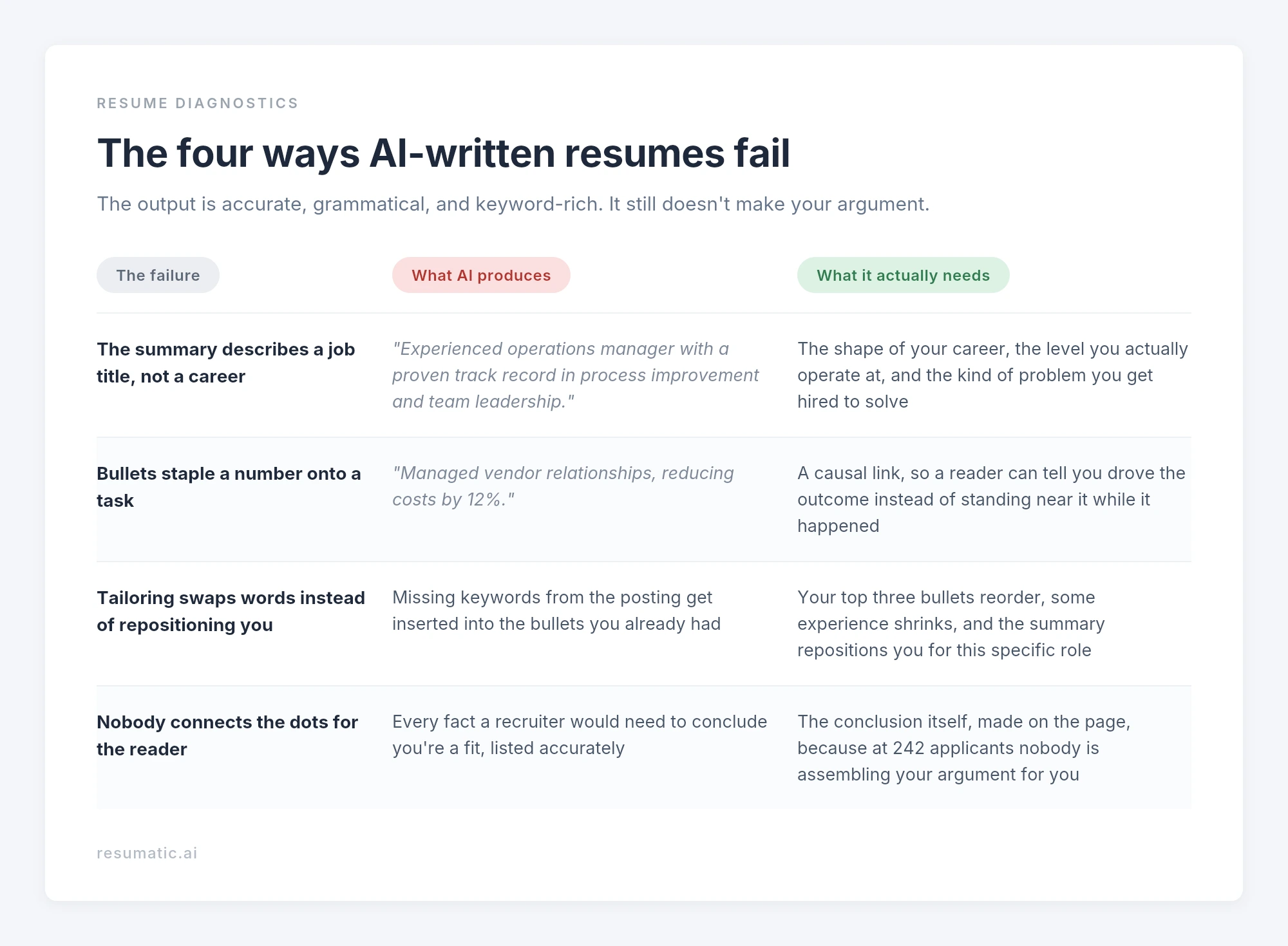
The third one is the one people underestimate most, so it's worth sitting with.
AI tailoring reads the job posting, finds the terms your resume is missing, and inserts them. Your keyword coverage goes up. Your fit doesn't change at all. You're still a generalist applying to a specialist opening, except now the generalist resume contains the word "Kubernetes." There's a useful explanation of that gap in this piece on why keywords alone won't fix your resume and what actually works, and the short version is that keyword coverage is one checkpoint rather than the whole screen.
Real tailoring is a positioning decision, not a find-and-replace operation, and it's the part AI is worst at because it requires knowing what to leave out. Strong candidates get passed over constantly for being positioned too broadly rather than for lacking the experience, a pattern worth watching in this breakdown on broad positioning and resume targeting. If you want the mechanics, this guide on tailoring your resume to a job description lays out the matching logic.
The fourth failure is the quietest and the most expensive. Most AI-written resumes are accurate. Every fact a recruiter would need to reach the conclusion "this person can do the job" is sitting right there on the page. What's missing is the conclusion. The reader has to build the argument themselves, and nobody is doing that work for you anymore.
There's a version of this that hits early-career applicants harder. If you don't have much formal experience yet, AI has almost nothing real to work with, so it fills the gap with adjectives. The fix is to give it better material rather than better prompts. This guide to creating a CV without experience covers how to present coursework, projects, and internships without inflating what you actually did.
What does a recruiter actually see when they open an AI-written resume?
They see something competent and forgettable, which in a stack of 200 is functionally the same as bad.
This is the thing that surprises people. They assume the resume is being rejected. It usually isn't. It's being read for eight seconds, understood as "plausible candidate, unclear fit," and set down. There's no rejection event. There's no feedback. There's just a resume that never gave the reader a reason to spend a ninth second on it, and a recruiter who has 199 more to get through before lunch.
This is where the mental model most people carry is wrong. According to Coversentry's ATS statistics breakdown, applicant tracking systems mostly rank and sort candidates rather than auto-rejecting them on contact. Your resume usually isn't being thrown out. It's being scored too low to surface, which produces exactly the same silence with none of the closure.
A resume that's accurate but unpersuasive loses to a resume that's slightly less impressive but makes its case in the first three lines. That's not fair, exactly. It's just how reading under time pressure works.
How many applications is each job actually getting?
Now for the part of your silence that isn't your fault, because it's a real part and pretending otherwise would be dishonest.
It's worth knowing how normal the silence is before you read anything into yours. The average job seeker submits somewhere between 6 and 100 applications to land a single interview, and 40% of unemployed job seekers had no interviews at all in the past year, according to Career Agents' breakdown of why job seekers aren't getting interviews. Silence is the default state of this system. It isn't evidence about you.
The volume has changed in a way that most job seekers still haven't fully internalized. The average job opening now receives roughly 242 applications, which works out to about a 0.4% success rate for any individual applicant, up from around 100 applications five years ago. Glassdoor's corporate average lands near 250, so this isn't one outlier board. It's the baseline. In one widely reported case, an HR consultant received over 1,200 applications for a single remote role and pulled the listing entirely rather than try to work through the pile.

The supply side got worse at the same time. LinkedIn's own data showed a 45.5% surge in applications submitted in Q3 2024, at the same time job postings dropped 10.6%. More people applying, to fewer roles, faster.
I want to be careful here, because I don't have a measured figure for what share of applications get a human read, and I'm not going to invent one. What I'll say is my read, based on how roles actually get filled and what hiring teams tell me: no team buried under 250 applications is opening all 250. The first tranche gets read qualitatively. After that, screening collapses into keyword filters and quick pattern matching, and a large chunk of that pile is never meaningfully reviewed by anyone.
Which means some of your applications were dead on arrival, and no resume edit would have saved them.
Are AI auto-apply tools making it harder to get interviews?
Yes, and I say that as someone with no stake in the answer. Resumatic doesn't sell an auto-apply tool and never will, so I'm not defending or attacking a competitor here.
The pitch for these tools is that the math is brutal, so you should send more. The problem is that the math is brutal partly because everyone is sending more. Every bot-submitted application lands in the same pile your careful application lands in, which raises the volume the hiring team has to triage and lowers the odds that anyone reads deeply enough to find you.
The conversion data doesn't support the pitch either. Bulk auto-apply with a generic resume converts at roughly 1 to 6 percent, while tailored applications land closer to 5 to 15 percent, and one frequently cited case involved a developer sending about 5,000 bot-submitted applications and getting roughly 20 interviews, a hit rate near half a percent. You can absolutely spend your way to a handful of callbacks by brute force. You'll spend months doing it, you'll learn nothing from the rejections because they're not signal, and you'll have made the pile worse for yourself the next time you apply.
There's a bleak feedback loop in this. Volume tools flood the funnel, hiring teams respond by leaning harder on automated screening, candidates respond by using more volume tools. Everyone is optimizing and nobody is being read.
What should I check before I send another application?
Here's the sequence I'd actually run, in order, because the first checkpoint blocks everything after it. Fixing your LinkedIn headline while your resume can't make its own argument is rearranging deck chairs.
If you want a line-by-line cleanup list to run alongside this, work through these resume tips for boosting interviews.
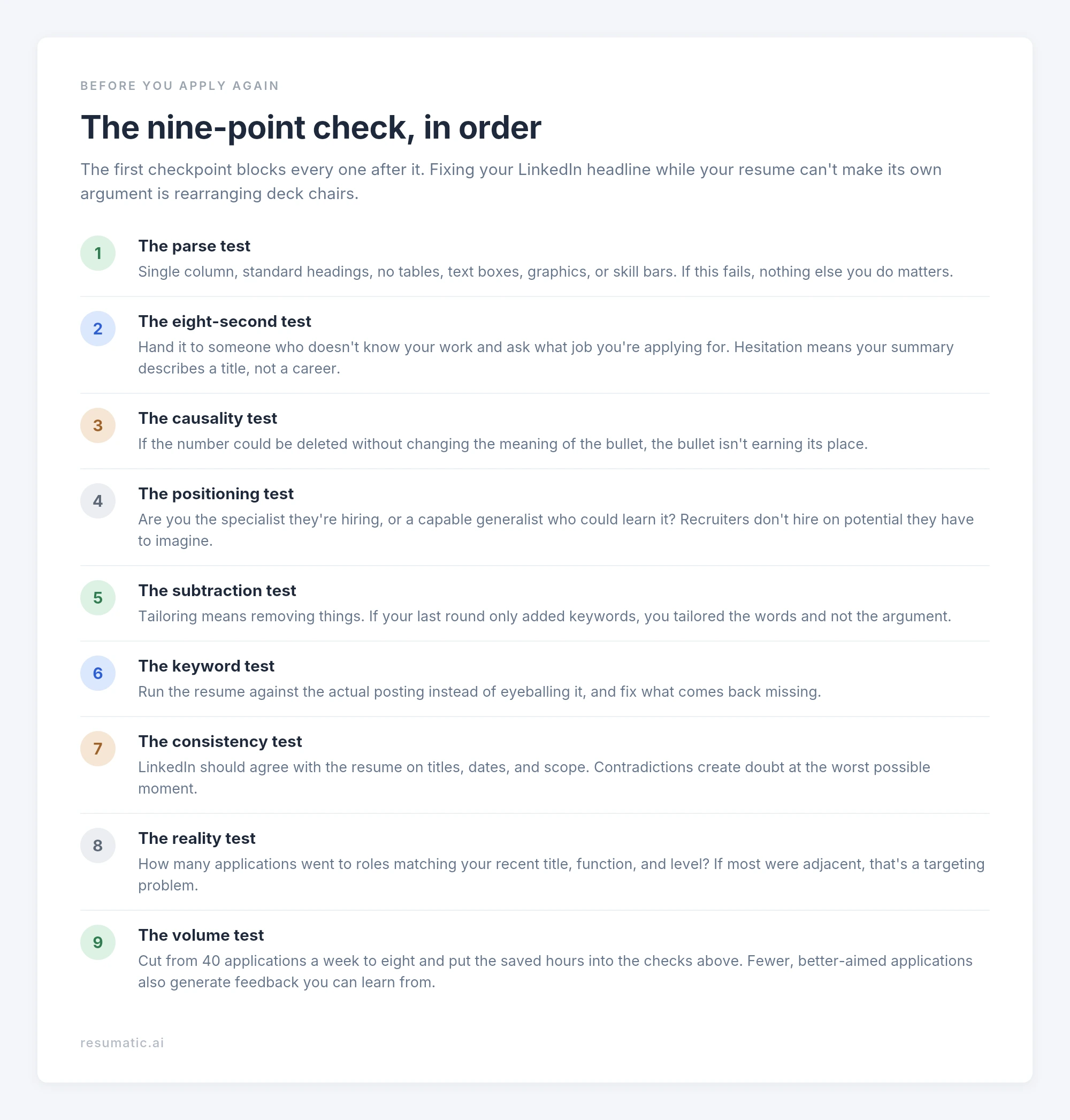
- The parse test. Can the software read the file cleanly? Single column, standard headings, no tables, no text boxes, no graphics, no skill bars. If this fails, nothing else you do matters.
- The eight-second test. Hand your resume to someone who doesn't know your work and ask them what job you're applying for. If they hesitate, your summary is describing a job title instead of a career.
- The causality test. Go through your bullets and ask, for each one, whether a reader can tell why the result happened. If the number could be deleted without changing the meaning of the sentence, the bullet isn't earning its place.
- The positioning test. Read the posting, then read the top third of your resume. Are you presenting as the specialist they're hiring for, or as a capable generalist who could learn it? Recruiters don't hire based on potential they have to imagine.
- The subtraction test. Tailoring means removing things, not just adding keywords. If your last round of tailoring only added, you tailored the words and not the argument.
- The keyword test. Run the resume against the actual posting instead of eyeballing it. Resumatic's ATS resume checker compares your resume with a job description and flags missing keywords and formatting issues.
- The consistency test. Your LinkedIn should agree with your resume on titles, dates, and scope, because contradictions create doubt at exactly the moment someone is deciding whether to call you. If your profile has drifted, this LinkedIn resume builder tool helps structure the content so the two stop disagreeing.
- The reality test. Look honestly at how many of your applications were to roles where your recent work lines up with the title, function, and level. If most were adjacent, your interview rate is telling you about targeting, not about you.
- The volume test. If you've been sending 40 applications a week, cut it to eight and put the saved hours into the four above. Fewer, better-aimed applications beat a large pile of wishful ones, and they generate feedback you can actually learn from.
When is the problem not your resume at all?
Sometimes it isn't, and this is the part I wish more people in my industry would say.
If you're a mid-level marketer applying into a market where every laid-off marketer in your city is chasing the same twelve roles, the resume can only do so much. It can move you from unread to read. It can't create demand that doesn't exist. Some postings were filled internally before they went live, some were never real, and some screened you out on a knockout question about a certification you're two weeks from finishing. Both of those traps are worth understanding, and this discussion of ghost jobs and knockout filters covers how they work. Neither is something a better bullet point would have fixed.
There's a broader version of this too. Conventional hiring screens out capable people for reasons that have nothing to do with capability, and if the standard process has never worked for you, that's worth treating as information rather than as a verdict. Resources on meaningful work for autistic adults get at this directly, and the underlying point generalizes to anyone the process keeps filtering out for the wrong reasons.
I bring this up because the people who spiral hardest are the ones who treat every silence as a verdict on their worth. It isn't. It's mostly a verdict on how legible you were in eight seconds, and partly a verdict on a market you didn't design.
Your job is to remove the preventable misses. That's it. You can't control the rest, and burning energy on it is the fastest way to run out of the energy you need for the parts you can control.
Frequently asked questions
Q: Why am I not getting interviews even though I'm qualified?A: Being qualified and looking qualified in eight seconds are different things. Most resumes that fail are accurate but unpersuasive, listing everything a recruiter would need to conclude you're a fit without ever making that conclusion on the page. At 242 applications per opening, nobody is assembling your argument for you. You have to do it.
Q: Does using AI to write my resume hurt my chances?A: Not inherently, but it won't save you either. AI produces resume-shaped text quickly. It defaults to summaries that describe a job title rather than a career, and bullets that staple a number onto a task without explaining why the result happened. AI is a good drafting tool and a poor judgment tool, and resumes are mostly a judgment problem.
Q: How many applications should I send per week?A: Fewer than you're sending now, almost certainly. Eight to ten well-targeted applications, where your recent work lines up with the title, function, and level, will outperform 40 loosely matched ones. Bulk applications also generate no useful feedback, so you learn nothing from the rejections and repeat the same mistakes for months.
Q: Are AI auto-apply tools worth using?A: I don't think so. Bulk auto-apply with a generic resume converts at roughly 1 to 6 percent, compared with 5 to 15 percent for genuinely tailored applications. The tools also worsen the volume problem that's burying you in the first place, since every bot submission lands in the same pile a hiring team has to triage.
Q: How long should I wait before assuming I've been rejected?A: Two to three weeks with no contact is a reasonable assumption of no, though many companies never close the loop at all. Don't read silence as a careful evaluation of your background. Frequently nobody reviewed the application in any meaningful way, especially if you applied more than 48 hours after the posting went live.
About the author
Alex Khamis, CPRW, is the cofounder of Resumatic and the founder of Final Draft Resumes. He has personally written more than 1,200 resumes across 50+ industries since 2019 and moderates r/resumes (1.2M+ members), which means most of what he sees in a given week is someone who has been applying for months without a callback. LinkedIn | About Resumatic
If you want to know which of the two problems you're facing, start with the cheap diagnostic. Run your resume against a posting you actually want through Resumatic, see what comes back, and if it's clean and you're still getting nothing, the problem is targeting or the market. You can stop rewriting the resume for the eleventh time.
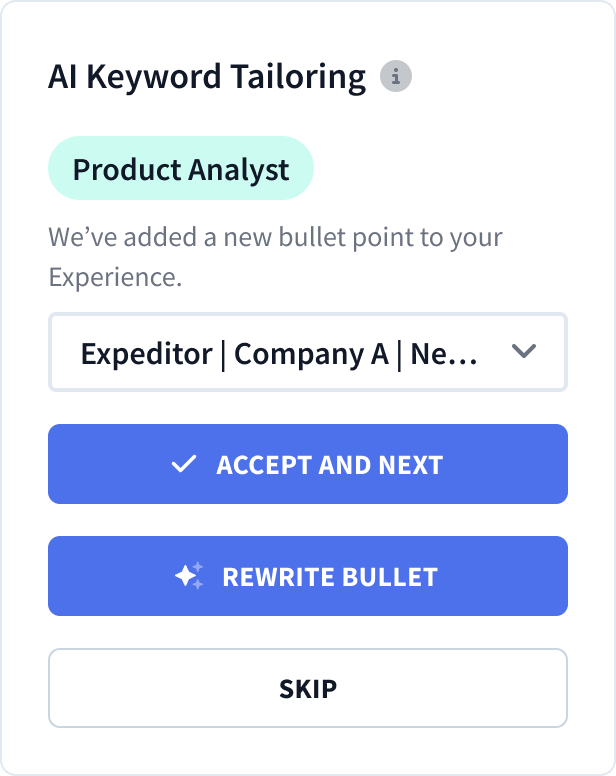
Automatic AI Resume Tailoring
Customize your resume with AI-guided precision.