8 Entry Level Resume Objective Examples to Use Now
Use a resume objective only when it does a job your resume cannot do on its own. For entry-level candidates, that means clarifying direction, explaining a career change, connecting school or project work to a target role, or aligning a broad background to one specific opening. If your target role is already obvious from your headline, skills, and experience, cut the objective.
That decision matters more than the wording. A weak objective wastes the most valuable space on the page. A focused one gives hiring managers context fast and supports ATS matching with job-specific language, which aligns with Indeed’s guidance on entry-level resume objectives.
Use the framework below as a set of templates for distinct situations, not a bank of lines to copy word for word. Each objective type fits a different problem: no direct experience, a career shift, a skills-first resume, or a role that requires tighter keyword alignment. If you need help choosing the right capabilities to feature, review these best skills to put on a resume before you write the statement.
If an objective still feels forced, use a different top-of-resume format. A personal brand statement works better when you need to present a broader professional identity instead of a narrow job target.
Table of Contents
1. Skills-Based Objective Statement
Use a skills-based objective when your strongest evidence sits in coursework, projects, certifications, part-time work, or volunteer roles. This format works best when you can name a small set of relevant skills and connect them directly to the job title. It’s often the cleanest option for entry level resume objective examples because it avoids vague goals and gives recruiters immediate context.
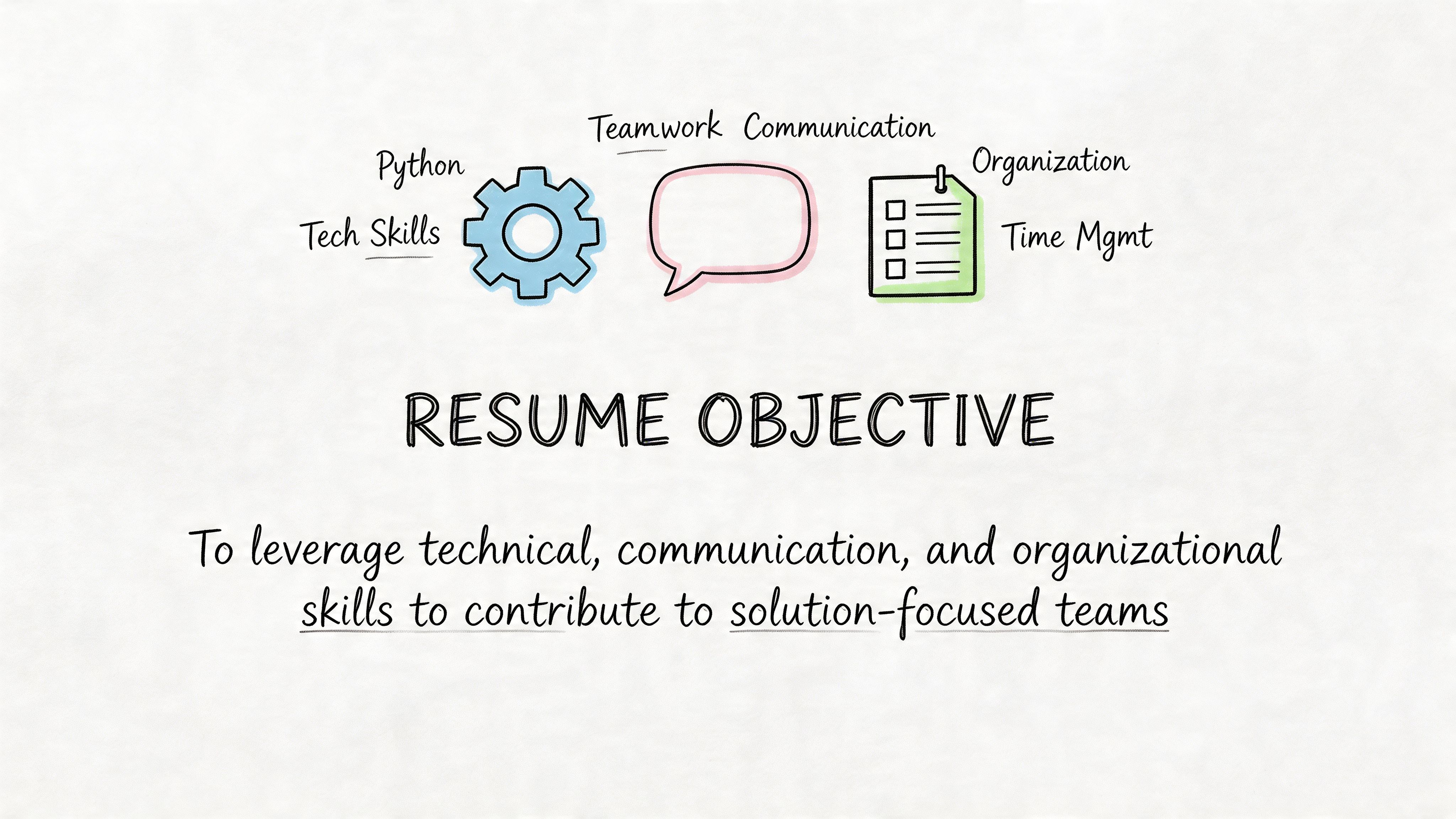
A skills-based objective should name the target role, then highlight two or three skills that match the posting. Keep the language specific. Don’t write “good people skills” or “hardworking.” Write the actual skills the employer listed.
Build it from the job posting
Start with the job description. Pull out the required tools, methods, and interpersonal skills. Then use the same wording where it fits truthfully. If the posting asks for Python, SQL, and communication, put those terms near the top.
- Lead with the role name: Write the exact title if it matches your target. “Seeking Entry-Level Software Developer role” is better than “Looking for a position in tech.”
- Choose only core skills: Limit the objective to the skills most likely to affect screening. Use your full skills section for the rest.
- Mix hard and soft skills: Pair one technical skill with one execution skill. For example, “Excel and stakeholder communication” or “JavaScript and problem-solving.”
Use the keywords employers already use. Don’t invent synonyms if the posting gives you the right language.
Examples you can customize:
Seeking Customer Service Associate role to apply conflict resolution, written communication, and CRM skills in resolving customer issues and supporting retention.
Recent computer science graduate pursuing Entry-Level Software Developer position with hands-on experience in Python, JavaScript, and SQL, contributing clean code and effective collaboration in agile teams.
For skill ideas that fit this format, review best skills to put on a resume and select only the ones you can support elsewhere on the page.
2. Employer-Focused Objective Statement
Use an employer-focused objective when you’re applying to a specific company and your resume needs to show why that company, not just that role. This format shifts the sentence away from your goals and toward the value you’ll bring. It works well for mission-driven organizations, recognizable brands, and smaller companies where culture and fit matter.
This format still needs ATS keywords. But the center of gravity changes. Instead of “I want to grow my career,” the sentence should say what you’ll help the employer do.
Name the company only when you customize
If you mention the company name, customize the whole sentence. Don’t swap only the employer name and leave the rest generic. Tie your background to the company’s product, mission, team, or operating model.
Examples:
Recent marketing graduate seeking Marketing Coordinator role at BrightWave to support brand growth through content planning, social media execution, and campaign reporting.
Entry-level data analyst pursuing an opportunity with GreenGrid to support sustainability reporting through SQL, dashboard building, and clear data communication.
A useful structure is simple:
- Company and role: “Seeking Operations Coordinator role at [Company]”
- Relevant capability: “using scheduling, documentation, and cross-team communication”
- Employer outcome: “to support accurate project delivery and smooth internal workflows”
Make the employer benefit explicit
Research the company before you write the line. Read its careers page. Look at product pages. Check the language in the posting. Then rewrite your objective so the final phrase points to a business need.
Practical rule: If the sentence only describes what you want, delete it and start again.
Good employer-focused objectives often pair well with a customized resume overall. If you need a process for that, use how to tailor resume to job description and land interviews to align your objective with the rest of your document.
3. Achievement-Focused Objective Statement
Use an achievement-focused objective if you already have measurable proof from projects, internships, campus work, freelance assignments, part-time jobs, or volunteer roles. This is the strongest format when your experience is limited but your results are concrete.
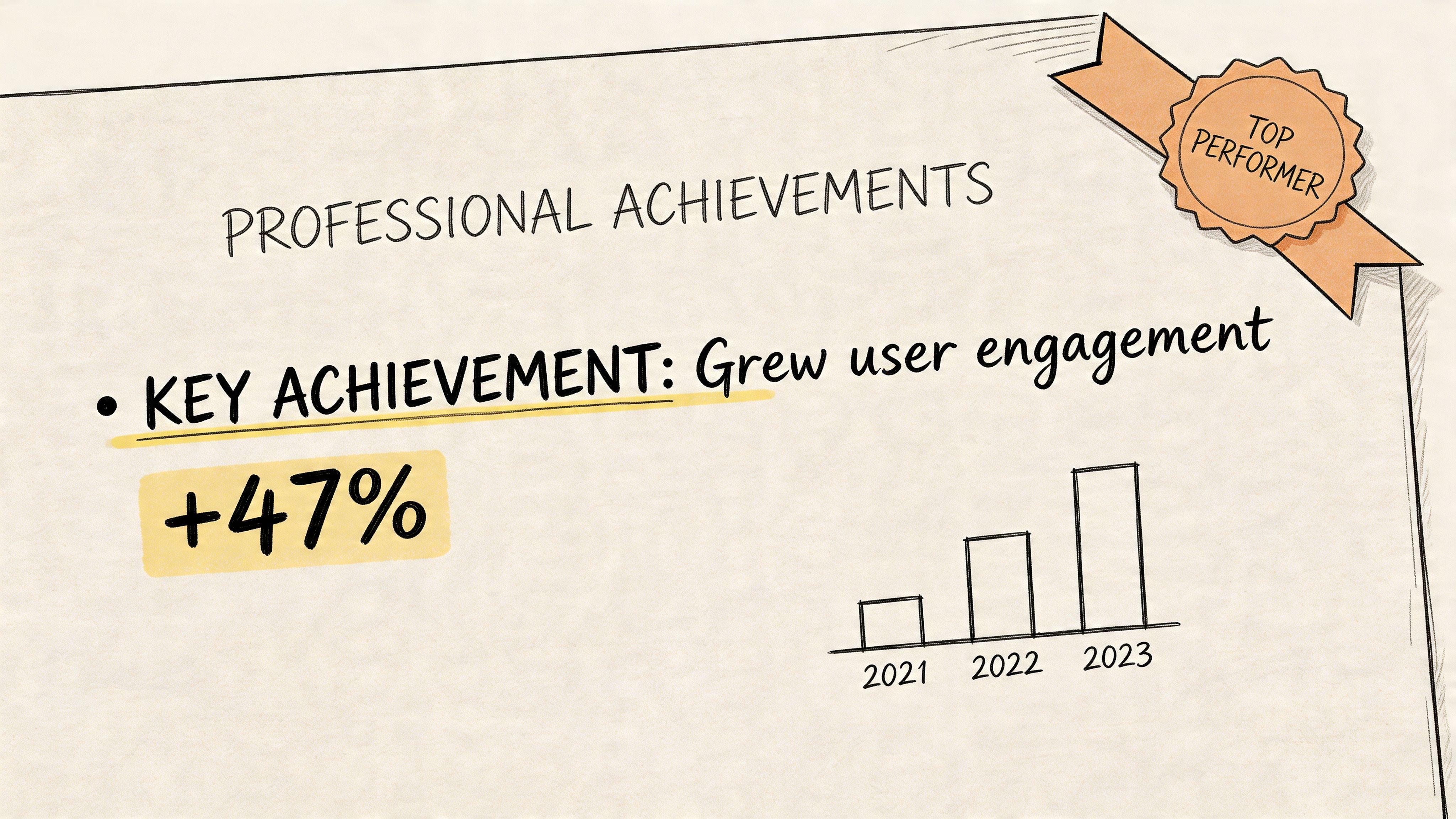
Quantified language matters here. Research on entry-level resume screening shows that objectives and resume content built around action verbs and measurable outcomes outperform vague responsibility-based descriptions in both human and machine evaluations, with examples such as “resolved over 50 daily customer inquiries with a 96% satisfaction rate” and “improved accuracy by 15%, resulting in smoother financial reporting,” according to BeamJobs’ entry-level resume examples.
Put one result in the objective, not three
Your objective is still short. Use one metric or one compact result, then let your bullets carry the rest. Pick the result that maps closest to the target role.
Examples:
Entry-level finance graduate seeking Financial Analyst role after improving reporting accuracy by 15% in academic and internship-based financial analysis projects.
Marketing graduate pursuing Marketing Associate position after managing student campaign work that improved local event traffic by 150%, applying analytics, copywriting, and channel coordination.
Use results from any credible setting:
- Course projects: Built dashboards, analyzed data, improved process accuracy
- Internships: Supported campaigns, handled reporting, resolved customer issues
- Campus roles: Increased attendance, organized volunteers, tracked budgets
- Part-time work: Managed volume, maintained accuracy, improved service quality
Rewrite weak objectives into evidence
Weak version:
Seeking an entry-level accounting role where I can use my skills.
Stronger version:
Recent accounting graduate seeking entry-level accounting role after entering financial data with 98% accuracy and supporting smoother monthly reporting in internship and class-based projects.
This format works because it gives the hiring manager a reason to believe your claim. It also gives you a direct interview talking point.
4. Industry-Specific Objective Statement
Use an industry-specific objective only when the target field has its own terminology, systems, or compliance expectations. Otherwise, skip it and use a stronger format from this list. This type works best when you have relevant coursework, certifications, projects, or adjacent experience that can prove field fit fast.
Industry language signals readiness. It also creates risk. If you stuff the objective with terms you cannot support elsewhere on the page, the resume reads inflated and weak.
Use the vocabulary the role actually requires
Scan several job postings for the same title. Pull repeated terms, then keep only the ones you can defend with a class project, internship, lab, certification, campus role, or part-time work. For software, that might mean Git, APIs, testing, SQL, or Java. For healthcare, it may mean EHR, HIPAA, documentation accuracy, or patient data handling. For supply chain, focus on inventory, vendor coordination, purchasing, forecasting, or process documentation.
This category is one of eight objective types in this article. Use it for field alignment, not for broad claims about being hardworking, motivated, or ready to learn.
Examples:
Computer Science graduate seeking entry-level Software Developer role with hands-on experience in Java, Git, SQL, and API-based class projects, applying testing and debugging skills in an agile development environment.
Recent graduate pursuing Health Information Management role with training in EHR workflows, documentation standards, and patient data handling, supported by coursework in regulated healthcare processes.
Business graduate targeting entry-level Supply Chain Coordinator position with project experience in inventory tracking, vendor communication, and process documentation to support day-to-day operations.
Match the rest of the resume to the objective
The objective sets the frame. The projects, skills, and bullets must prove it. If your objective says "backend development," your resume should show code, tools, and project context. If it says "regulated healthcare settings," your experience section should show documentation, privacy awareness, or records work.
Use resume examples by role and industry to compare how top-of-resume language changes across functions. Then mirror that terminology across your skills, projects, and experience so the objective reads like evidence, not decoration.
5. Growth-Oriented Objective Statement
Use a growth-oriented objective when you need to show readiness to learn without sounding underqualified. This is common for new graduates, people moving from internships to full-time roles, and applicants whose experience is adjacent but not exact.
The mistake in this category is easy to spot. Many objectives talk only about learning, gaining experience, or starting a career. That wastes space. The better version shows what you can do now and what you’re prepared to build next.
Pair current ability with next-step development
A growth-oriented objective needs two parts. First, state the capability you already bring. Second, name the area where you’ll grow in the role. Keep both tied to employer value.
Examples:
Entry-level Business Analyst seeking role that applies Excel, research, and stakeholder communication while building deeper experience in dashboarding and business reporting.
Communications graduate pursuing Customer Success Coordinator position to support client relationships and documentation while expanding knowledge of SaaS workflows and retention practices.
This format works well in situations like these:
- No direct full-time experience: You have coursework, projects, or internships, but not a matching title.
- Bridge role applications: You’re moving from customer service into operations, marketing into analytics, or admin into project support.
- Training-heavy environments: The company expects onboarding and growth, but still wants useful baseline skills.
State your current value before your learning goal. Employers hire for contribution first.
Keep the learning language controlled
Use phrases like “while building deeper experience in” or “while expanding expertise in.” Don’t write “hoping to learn” or “seeking a chance to gain knowledge.” Those phrases center your needs and weaken your position.
A good growth-oriented objective sounds practical. It says you can contribute now, then improve quickly in the areas the role develops.
6. Problem-Solving Objective Statement
Use a problem-solving objective when the job description emphasizes fixing issues, improving workflows, reducing errors, troubleshooting, investigating, testing, or coordinating across moving parts. This format is strong for operations, QA, analytics, customer support, IT, and administrative roles.
The key is specificity. Don’t claim you’re a problem solver in the abstract. Name the type of problem you handle and the tools or habits you use.
Tie your objective to one business problem
Read the posting and identify the operational pain point. Then write the objective around that challenge.
Examples:
Entry-level Operations Analyst seeking role focused on process improvement, using spreadsheet analysis, documentation, and workflow tracking to reduce delays and support accurate reporting.
Computer science graduate pursuing QA Engineer position to identify software defects, document issues clearly, and support reliable releases through structured testing.
Administrative assistant candidate seeking office support role to improve scheduling accuracy, document organization, and follow-through across daily team operations.
A useful rewrite pattern:
- Weak: “Seeking a role where I can use my problem-solving skills.”
- Strong: “Seeking Operations Coordinator role to improve scheduling, file accuracy, and internal communication through careful tracking and process follow-up.”
Support the claim elsewhere
Your objective introduces the problem-solving angle. Your bullets need to prove it. Add a project, internship, or work example that shows you diagnosed an issue, fixed a process, or improved consistency.
For stronger supporting language, use problem-solving skills on a resume to turn general claims into concrete task-and-outcome statements.
Hiring managers believe problem-solving claims when the task is specific and the action is visible.
7. Team-Contribution Objective Statement
Use a team-contribution objective when the role depends on coordination, handoffs, service standards, or shared targets. This format is effective for HR, sales development, support, operations, retail, and entry-level corporate roles where employers need someone who can work well inside a system.
A team-focused objective shouldn’t erase individual responsibility. It should show that you understand how your work supports group performance.

Show how you fit into a team
Good examples:
Entry-level HR Coordinator seeking to support recruiting and employee operations through organized communication, accurate documentation, and dependable coordination across teams.
Recent graduate pursuing Sales Development Representative role to contribute to team pipeline goals through prospect research, outreach support, and clear handoff communication.
Customer support applicant seeking to contribute to service team performance through ticket management, written communication, and consistent follow-up.
This format is useful when your best examples come from group work:
- Class projects: You coordinated timelines, handled documentation, or presented findings
- Campus organizations: You planned events, assigned tasks, or managed member communication
- Part-time jobs: You worked shift handoffs, shared customer queues, or supported store operations
Keep the wording concrete
Avoid generic phrases like “team player” unless you explain what that means in practice. Replace them with actions such as “coordinated,” “supported,” “communicated,” “documented,” or “partnered.”
A stronger line sounds like this:
Recent graduate seeking recruiting coordinator role to support interview scheduling, candidate communication, and hiring team organization.
That tells the employer exactly how you’ll contribute.
8. Adaptive Objective Statement ATS-Optimized
Use an adaptive objective when you’re applying to several closely related roles and need fast customization without rewriting your whole resume each time. This is the most tactical of the entry level resume objective examples. It prioritizes keyword coverage, clean structure, and easy swapping of role-specific terms.
Keep it natural. Don’t stuff the sentence with every skill from the job ad. Use the exact role title, then add a short list of matching tools or capabilities and one contribution statement.
A RateMyCV study reported that among 1,200 global applicants, generic objectives such as “seeking entry-level role” produced a 5% response rate, while metric-rich objectives reached 28%, and its formula of career stage, skills, value, and company outperformed in recruiter attention patterns, according to RateMyCV’s resume objective examples research.
Build a reusable template
Start with a base version:
Recent graduate with [skill 1], [skill 2], and [skill 3] seeking [job title] role to support [business function] through [relevant capability].
Then create role-specific variants.
Examples:
Entry-level Data Analyst with SQL, Python, and Tableau skills seeking Business Intelligence role to support reporting, dashboard creation, and data-informed decision-making.
Recent graduate with social media management, content writing, and SEO knowledge pursuing Marketing Coordinator position to support campaign execution and audience growth.
This item works best when you keep a few versions ready:
- Version one: Data and analytics roles
- Version two: Marketing and communications roles
- Version three: Operations and admin roles
Test parseability before sending
An ATS-friendly objective should be one or two sentences, use standard job titles, and avoid graphics, symbols, and unusual formatting. If your resume uses a target role like “Business Intelligence Analyst,” repeat that exact phrase in the objective if it matches the posting.
Use how to make your resume ATS-friendly and land interviews to check whether your wording and formatting stay machine-readable.
Watch this for a practical walkthrough on ATS resume writing.
8-Point Comparison of Entry-Level Resume Objectives
| Objective Type | Implementation Complexity 🔄 | Resource Requirements ⚡ | Expected Outcomes 📊⭐ | Ideal Use Cases 💡 | Key Advantages ⭐ |
|---|---|---|---|---|---|
| Skills-Based Objective Statement | 🔄 Low, straightforward, keyword-focused | ⚡ Low, job posting + basic keyword tool | 📊 Strong ATS visibility; ⭐ Clear skill signal | Recent grads & career changers with concrete skills | Passes ATS filters; quickly communicates qualifications |
| Employer-Focused Objective Statement | 🔄 Medium, requires tailored company research | ⚡ Medium, company research & customization per app | 📊 Higher perceived fit; ⭐ Better hiring-manager connection | Candidates targeting specific companies | Demonstrates alignment with employer needs; differentiates applicant |
| Achievement-Focused Objective Statement | 🔄 Medium, must identify and quantify results | ⚡ Medium, collect metrics/evidence from projects or internships | 📊 High impact with measurable proof; ⭐ Strong credibility | Applicants with internships, projects, or measurable results | Provides concrete proof of capability; appeals to data-driven recruiters |
| Industry-Specific Objective Statement | 🔄 Medium–High, needs sector knowledge and correct jargon | ⚡ Medium, industry research, possible certifications | 📊 Very effective within sector; ⭐ Resonates with specialized hiring | Specialized fields (tech, healthcare, finance, engineering) | Speaks industry language; improves sector-specific ATS matches |
| Growth-Oriented Objective Statement | 🔄 Low–Medium, balance learning with capability | ⚡ Low, identify development goals and present skills | 📊 Good for signaling coachability; ⭐ Positive cultural fit | Roles with training programs; entry-level hires seeking development | Shows motivation and long-term commitment; good for learning-focused roles |
| Problem-Solving Objective Statement | 🔄 Medium, needs articulation of relevant challenges | ⚡ Medium, examples of problems solved or frameworks known | 📊 Strong for analytical roles; ⭐ Positions candidate as proactive | Analytical, operations, QA, product, or consulting roles | Emphasizes solution mindset and critical thinking |
| Team-Contribution Objective Statement | 🔄 Low, emphasize collaboration and communication | ⚡ Low, cite teamwork experience and tools used | 📊 Good cultural fit; ⭐ Highlights interpersonal skills | Collaborative teams, service/support, client-facing roles | Shows teamwork, communication, and cross-functional effectiveness |
| Adaptive Objective Statement (ATS-Optimized) | 🔄 Medium–High, requires ATS knowledge and iterative testing | ⚡ Medium, tools like Resumatic, keyword research, A/B testing | 📊 Maximizes ATS passage; ⭐ Broad application success | Mass-applying candidates; all entry-level seekers prioritizing ATS | Highly customizable, testable, and optimized for ATS filtering |
What to do now
Decide first whether you should use an objective at all. An entry-level resume objective is a tool, not a default. Use it when your resume needs context fast: no direct experience, a career change, a return to work, a broad background that needs focus, or a highly specific target role. Skip it when your experience already makes the target job obvious.
Choose one objective type based on your situation, not based on which example sounds polished. The eight options in this article are decision templates. Skills-Based fits coursework, certifications, and tools. Employer-Focused fits mission-driven employers and culture-heavy roles. Achievement-Focused fits internships, class projects, and measurable wins. Industry-Specific fits roles that expect sector language. Growth-Oriented fits training-heavy entry roles. Problem-Solving fits analytical work. Team-Contribution fits service and cross-functional roles. Adaptive ATS-Optimized fits high-volume applications where keyword accuracy matters.
Then write one tight statement. Keep it to one or two sentences, as noted earlier in the Indeed guidance mentioned earlier. Put the target role first. Add two or three relevant skills or qualifications. End with the value you will deliver to the employer.
Tailor it to a real job posting. Do not send the same objective everywhere. Pull the exact job title, required tools, and repeated terms from the posting, then mirror that language where it is accurate. If the role stresses SQL, reporting, and stakeholder communication, use those words. If it stresses scheduling, documentation, and coordination, use those instead.
Cut filler hard. Delete lines like “seeking a challenging opportunity,” “to grow my career,” and “to gain experience.” Those phrases waste space and tell the recruiter nothing. Replace them with evidence, role-specific language, or a clear contribution.
Use this order:
- Review your resume and decide whether an objective adds useful context or should be replaced by a summary.
- Pick the one objective type that matches your actual situation.
- Draft a one to two sentence version using the matching template.
- Find a target job description and pull the main skills, tools, and title.
- Customize the draft with those terms and remove generic language.
- Check that the wording is ATS-friendly and easy to scan.
Keep two or three versions if you apply across different role families. That works better than forcing one generic line onto every application. Do the same if you’re applying to remote jobs listed by top remote companies, because remote postings often emphasize async communication, autonomy, and collaboration tools.
Resumatic helps you turn a job description into a customized, ATS-ready resume with keyword matching, achievement-focused bullet suggestions, and resume scoring. Use Resumatic if you want a faster way to build and test role-specific objective statements for each application.
Drafted with Outrank
Automatic AI Resume Tailoring
Customize your resume with AI-guided precision.