6 Flight Attendant Resume Sample Examples
Airlines don’t hire from generic resumes. They hire from resumes that show safety, service, and operational judgment in language their ATS can parse. The strongest flight attendant resume sample isn’t the prettiest one. It’s the one built for your career stage, with the right keywords, the right sections, and bullets that prove what you handled.
Use the six examples below to build a resume that matches your actual experience. Keep it tight. Keep it ATS-safe. Put the most relevant qualifications first.
Table of Contents
1. Entry-Level Flight Attendant Resume No Experience
Airlines do not hire entry-level candidates on potential alone. They hire proof. Your resume needs clear evidence that you can handle passengers, follow procedures, stay calm, and communicate fast under pressure.
A strong entry-level flight attendant resume sample stays on one page and stays ATS-friendly. Put the highest-value sections first: summary, skills, certifications, languages, education, and customer-facing experience. Skip dense paragraphs, graphics, text boxes, and creative formatting that can break ATS parsing.

Start with transferable proof
Use your strongest non-aviation experience as airline evidence. Retail, hospitality, food service, healthcare support, campus leadership, and volunteer roles all work if the bullets show the right signals. Focus on customer volume, conflict handling, safety procedures, teamwork, and pace.
Use an objective only if you are changing fields or have very limited work history. Keep it short. Match it to the airline posting. If you need help writing that section, study these entry-level resume objective examples.
Write bullets that sound like hiring evidence, not job descriptions.
Practical rule: Replace “responsible for customer service” with a bullet that shows volume, composure, and results.
Barista | Starbucks- Assisted 50+ customers daily while maintaining speed, accuracy, and a professional service standard during high-volume shifts- Resolved order issues calmly and clearly, helping maintain a positive guest experience in a fast-paced setting- Followed sanitation and safety procedures consistently while balancing cash handling, drink preparation, and customer requestsThat structure works because it feeds ATS and gives recruiters specifics. Use exact keywords from the posting where they are true: passenger assistance, safety procedures, customer service, conflict resolution, boarding support, first aid, language proficiency, team collaboration. If your background is heavily service-based, review these customer service resume examples that show transferable service bullets and convert the strongest lines into airline language.
Create a separate Certifications section if you have CPR, first aid, AED, or aviation-related training. Use the exact certification names shown in the job ad. ATS filters often match precise terms, not loose paraphrases.
Include these sections:
- Summary: One short paragraph focused on customer-facing experience, safety mindset, language ability, and certification status.
- Skills: Passenger assistance, emergency procedures, conflict resolution, communication, teamwork, multitasking.
- Languages: List each language separately with proficiency level.
- Certifications: CPR, first aid, AED, and any airline-specific training already completed.
Keep the resume clean. Use standard section headings. Save it as a PDF only if the airline allows PDFs. Otherwise send a Word file.
Hiring demand is strong, but so is screening. The U.S. Bureau of Labor Statistics projects faster-than-average growth for flight attendant roles and thousands of openings each year. That does not reward vague resumes. It rewards resumes that parse cleanly, match the posting, and prove you can do the work before you ever step onto an aircraft.
2. Early-Career Flight Attendant Resume 1-3 Years Experience
Your resume stops being a service resume here. It becomes an operations resume with customer-facing proof. Show that you can handle cabin safety, service delivery, boarding flow, and irregular situations without supervision.
Recruiters do not need another bullet that says “provided excellent in-flight service.” They need scope. They need context. They need airline language that passes ATS and tells a hiring team you already know the job.

Show flight-specific evidence
Use reverse-chronological order. Put your current airline role first. Put safety, compliance, and service impact in the first two bullets under each job. Lead with what an ATS and recruiter will scan for first: flight operations, FAA compliance, passenger management, emergency readiness, and service standards.
Use metrics if they are real. If you do not have exact numbers, use credible scope indicators instead. Passenger load, route type, aircraft type, cabin class, on-time boarding support, training participation, and recognition all work. For help turning plain duties into measurable wins, study these resume accomplishment examples and rewrite methods.
Here’s the difference:
Before- Provided customer service to passengers during flights- Helped with boarding and safety proceduresAfter- Delivered in-flight service across high-volume domestic routes, supporting full cabins during boarding, service, and arrival while maintaining calm passenger communication- Conducted safety demonstrations, completed pre-flight equipment checks, and enforced cabin compliance procedures in line with airline policy- Supported new crew members during line familiarization and day-to-day operations, helping maintain service consistency and procedural accuracyThose numbers you see in resume samples, such as customer satisfaction scores, passenger counts, onboarding improvements, or in-flight sales growth, should be treated as examples of strong bullet structure unless they come from your own records. Do not copy them. Build your own version with facts you can defend.
Pull wording from adjacent service roles only when it strengthens your airline fit. Review these customer service resume examples for bullet patterns that show de-escalation, high-volume service, and issue resolution, then rewrite them with airline terms like boarding, cabin compliance, safety checks, and passenger assistance.
Add a short Additional Qualifications or Certifications section if it gives you ATS value fast:
- Aircraft familiarity: List aircraft types only if you worked on them.
- Language ability: Move route-relevant languages near the top third of the page.
- Recognition: Include safety commendations, service awards, or trainer support work.
Use the exact phrasing from the job posting when it matches your experience. Good examples include “passenger safety,” “pre-flight safety checks,” “cabin compliance,” and “cross-cultural communication.”
If you use Resumatic, use the ATS keyword targeting tools to mirror the airline posting, then use the bullet rewrite suggestions to replace weak service lines with achievement-focused, flight-specific language. That is the right move at this level. You already have relevant experience. Your job now is to present it in the terms airlines scan for first.
3. Mid-Career Flight Attendant Resume 3-7 Years Experience
Your resume needs to prove you are trusted with harder flights, stronger service expectations, and more crew responsibility. Mid-career candidates lose interviews when their bullets still read like entry-level duty statements. Fix that fast.
At 3 to 7 years, airlines expect evidence of progression. Show route complexity, premium or high-volume assignments, irregular operations support, mentoring, and visible crew coordination. Put that evidence near the top of the page so ATS systems and recruiters can find it in seconds.
Prove progression with airline-specific achievements
A useful benchmark comes from a real-world resume case. A United Airlines supervisor example featured by ResumeTemplates showed clear scope, team leadership, and measurable operational impact. Use that structure. Do not copy the details. Write your own version with facts you can support.
Weak bullets list cabin duties. Strong bullets show increased trust, operational range, and results tied to airline work. Focus on terms airlines scan for first, including passenger safety, pre-flight safety checks, cabin compliance, boarding efficiency, service recovery, and cross-cultural communication.
Use accomplishment framing like this:
Flight Attendant | Major Carrier- Assigned to high-volume domestic and international routes, supporting passenger safety, pre-flight safety checks, and cabin compliance across complex boarding operations- Mentored newly hired crew during line observation and recurrent procedure support, improving service consistency and policy adherence- Coordinated with lead flight attendant during delays and passenger escalations, resolving onboard issues and supporting smooth service recoveryNow tighten your mid-career resume around promotion signals that matter:
- Show scope growth: More complex routes, larger aircraft, premium cabin support, or irregular operations assignments.
- Show leadership without changing titles: Training support, section responsibility, boarding coordination, and de-escalation work count.
- Use keywords from the posting: Match the airline's language if you have done the work.
- Replace duty bullets with outcome bullets: State what you handled, what changed, and why it mattered.
If your current bullets still sound generic, rewrite them before you apply. This guide on how to write accomplishments on a resume will help you turn routine service lines into credible, ATS-friendly achievements.
If you use Resumatic, run the job posting through its keyword targeting tools first. Then use the bullet rewrite suggestions to swap vague phrases like “provided excellent customer service” for flight-specific language tied to compliance, crew support, and passenger handling. That is the right move at this level. You already have airline experience. Your resume must show why it is stronger now than it was three years ago.
4. Specialized Flight Attendant Resume International-Premium Cabin
International premium cabin resumes get screened harder and faster. Generic service language fails here. Your resume must show premium standards, route complexity, multilingual communication, and safety discipline in the first scan.
Put specialization near the top. Lead with premium cabin assignments, long-haul or international routes, language proficiency, and any service training tied to business or first class. Recruiters should not have to hunt for it.

Use premium and international keywords
Language skills matter more at this level because they support service, compliance, and passenger handling on global routes. Create a dedicated Languages section. State proficiency clearly, such as conversational, professional, or fluent. Do not hide languages in your summary.
Write premium experience with sharper, airline-specific wording:
Premium Cabin Flight Attendant- Delivered polished in-flight service in premium cabin environments, including meal presentation, personalized passenger support, and discreet issue resolution- Assisted international travelers with clear communication across boarding, seating, meal service, and arrival procedures- Maintained composure and service consistency for VIP and high-expectation passenger groups on long-haul routesThose bullets are a start. Stronger bullets show standards, context, and result. Use rewrites like these:
Premium Cabin Flight Attendant- Executed business and first-class meal service to brand standard on long-haul international routes, supporting consistent premium passenger satisfaction- Provided multilingual passenger support during boarding, service, and arrival, reducing confusion and helping smooth cabin operations- Handled VIP requests and in-flight service recovery with discretion, protecting service standards in high-expectation cabin environmentsTarget the posting exactly. Use keywords such as:
- Service terms: Premium cabin service, first-class dining service, business class service, VIP passenger support
- Operational terms: International flights, long-haul routes, multilingual communication, customs and arrival support
- Training terms: Premium service training, cultural awareness, safety procedures, compliance
Safety still decides interviews. Premium service helps only when your resume also shows procedure, consistency, and calm execution.
If your background includes luxury hospitality, concierge work, or corporate client service, translate it carefully. A career-change resume framework for transferable experience can help you convert high-touch service work into airline language without sounding generic.
If you use Resumatic, check the airline posting for exact premium-cabin terms first. Then use its keyword targeting and bullet rewrite tools to replace broad phrases like “provided excellent customer service” with terms tied to premium delivery, multilingual support, and international operations. That is how you make specialization obvious to both ATS software and human recruiters.
5. Career-Change Flight Attendant Resume Experienced Professional Transitioning
Your old job titles do not matter. Your resume language does. Airlines interview career changers who can prove safety discipline, passenger control, service consistency, and calm execution under pressure.
Keep your prior experience. Convert it into flight attendant terms that ATS systems can match. Hospitality, military, healthcare, retail leadership, education, and corporate client service can all support a strong transition if your bullets use the right keywords and show measurable responsibility.
Translate your old work into airline language
Start with a sharp summary. Keep it short. Make the transition explicit. If you need help tightening that top section, review this guide on writing a resume summary that gets you hired.
Use a summary like this:
Professional SummaryCustomer-facing operations professional transitioning into aviation, with experience in high-pressure service environments, conflict resolution, team coordination, and safety-focused procedures. Trained to support passenger safety, onboard service, compliance, and efficient cabin operations.Then fix your bullets. Do not paste old duties into the page. Rewrite them with airline vocabulary and clear outcomes. ATS software scans for role-specific terms, so use words pulled from the posting, such as passenger safety, FAA compliance, emergency procedures, service recovery, de-escalation, boarding support, special assistance, and crew coordination.
Examples help:
- Hotel supervisor: Led front-of-house staff during peak occupancy, resolved guest escalations, and maintained service standards under time pressure
- Registered nurse: Applied emergency response training, followed strict safety procedures, and communicated clearly with distressed individuals and cross-functional teams
- Retail manager: Supervised high-volume customer operations, handled conflict resolution, trained staff on compliance procedures, and maintained calm service during disruptions
- Military background: Followed protocol, responded to emergencies, operated in high-stress environments, and supported team coordination with strict procedural discipline
For a stronger conversion process, use this guide on how to write a career change resume to land interviews.
Employment gaps need a direct explanation. Keep it brief. Put the fuller context in your cover letter if needed. As discussed in Enhancv’s review of flight attendant resume gaps, many generic samples skip this issue, which leaves recruiters to guess. Do not let that happen.
Add a short support section if it strengthens the transition:
- Certifications first: Put CPR, first aid, language skills, and flight attendant training in a high-visibility section
- Relevant experience only: Keep roles that support safety, service, conflict handling, or operational coordination
- Transition proof: Include volunteer work, travel-intensive roles, onboarding work, or customer-facing projects if they support the airline move
Resumatic is useful here because career-change resumes often fail on phrasing, not experience. Use its keyword targeting to mirror airline posting language. Use its bullet rewrite tools to turn generic lines into ATS-friendly statements with flight-relevant terms. Replace broad phrases like “helped customers” with specific wording tied to compliance, passenger support, service recovery, and team coordination.
A short video can help if you’re reshaping your whole narrative before writing the resume.
6. Senior Flight Attendant-Crew Lead Resume 7-Years Experience-Leadership Track
Senior flight attendant resumes win on leadership proof. Years alone do not qualify you for a crew lead track. Your resume must show command presence, policy enforcement, crew coordination, and incident control in language that passes ATS filters.
Target the actual promotion path. If you want a crew lead, inflight supervisor, training coordinator, or base operations role, load your summary and experience section with the terms those jobs use: crew leadership, cabin compliance, conflict resolution, safety procedures, training support, service recovery, irregular operations, and passenger incident management.
Keep the document focused. Two pages are fine if you have real scope to show. Use the extra space for leadership achievements, aircraft or route complexity, training responsibilities, and compliance-related wins. Do not fill it with routine service tasks.
Show leadership scope in ATS language
Senior resumes need evidence of control, not just participation. A strong external example from Resume Genius’s flight attendant resume example shows the right level of detail: emergency response, passenger volume, timing, and compliance outcome. That is the standard.
Weak bullet:
- Helped lead cabin service and supported team members during flightsStrong bullet:
- Led multi-attendant cabin crews on high-volume routes, directing preflight safety checks, in-flight service execution, and escalation handling while maintaining FAA and airline policy complianceWeak bullet:
- Assisted with training new flight attendantsStrong bullet:
- Mentored newly onboarded flight attendants on safety demonstrations, service standards, documentation accuracy, and irregular operations procedures during line flightsWrite your bullets like this:
Senior Flight Attendant | Crew Lead- Directed cabin crews across complex flight operations, managing safety compliance, service timing, and communication during delays, medical events, and onboard disruptions- Coached junior attendants during onboarding and recurrent training support, improving team readiness and policy consistency on active routes- Resolved passenger conflicts and service failures with documented follow-through, protecting cabin order, brand standards, and crew coordinationYour summary also needs a leadership upgrade. Do not write it like a front-line applicant. Write it like a candidate moving into supervision. Follow the structure in how to write an executive resume summary that gets you hired if your target role includes oversight, training ownership, or operational decision-making.
Resumatic helps at this level because senior resumes often fail on vague wording. Use its keyword targeting to match leadership-track postings. Use its bullet rewrite feature to replace flat lines like “supported the crew” with ATS-friendly phrasing tied to compliance, mentorship, operational control, and incident response. That is how you show seniority on the page.
6-Stage Flight Attendant Resume Comparison
Pick the resume format that matches your actual level. ATS systems reward fit, not effort. A strong flight attendant resume uses the right keywords, the right scope, and the right proof for your stage.
| Resume Type | 🔄 Implementation Complexity | ⚡ Resource Requirements | ⭐ Expected Outcomes | 📊 Key Advantages | 💡 Ideal Use Cases |
|---|---|---|---|---|---|
| Entry-Level Flight Attendant Resume (No Experience) | Low. Simple structure, direct keyword matching, clear section order | Moderate. FAA certification, language skills, volunteer work, customer-facing experience | Moderate. Better ATS readability and more entry-level screening calls | Shows certification status, service mindset, and transferable communication skills | Recent graduates, first-time applicants, professionals with limited aviation history |
| Early-Career Flight Attendant Resume (1–3 Years) | Medium. Needs flight volume, route context, and measurable service results | Moderate. Flight records, aircraft types, service metrics, reliability indicators | High. Stronger match for major carriers and route-specific openings | Proves active cabin experience, airline procedures knowledge, and performance consistency | Regional attendants applying to larger airlines, international applicants, attendants building route range |
| Mid-Career Flight Attendant Resume (3–7 Years) | Medium to high. Requires progression, mentorship, and operational depth | High. Advanced training, leadership examples, irregular operations history, safety documentation | High. Supports promotion into senior cabin or training-track roles | Shows growth, stronger judgment, and broader responsibility across crews and flights | Premium cabin moves, instructor-track applications, crew support roles |
| Specialized Flight Attendant Resume (International/Premium Cabin) | High. Needs specific service language, route relevance, and premium standards vocabulary | High. Language credentials, premium cabin experience, VIP service examples, long-haul route history | High for niche roles. Strong fit for premium and international postings | Highlights multilingual communication, high-touch service, and cabin-specific expertise | Business class, first class, private aviation, long-haul international carriers |
| Career-Change Flight Attendant Resume (Experienced Professional Transitioning) | Medium. Prior work must be translated into airline-ready terms and ATS keywords | Moderate. Aviation certification, prior leadership results, customer service history, crisis response examples | Variable. Strong if the posting keywords appear clearly and accurately | Uses transferable leadership, conflict handling, and service experience without forcing aviation jargon | Military transition, hospitality management, healthcare, retail leadership, corporate service roles |
| Senior Flight Attendant/Crew Lead Resume (7+ Years, Leadership) | High. Requires leadership metrics, training scope, and operational decision-making examples | High. Team oversight data, training records, safety outcomes, incident response history | Very high. Best position for supervisory, training, and promotion-track roles | Proves leadership, compliance ownership, coaching ability, and operational control | Crew lead promotion, inflight supervisor track, training coordinator, base leadership roles |
Use this table as a decision tool, not a checklist. Each stage needs different keywords. Entry-level resumes should focus on certification, customer service, and communication. Senior resumes should center on compliance, crew leadership, training, incident response, and operational reliability.
Resumatic is useful here because ATS fit changes by level. Its job-targeting features help you match airline postings with stage-appropriate keywords instead of stuffing the same terms into every version. Its bullet rewrite tools also help convert weak lines into clear, achievement-focused statements that reflect actual cabin scope, passenger care, safety work, and leadership responsibility.
What to do now
- Select the resume sample that matches your experience level.
- Copy the section order that fits your stage. Entry-level resumes should stay lean. Senior resumes should emphasize leadership and training.
- Pull exact keywords from the airline posting and place them in your summary, skills, certifications, and experience bullets where they accurately apply.
- Rewrite duty-based bullets into achievement-focused bullets. Use passenger volume, service scope, training responsibility, safety work, and operational outcomes when you can support them.
- Remove anything that hurts ATS parsing. Don’t use tables, graphics, text boxes, or decorative columns in the actual file you submit.
- Add a short cover letter note if you’re changing careers or need to explain a gap cleanly.
- If you want a second pass, use Resumatic’s resume builder and ATS score against the exact airline posting so you can check keyword match, formatting, and missing qualifications before you submit.
- If you’re also building your broader professional presence, this guide to growing influence online is a useful companion.
If you want to move faster, use Resumatic to turn a flight attendant job description into an ATS-ready resume with the right keywords, cleaner bullet points, and a clear score showing what to fix before you apply.
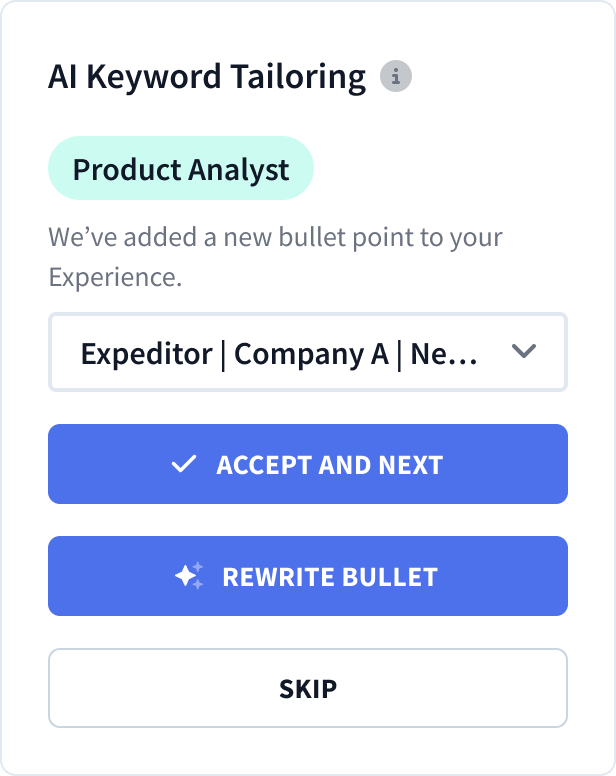
Automatic AI Resume Tailoring
Customize your resume with AI-guided precision.