How Long Should a Cover Letter Be? (Ideal Length and Word Count)
A cover letter should be 200 to 350 words, which fits on roughly half a page to one full page and runs three to four short paragraphs. One page is the firm ceiling for almost every applicant. The right length is the shortest version that still connects your experience to the specific role, so most strong letters land closer to 250 words than 400.
Key takeaway
- 200 to 350 words, three to four short paragraphs, one page maximum.
- Shorter usually wins, because the letter's job is to connect your experience to one specific role, not to restate the resume.
- Length scales a little with seniority, and academic letters genuinely run longer, but the one-page ceiling holds for nearly everyone.
How long should a cover letter be?
The honest answer is a range, and it's tighter than most people expect. For a standard job application, aim for 200 to 350 words across three to four short paragraphs, which works out to somewhere between half a page and one full page. One page is the ceiling. Not a soft suggestion you can stretch when you have a lot to say, but a real limit, because the person reading it is moving fast and a second page almost never gets read.
It helps to stop thinking in pages and start thinking in jobs. A cover letter has a small number of things to do: explain why you're applying for this specific role, surface the two or three pieces of your background that matter most for it, and give the reader a reason to turn to your resume already interested. Everything past that is padding, and padding is what pushes a letter onto a second page.
The length you actually want depends a little on the situation. Here's how it breaks down.
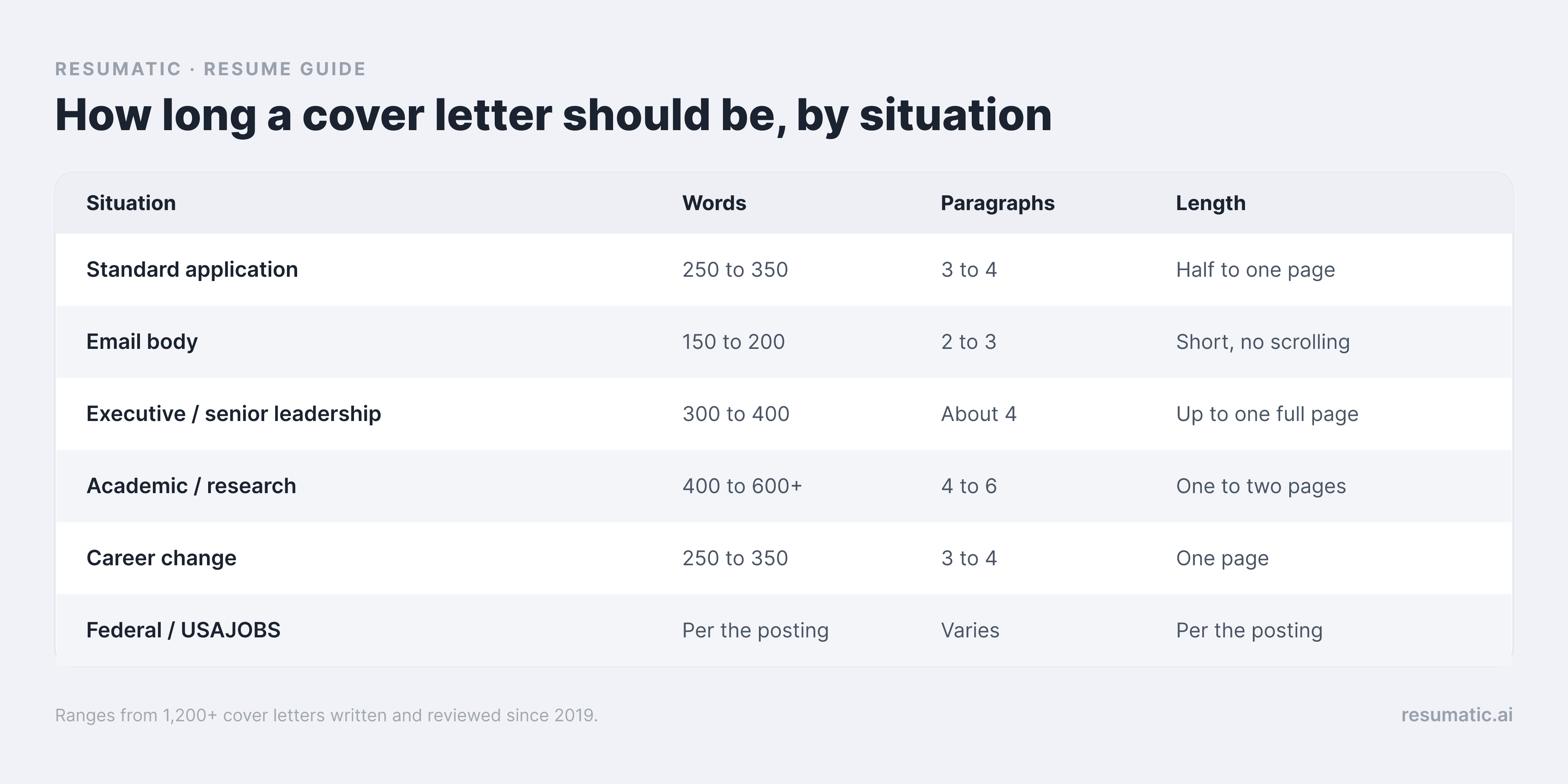
- Standard application (most roles): 250 to 350 words, three to four short paragraphs, half a page to one full page.
- Email body (pasted into the email): 150 to 200 words, two to three short paragraphs, short enough to read without scrolling.
- Executive or senior leadership: 300 to 400 words, about four paragraphs, up to one full page.
- Academic or research: 400 to 600 or more words, four to six paragraphs, one to two pages depending on the field.
- Career change: 250 to 350 words, three to four paragraphs, one page.
- Federal or USAJOBS: follow whatever length the posting specifies.
How many words and paragraphs should a cover letter be?
For most applications, 250 to 350 words and three to four paragraphs is the target, and there's a clean structure that keeps you inside it without much effort.
The opening paragraph, usually 50 to 80 words, names the role and gives a specific reason you're applying to this company rather than a generic one. The middle, one or two paragraphs of roughly 80 to 120 words each, is where you put your strongest proof: the experience that maps most directly onto what the job needs. The closing paragraph, 40 to 60 words, points forward and makes the ask. If you want to get the how to end a cover letter part right, that closing is shorter than people think.
If you're pasting the letter into the body of an email instead of attaching it, cut harder. Email gets skimmed on phones, so 150 to 200 words and two or three short paragraphs is plenty. The word count matters less than the discipline behind it. When you cap yourself at 350 words, you're forced to choose what actually belongs, which is the entire point of the exercise.
What does a cover letter at the right length actually look like?
This is easier to show than to assert, so here's a real one, fully de-identified.
A scientist I'll call Dr. Maya Ellison was applying for a Chief Scientific Officer role, moving from a long academic career into a health-data company. Her first draft ran more than 1,100 words across two full pages. It was organized into five themed sections, each with its own heading, and it was genuinely impressive in the way an academic cover letter is impressive: thorough, careful, and exhausting to read. The tightened version came in at 327 words on a single page.
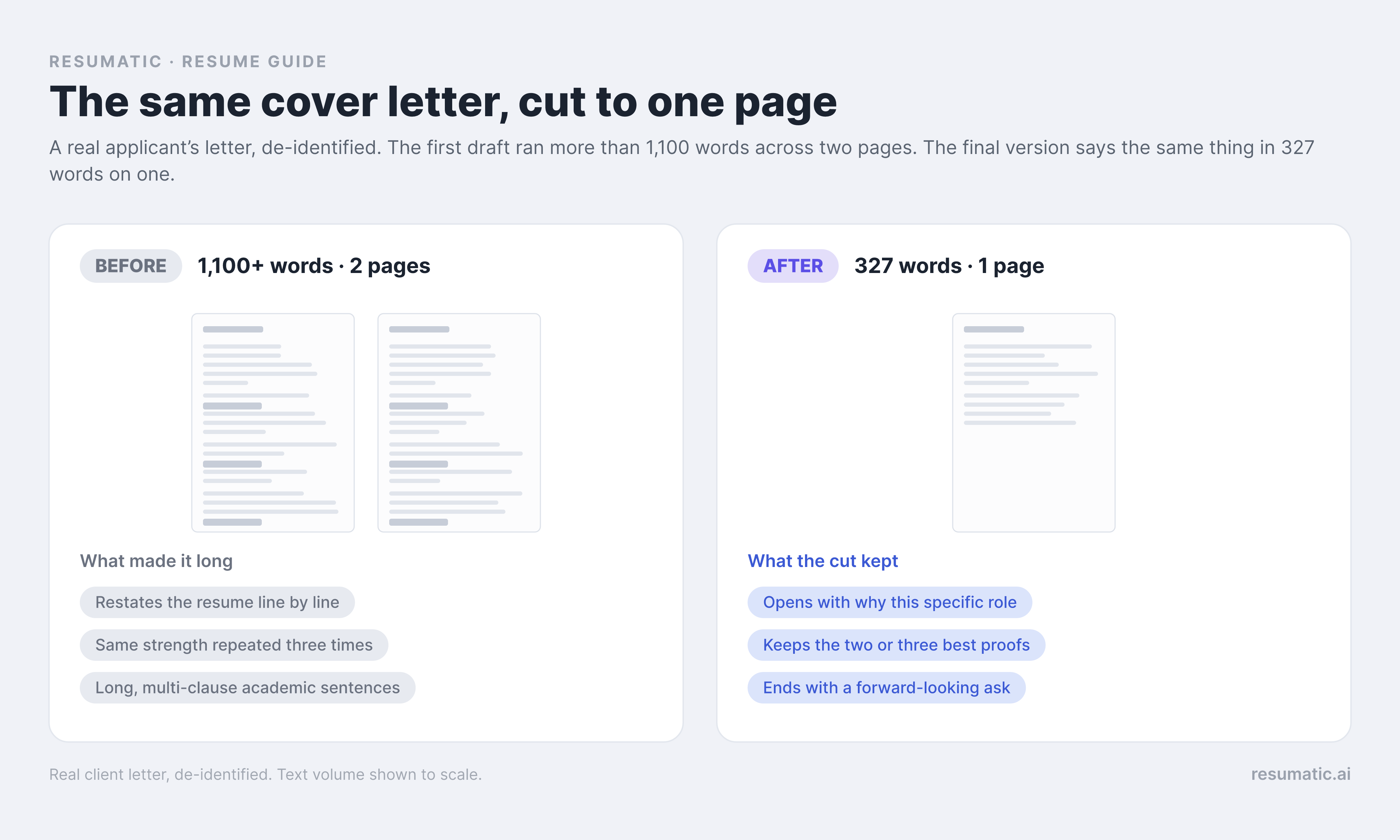
The long version did a lot of things the reader didn't need. It walked through her entire career arc, restated accomplishments that were already on her resume, and explained the same core strength (leading research through organizational change) in three separate places. The short version kept the through-line: why she wanted this specific role, the two or three credentials that mattered most for it, a tight list of the value she'd add, and a forward-looking close.
I want to be careful about what I'm claiming here. I can't tell you the shorter letter got her the job, and I'm not going to pretend that letter length is why anyone gets hired, because it isn't. What the before and after shows is narrower and more useful: when you cut a 1,100-word letter down to 327, nothing load-bearing has to go. The detail that felt essential at two pages turns out to be context the reader was never going to read.
What makes a cover letter too long, and what should you cut?
Across the 1,200-plus cover letters I've written and reviewed since 2019, the same handful of patterns are responsible for almost every overlong draft. If your letter is creeping past one page, it's probably doing at least three of these:
It restates the resume line by line, which is the most common one. The cover letter isn't a second resume; it's the argument for why the resume is relevant to this job. It opens with throat-clearing ("I am writing to apply for the position of..."), which the reader already knows from context. It explains your whole career instead of the part that matters for this role. It buries points inside long, multi-clause sentences, an academic habit that reads as dense rather than smart. And it repeats your strongest selling point in two or three different paragraphs, on the theory that saying it again makes it land harder. It doesn't.
What you keep is the opposite of all that: the connection between your background and this specific role, the two or three proofs that matter most, and a genuine reason you want this job and not just a job. In Dr. Ellison's case, the cut came from collapsing four of the five themed sections into the one argument the role actually turned on. If you want a fuller treatment of building the letter rather than trimming it, the guide on how to write a cover letter that gets read walks through the structure, and the annotated cover letter examples show the finished shape across different roles.
Does the right length change by seniority or industry?
A little, yes, though less than people hope. The ceiling moves, not the principle.
Executive and senior leadership letters can reasonably fill a full page, around 300 to 400 words, because there's more scope and strategy to justify and the reader expects a bit more substance. Academic and research letters are the real exception: they genuinely run one to two pages because the genre expects detail on publications, grants, and teaching that industry letters don't. That's exactly why Dr. Ellison's academic draft ran long. It was written to academic norms for an industry job, and the fix was to write to the new audience instead of the old one. Email-body letters go the other way, shorter and tighter, 150 to 200 words. Federal and USAJOBS applications are their own category, so follow whatever the posting specifies.
For everyone outside academia, the one-page ceiling holds. When in doubt, the shorter version is almost always the stronger one, and it's certainly the one more likely to get read all the way through.
Frequently asked questions
Q: How long should a cover letter be in 2026?
A: A cover letter should be 200 to 350 words, fitting on half a page to one full page, in three to four short paragraphs. One page is the maximum for nearly every applicant. The trend has moved toward shorter, more targeted letters, so when you're unsure, cut rather than add. The goal is the shortest version that still connects you to the role.
Q: How many words should a cover letter be?
A: For a standard application, 250 to 350 words is the target. If you're pasting the letter into the body of an email, drop to 150 to 200 words, since email gets skimmed quickly and often on a phone. Going much past 350 usually means you're restating your resume rather than making the case for why it's relevant.
Q: Can a cover letter be more than one page?
A: For almost all applications, no. A second page rarely gets read, and the discipline of one page forces you to keep only what matters. The main exception is academic and research roles, where a one-to-two-page letter is the norm because the field expects detail on publications, grants, and teaching. Outside academia, stay on one page.
Q: How many paragraphs should a cover letter be?
A: Three to four short paragraphs. An opening that names the role and gives a specific reason you're applying, one or two middle paragraphs carrying your strongest and most relevant proof, and a brief closing that points forward and makes the ask. More than four paragraphs usually signals the letter is drifting into a full retelling of your resume.
Q: Is a shorter cover letter better?
A: Usually, yes. A tight 250-word letter that connects your experience to the specific role beats a 600-word letter that restates your resume, because the reader is moving fast and looking for fit, not volume. Shorter isn't automatically better if it's vague, though. The aim is the shortest letter that still does the job, not the shortest letter possible.
About the author
Alex Khamis, CPRW, is the cofounder of Resumatic and the founder of Final Draft Resumes. He moderates r/resumes (1.2M+ members) and has personally written and reviewed more than 1,200 resumes and cover letters across executive, technical, and career-transition roles since 2019. LinkedIn
If you want a fast way to get a first draft inside the right length, Resumatic builds a clean, ATS-aware cover letter from your resume in a few minutes, and you can trim it to 250 to 350 words. Generate a cover letter free.
Automatic AI Resume Tailoring
Customize your resume with AI-guided precision.