How to End a Cover Letter (Closings That Get a Response)
End a cover letter with a two or three sentence closing paragraph that restates your interest, points to the specific value you would add, and asks directly for an interview. Then sign off with "Sincerely" or "Best regards" and your full name. Keep it confident and short, and make the last line about what you can do for the employer, not how grateful you are to be considered.
Key takeaway
- A strong closing does three things: restates interest, signals value, and asks for the interview.
- "Sincerely" and "Best regards" are the safest sign-offs. Save "Warm regards" for relationship-driven fields.
- Cut the over-thankful filler. The last line should point at the employer's need, not your gratitude.
How should you end a cover letter?
The closing paragraph has three jobs, and a good one does all of them in two or three sentences. It restates your interest in the role, it connects one of your strengths to what the employer actually needs, and it asks directly for a conversation. That is the whole job. The mistake most people make is treating the close as a place to be polite rather than a place to be useful, which is how you end up with three sentences of thank-you and no actual ask.
Here is the sequence that works for almost any application:
- Restate interest in one short clause, without repeating your opening line word for word.
- Point at the value you would add, ideally tied to something specific about the role or team.
- Ask for the interview in plain language, then stop.
Once the paragraph is right, the sign-off and your name finish the letter. If you want a refresher on what goes in the rest of your cover letter, the opening and body matter more than the close, but a weak ending undoes good work, because the last thing a reader sees is the thing they remember.
What does a strong closing actually look like?
These are real closings from cover letters in our annotated cover letter examples library, chosen to show how the same pattern holds across very different situations. Notice that every one of them points the value outward, at the employer, and asks for a conversation rather than waiting for one.
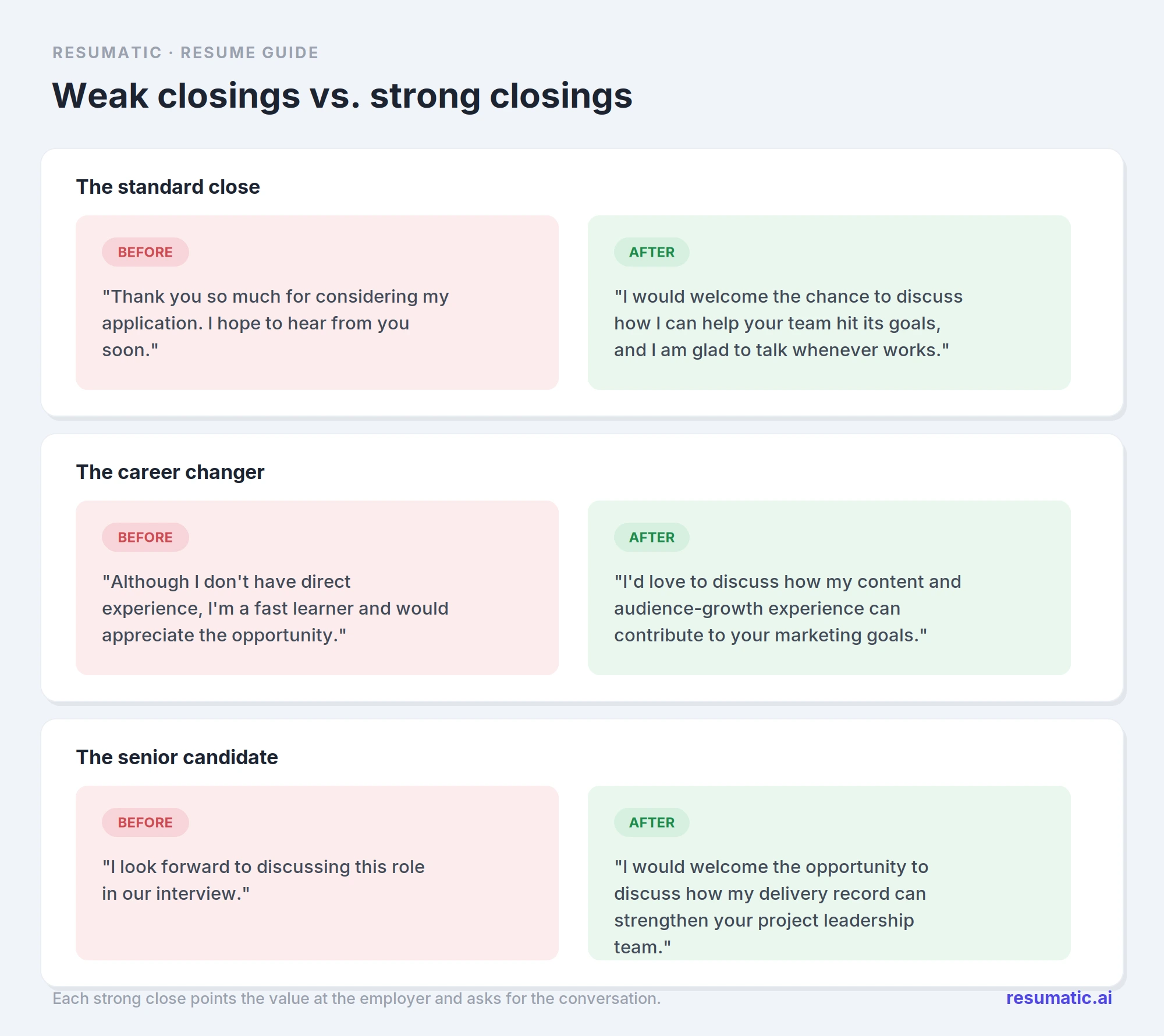
- The senior closing. A project manager with ten years of experience ends with "I would welcome the opportunity to discuss how my delivery track record and client management approach can strengthen your project leadership team." It names exactly what she brings and frames it as strengthening their team, not advancing her own career. The value faces outward.
- The career-change closing. A teacher moving into marketing closes with "I would love the opportunity to discuss how my experience creating engaging content for diverse audiences can contribute to GreenTech's marketing goals." He restates the transferable skill in the closing itself, reinforcing the bridge one final time before he signs off.
- The referral closing. An engineer who was referred ends with "I would appreciate the chance to discuss how my distributed systems experience can contribute to Orion's infrastructure goals." It stays specific to the team's real work, which keeps the insider context from the referral alive all the way to the last line.
- The employment-gap closing. After explaining a two-year gap earlier in the letter, the candidate keeps the close short: "I look forward to discussing how my experience can support your marketing goals. Thank you for your time." It is forward-looking and unapologetic, which is the right note to end on after addressing a gap.
- The specialty closing. A nurse signs off with "I would welcome the opportunity to discuss how my cardiac care experience and commitment to quality improvement can support your unit's goals," followed by "Sincerely, Rachel Moreno, RN, CCRN." The credentials in the signature reinforce fit at the last possible moment.
The common thread is worth saying plainly. None of these closings thank the reader and stop. Each one connects a specific strength to the employer's goal and then asks to talk. That is the pattern to copy.
Which sign-off should you use?
After the closing paragraph, you need a sign-off and your full name. Most people overthink this. A short list of options covers almost every situation, and the differences are about tone and field rather than right versus wrong.
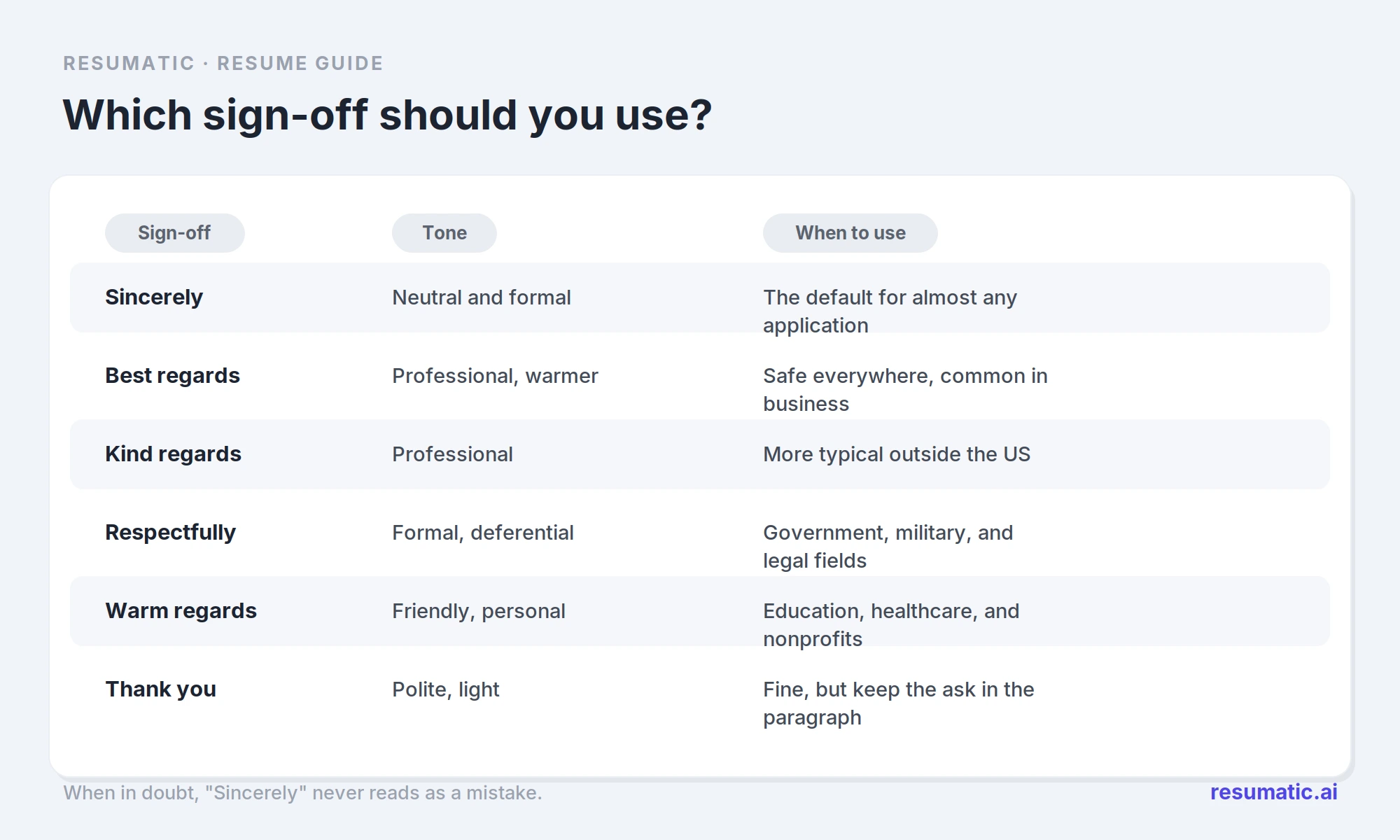
A teacher applying to a school can reasonably use "Warm regards" because the field runs on relationships. A candidate applying to a law firm or a federal agency is safer with "Sincerely" or "Respectfully." When in doubt, "Sincerely" never reads as a mistake. Skip "Cheers" for most US applications, and skip dated forms like "Yours faithfully" entirely.
What closings should you avoid?
This is where most cover letters quietly lose. The patterns below show up constantly in the resumes and letters I read, both in my own practice and across r/resumes, and they all share the same flaw: they spend the most valuable real estate in the letter on something other than the ask.
- The over-thankful close. Leading the closing with "Thank you so much for taking the time to consider my application, I truly appreciate it." One line of thanks is fine. Building the whole close around gratitude puts the focus on you being grateful instead of on what you offer.
- The passive wait. "I hope to hear from you." It cedes control and asks for nothing. Replace it with a direct request for a conversation.
- The presumptuous close. "I look forward to discussing this in our interview." Assuming the interview can read as arrogant. Ask for it, do not schedule it on their behalf.
- The apology. "Although I may not have every qualification listed." Never end on a weakness. The close is the last thing the reader carries into their decision.
- The resume recap. Summarizing your whole background one more time. The closing is for the ask, not a second highlight reel.
- The generic enthusiasm. "I would be a great fit for this role." It says nothing specific. Name the value you would add or cut the sentence.
- The contact-info substitute. Listing your phone and email in place of an actual closing sentence. Include your details, but do not let them replace the paragraph.
- No close at all. Ending on the body paragraph and jumping straight to the sign-off. The reader needs one clear, confident final beat before your name.
How do you end a cover letter when you have no name or no contact details?
The sign-off does not change when you could not find a hiring manager's name. If you addressed the letter to a team rather than a person, you still close with a confident final paragraph and a standard sign-off like "Sincerely" followed by your full name. The greeting is where the missing name is handled, not the close.
For an email cover letter, the structure is the same, with one addition. After your name, include a short signature block with your phone number and email so the reader can act without hunting for your details. If you are pasting the letter into an online application field rather than attaching it, keep the sign-off and name, since dropping them makes the letter feel unfinished even inside a form.
Frequently asked questions
Q: How do you end a cover letter?
A: End with a short closing paragraph of two or three sentences that restates your interest, connects your strengths to the employer's needs, and asks directly for an interview. Then add a sign-off such as "Sincerely" or "Best regards" and your full name. Keep the focus on what you can contribute rather than on thanking the reader.
Q: What is the best sign-off for a cover letter?
A: "Sincerely" and "Best regards" are the safest and work in almost any industry. "Respectfully" suits traditional fields like law and government, while "Warm regards" fits relationship-driven work like education and healthcare. Avoid casual sign-offs like "Cheers" and dated ones like "Yours faithfully" for most US applications.
Q: Should you say thank you at the end of a cover letter?
A: A brief thank-you is fine, but it should not be the centerpiece of your closing. One short line is enough. Spend the rest of the closing pointing at the value you would add and asking for an interview, since that is what actually moves the application forward and leaves the stronger impression.
Q: How long should the closing paragraph be?
A: Two to three sentences. The closing is not the place to summarize your resume again. It restates interest, signals value, and requests a conversation, then stops. A long closing dilutes the ask and tends to push the letter past the one-page length most hiring managers expect.
Q: How do you end a cover letter without a contact name?
A: The sign-off stays the same. Even if you addressed the letter to a team because you could not find a specific name, you still close with a confident final paragraph and a standard sign-off like "Sincerely" followed by your full name. Add your phone number and email below your name so the reader can reach you easily.
About the author
Alex Khamis, CPRW, is the cofounder of Resumatic and the founder of Final Draft Resumes. He moderates r/resumes (1.2M+ members) and has spent over a decade studying what recruiters and applicant tracking systems actually do with the documents job seekers send. LinkedIn
If the rest of your letter is solid, the closing is the easy part. If you want a tailored draft to start from, Resumatic builds a cover letter from your resume in a few minutes, and you can adjust the closing to sound like you. Generate a cover letter free.
Automatic AI Resume Tailoring
Customize your resume with AI-guided precision.