How to Write a Cover Letter for Internship That Gets Read
I've been a resume writer for years, and if it's one thing I've learned that drives people to the brink of insanity more than a resume, it's writing a cover letter. Most people just find it awkward to talk about themselves, and a cover letter exacerbates this insecurity because it's a medium where your personality is allowed to come through.
A strong internship cover letter is one page, about 250 to 400 words, and usually lands in 3 to 4 concise paragraphs with a header, greeting, role-specific introduction, one body paragraph proving fit with a concrete example, and a short close. It works because recruiters scan fast, and the letter's job is to add context the resume can't, not to retell your entire story.
TLDR
- Keep it to one page and roughly 250 to 400 words.
- Use 3 to 4 short paragraphs: opener, proof of fit, and a direct close.
- Name the exact role and company in the first paragraph.
- Match one specific project, class, job, or club example to the posting.
- Do not repeat your resume line by line, add context instead.
- End with a polite ask for the next step.
- Use simple formatting that is easy for recruiters and ATS to scan.
What an Internship Cover Letter Has to Actually Do
In my experience, a cover letter for internship is more likely to get read when it does four things quickly: names the exact role and company, shows you understood the posting, gives one concrete piece of evidence that you can do the work, and asks for the next step. That's really it. The best versions stay within the one-page, 250 to 400 word range because that leaves the resume room to do its own job, while a longer letter often signals that the applicant didn't edit. This guidance comes from patterns I've seen over an 8-year career as a resume writer, including work with students and early-career applicants, and it lines up with practical guidance from Coursera's internship cover letter guide and Societe Generale's length guidance.

What the recruiter scan is really looking for
In my experience, most recruiters are not looking for literary flair. They're looking for a fast answer to a simple question, does this person understand the role and have any proof they can contribute? If the first paragraph doesn't name the internship and the company, the second doesn't connect your background to the posting, and the close doesn't invite a next step, the letter has usually missed the assignment. Not every employer weighs cover letters the same way, but when one is reviewed, these are the signals that tend to matter most on an initial scan.
Practical rule: if a sentence doesn't help the reader place you in the role, remove it.
The cover letter also isn't a second resume. It adds context, especially for students and recent graduates who may not have years of work history but do have coursework, projects, tools, and measurable achievements that can map to the internship. That separation matters, and if you're unclear on it, the distinction is worth reviewing in this cover letter versus resume comparison.
How to Write Each Paragraph From Top to Bottom
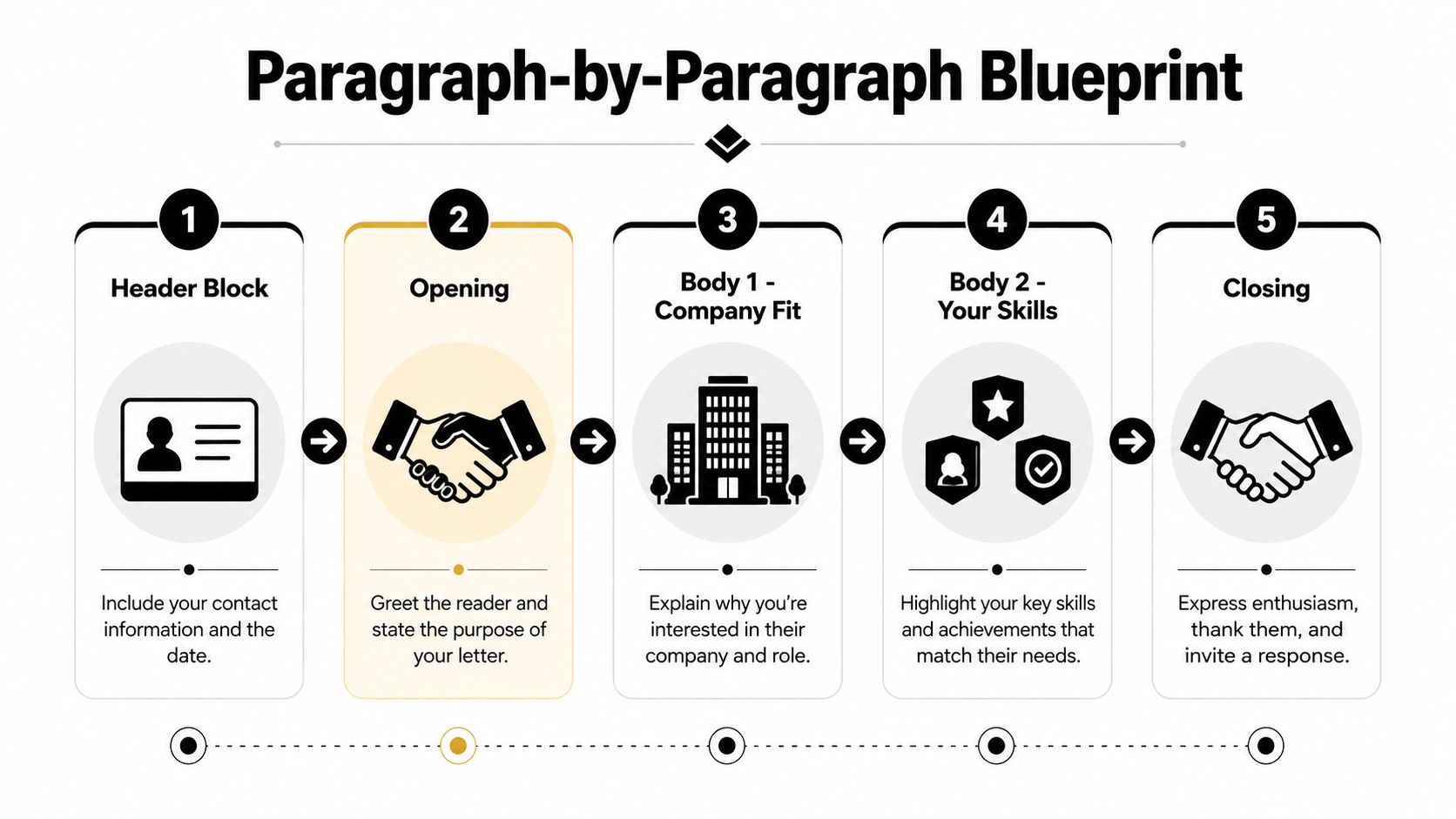
The cleanest internship cover letter usually follows the same order every time, because that order mirrors how a human reader searches for fit. Start with your contact block, then a greeting, then a short opener that names the role and why you're relevant, then one body paragraph with a concrete example, then a brief close that asks for the interview.
The header and greeting
Put your name, email, phone number, city, and date at the top, then add the hiring manager's name if you can find it. Dear Hiring Manager is acceptable when you can't identify a person, but Dear Ms. Park or Dear Jordan Lee is better because it shows you did the work. Avoid anything sloppy or overly casual, because the first line already tells a reader whether you're attentive.
The opener
Your opening sentence has one job, to make the letter obviously about that internship. Name the exact role, say where you found it, and include one reason the company or position fits your background. A weak opener talks about wanting experience in general, while a strong opener ties your background to a specific need in the posting.
Weak: “My name is Alex, and I am applying for your internship because I want to gain experience.”
Strong: “I'm applying for the marketing internship at BrightWave because your focus on sustainability aligns with a campus campaign I helped build for a local eco-friendly brand.”
The body and close
Your body paragraph should answer the question behind every internship posting, why should we interview you? Use one example that matches the posting's highest-priority need, then close by thanking the reader and asking for an interview or next step. If you want a model for the ending specifically, this guide to closing a cover letter gives a useful reference point.
What to Write When You Have Almost No Real Experience
I've found that students often think they need a real internship or full-time job before they can write a credible cover letter. They don't. The better question is whether you can turn a class project, a campus role, or a part-time job into evidence that matches the posting without trying to make it sound fancier than it was.

How to translate weak signals into real proof
A class project becomes useful when you name the tool, method, or outcome. A retail job becomes relevant when you frame it as customer communication, problem solving, or handling pressure. A club role matters when it shows initiative, coordination, or ownership, not just attendance.
The mistake is inflating these experiences into fake equivalencies. If you ran a student event, say that you coordinated volunteers, managed deadlines, or handled promotion, but don't pretend you led a corporate campaign. If the internship is technical, pull the most relevant bullets from your coursework portfolio or GitHub work, then choose the one that most closely mirrors the posting.
When it's honest to say you're early
Sometimes the strongest move is to acknowledge that you're still building the skill set, then pivot immediately to what you've already done with care and consistency. That kind of language reads as mature when it's paired with specific evidence, and it reads as weak when it's left hanging without proof. The reader doesn't need you to sound finished, they need you to sound usable.
If you want a set of examples aimed at early-career applicants, these entry-level cover letter examples are helpful because they show how the same evidence can be framed more than one way.
Sample Paragraphs for Tech, Data, and Business Internships
The fastest way to make a cover letter feel real is to anchor it in the language of the field. A software engineering internship expects different proof than a data analyst internship, and both are different again from a business or consulting role, even when the underlying structure of the paragraph stays the same.
FieldStrongest Proof PointWhere to Find ItSoftware EngineeringA project that shows code, testing, collaboration, or deploymentClass repo, hackathon, GitHub, capstoneData AnalystAn analysis that shows cleaning, visualization, or interpretationKaggle notebook, class project, research assignmentBusiness or ConsultingA case, recommendation, or presentation that shows structured thinkingCase competition, club project, internship presentation
Side by side sample body paragraphs
For software engineering, one version of this that I've seen work well sounds like this in practice: “In my software engineering coursework, I built a scheduling app in a three-person team, handled the backend logic in Python, and debugged the login flow until it worked reliably across test cases. That experience taught me how to read requirements carefully, collaborate under deadlines, and turn a rough idea into something usable, which is why I'm excited about this internship.”
For data, the same logic shifts to analysis. A pattern I've seen work is: “In a data analysis project for class, I cleaned a messy dataset in Excel and Python, built visualizations that made the pattern easier to explain, and presented the findings to my professor with a recommendation tied to the business question. I'd bring that same habit of turning raw information into a clear argument to this internship.”
For business or consulting, the paragraph should sound more recommendation-driven. One approach I've seen land well is: “During a case competition, I worked with a team to evaluate a retail expansion problem, compared three options, and presented a recommendation that balanced cost, customer demand, and execution risk. That experience sharpened how I structure decisions, and it maps closely to the kind of work this internship requires.”
If you need more field-matched examples, these internship cover letter examples are a useful pattern library.
Common Mistakes That Get an Application Archived
Most internship cover letters don't underperform because the applicant is unqualified. They underperform because the letter makes the reader do extra work, and most hiring managers will not do that on a short scan. If the page looks generic, careless, or repetitive, it is more likely to get archived quickly.
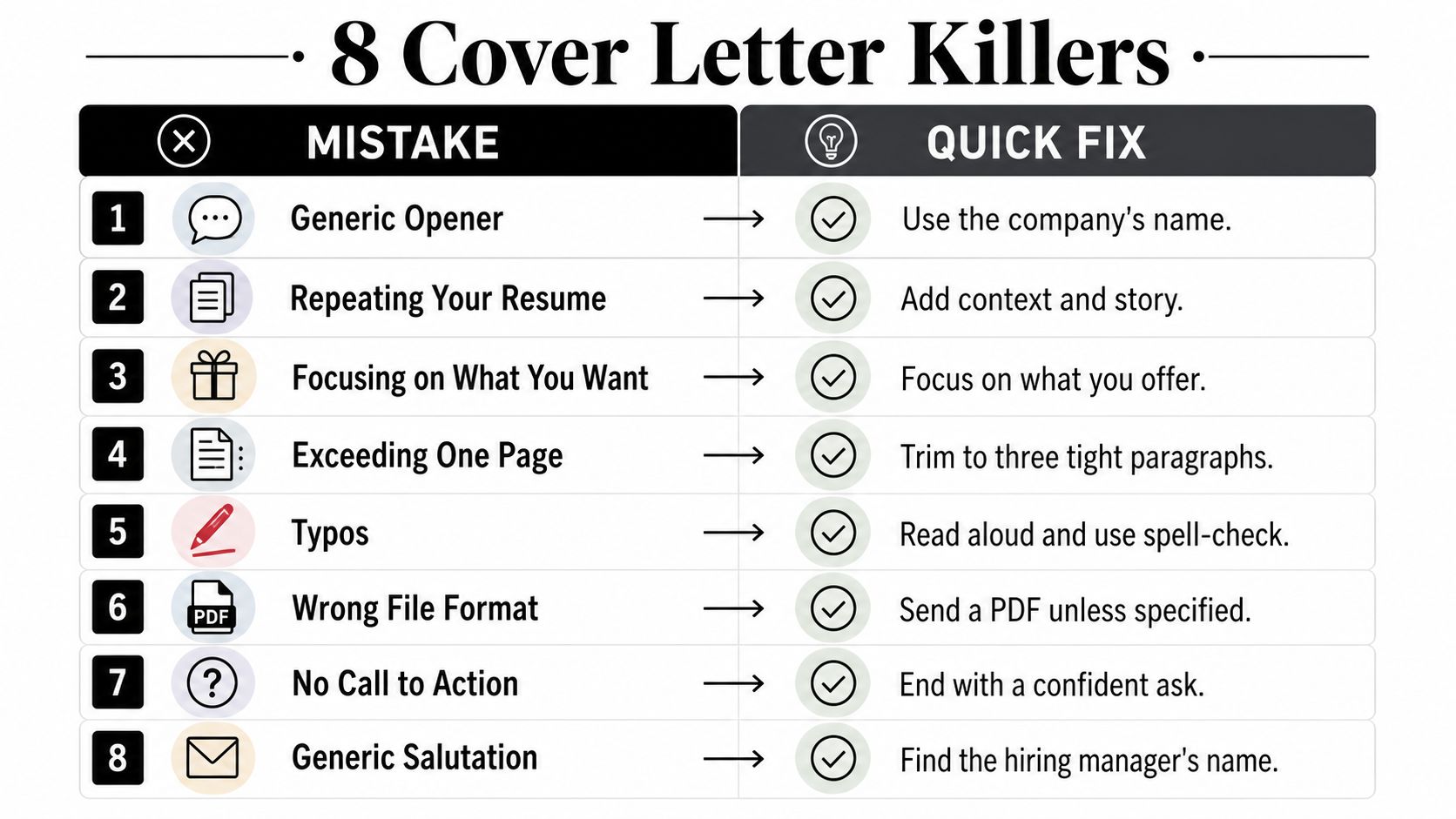
The eight mistakes I see most often
- Generic opener. Name the company and role in the first sentence.
- Repeating your resume. Add context, motivation, and one connecting detail.
- Focusing on what you want. Explain what you offer first.
- Going past one page. Trim to the evidence that matches the posting.
- Typos and awkward phrasing. Read it aloud and use spell-check.
- Wrong company or wrong name. Verify every proper noun before sending.
- Skill dumping without proof. Pair each skill with an example.
- Weak close. End with a direct, polite ask for next steps.
Honest limit: a cover letter can't rescue a weak resume. If the resume is thin, unfocused, or full of unrelated material, fix that first, because the letter only adds persuasion after the basics are in place.
The file name matters too. “coverletter_final_v3.pdf” tells the reader you're recycling drafts. A clean file name and a clean salutation don't win the internship on their own, but they keep avoidable mistakes from undermining a decent application.
How Should You Handle Formatting, ATS Rules, and AI Help?
A good cover letter for internship should be simple to parse, which means a single-column layout, standard fonts, no text boxes, and a clean PDF unless the posting asks for another format. Applicant tracking systems mostly look for practical text signals like job titles, skills, and degree names, while decorative formatting rarely helps and can sometimes get in the way. If you want a drafting tool, browse AI cover letter tools can speed up the first pass, but every line still needs human checking against the job description.
Use tools, but don't outsource judgment
An AI builder can help when you already know what you want to say and just need a cleaner draft. It tends to fail when you ask it to replace your choices, because then you get generic filler that sounds polished but doesn't map to the posting. Resumatic's cover letter generator fits that drafting workflow, but it still needs you to supply the role, the company, and the proof points that belong in the letter.
The file name should be plain and professional, something like FirstLast_Internship_CoverLetter.pdf. That keeps the document easy to identify and avoids the cluttered naming habits that make application folders harder to manage.
Internship Cover Letter Questions Students Actually Ask
If the posting doesn't mention a cover letter, should I still send one? Yes, unless the application system blocks it or the employer explicitly says not to. A well-matched letter still gives you room to explain fit, especially for internship roles where experience is limited and motivation matters.
What if the hiring manager's name isn't listed? Use Dear Hiring Manager or the team name if it's obvious from the posting. If you can find a real name through the company site or LinkedIn, that's better, but a clean generic salutation is far safer than guessing wrong.
Can I reuse one strong letter for similar roles? You can reuse the structure, but not the specifics. The company name, role title, and proof points should change every time, because a letter that looks recycled loses the point of writing one in the first place. For students keeping drafts organized, PDFWix student tools can help manage versions without turning the process into a mess.
What if the internship is unpaid or comes through a personal contact? Treat it the same way as any other application, with the same focus on fit, evidence, and professionalism. The compensation or referral source changes the logistics, but it doesn't change the reader's question, which is whether you can contribute and communicate clearly.
About the author
Alex Khamis, CPRW, is the cofounder of Resumatic and the founder of Final Draft Resumes. He moderates r/resumes (1.2M+ members) and has personally written resumes and cover letters for over 1,200 professionals across executive, technical, and career-transition roles since 2019. LinkedIn
If you want to put these principles to work, Resumatic is free to start, and it will help you draft a targeted cover letter alongside your resume in about the time it takes to read one posting closely.
Automatic AI Resume Tailoring
Customize your resume with AI-guided precision.