Cover Letter vs Resume: What Each One Is Actually For
A resume and a cover letter do two different jobs in the same application. Your resume is the structured record of what you've done, your roles, dates, skills, and measurable results, scannable in seconds. Your cover letter is the short narrative that explains the parts the resume can't: why you're making this move, and what your experience adds up to. One is the system of record. The other is the argument.
Key Takeaway
- A resume is the structured record of what you've done; a cover letter is the short narrative explaining why you're making this move and what it adds up to.
- The most common mistake is repeating the resume in paragraph form. A good cover letter explains the judgment behind your results, it doesn't restate them.
- Plenty of recruiters skip cover letters at high-volume funnels, but they carry the most weight for career changes, senior roles, and anything on your resume that needs explaining.
What is the difference between a resume and a cover letter?
The short version is that a resume tells a reader what you've done and a cover letter tells them why it matters here. The resume is a reference document, built to be skimmed in a few seconds and parsed by an applicant tracking system before a human ever sees it. The cover letter is a piece of writing addressed to a person, and its job is to connect the dots the resume leaves unconnected.
Here's how the two compare across the dimensions that actually matter when you're deciding what goes where.
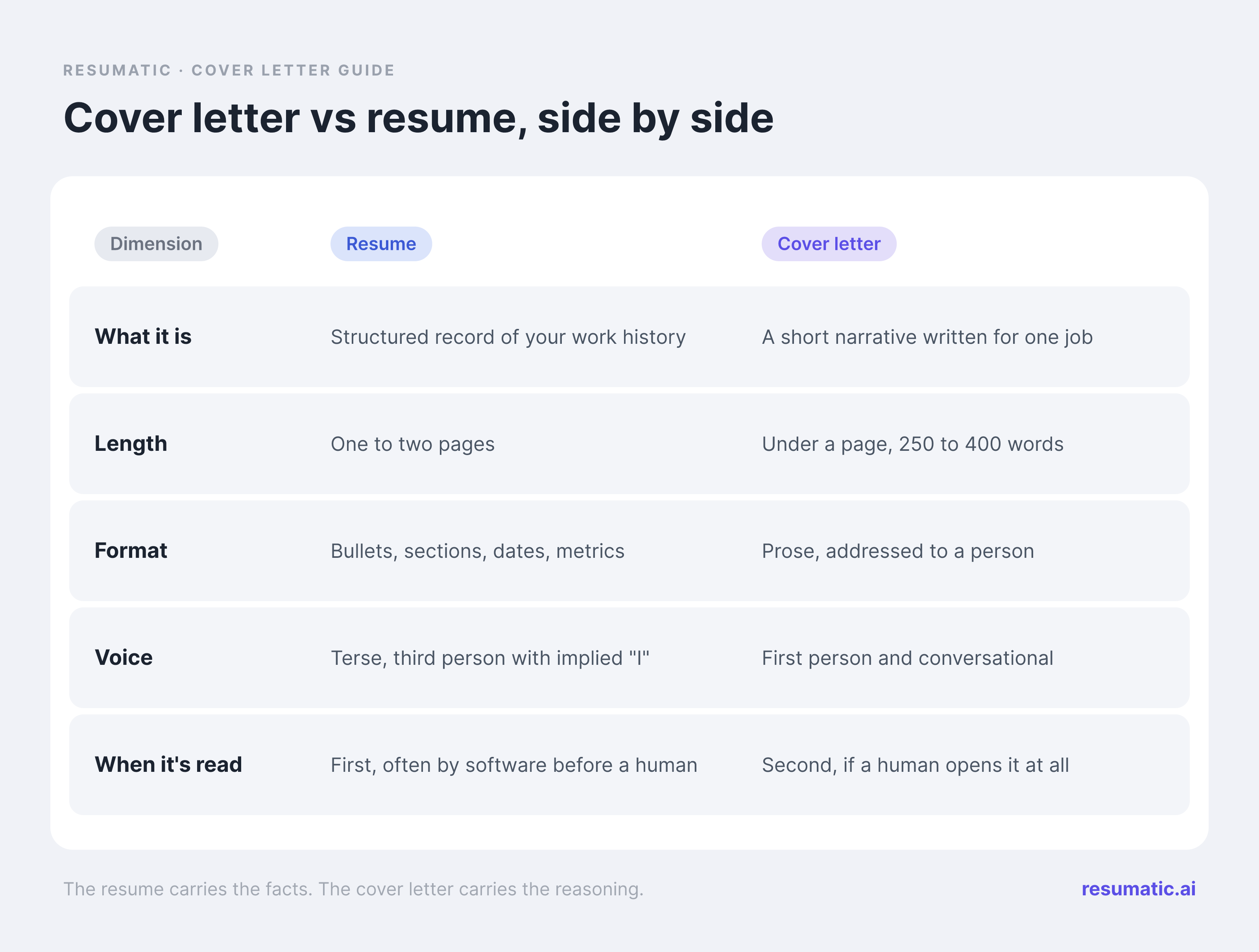
If you take one thing from the table, take the last row. The resume is almost always read first and does the heavy lifting. The cover letter is read second, by a smaller number of people, which is exactly why it can't just say the resume again in full sentences.
What can a cover letter say that a resume can't?
This is where the difference stops being abstract. The clearest way to see it is to take a single accomplishment and watch how it changes shape between the two documents.
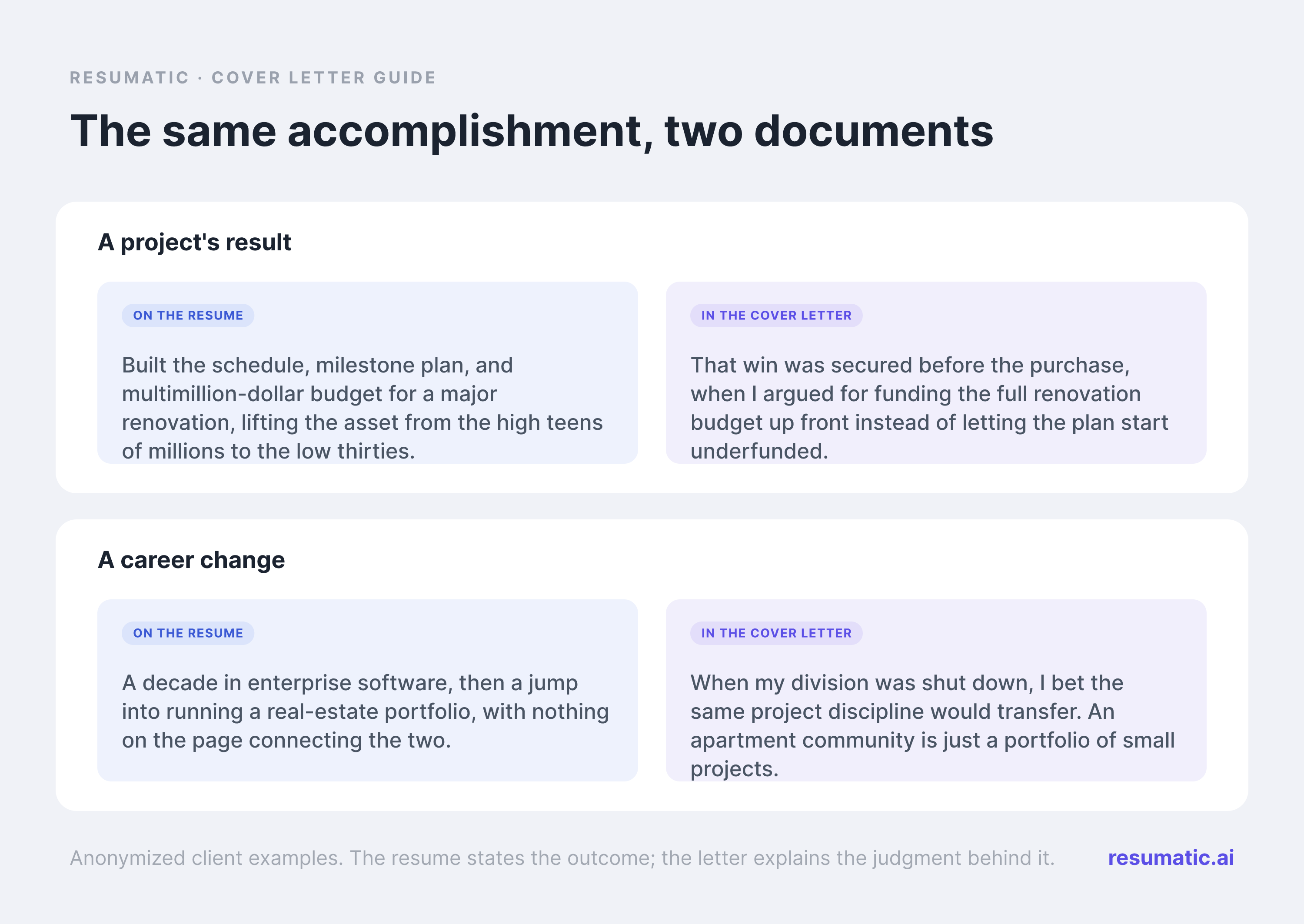
Consider a senior project manager who spent about a decade running enterprise software projects, then co-built a multifamily real-estate firm and ran its capital-improvement program. One of his strongest results was a large apartment renovation that lifted the property's value from the high teens of millions to the low thirties.
On the resume, that result is a single bullet. It names the project, the schedule and milestone plan he built, the multimillion-dollar budget he owned, and the jump in value. It's complete, it's quantified, and it tells you the outcome in one line. What it cannot tell you is how he pulled it off.
The cover letter takes the same project and does something the bullet has no room for. It doesn't restate the number. It explains the decision behind it: the win, he writes, was secured before the building was even purchased, when he argued for funding the full renovation budget up front rather than letting the plan start underfunded and stall halfway through. Same project, completely different job. The resume reports the outcome. The letter shows the judgment that produced it, which is the thing a hiring manager is actually trying to assess.
The same candidate shows why a cover letter exists at all. His resume reads as a decade of software project management followed by an abrupt jump into real estate, with nothing connecting the two. The letter supplies the missing reason. Shortly after he'd closed his first property deal as a side project, his employer shut down the consulting division he worked in, and instead of chasing another software PM role he bet that the discipline would carry over, on the logic that an apartment community is really just a portfolio of small projects, each one needing a scope, a schedule, and a budget someone owns. No resume format can say that. It's context, and context is the cover letter's entire reason for being.
A second example shows the other thing a cover letter does, which is state the throughline. Take a technical program manager whose career moved from image science into large government systems programs and then into commercial AI. Her resume documents each of those roles in reverse-chronological order, role by role, bullet by bullet, and it's thorough. But it never says out loud what the arc adds up to. A reader has to infer the pattern across five jobs.
Her cover letter just tells you. It compresses two separate resume bullets, building a new regional market from zero and sourcing a major share of the company's annual revenue, into one headline sentence, and then it names the throughline directly: a consistent record of taking on first-of-their-kind problems where no playbook exists. The resume is the system of record, complete and scannable. The letter is the highlight reel and the connective tissue, the part that says "here's what all of this means."
That's the division of labor. The resume holds everything. The cover letter picks the two or three things that matter most for this specific job and explains the reasoning, the context, or the arc that the resume can only imply. If you want to see how that plays out across complete documents, these annotated cover letter examples break real letters down section by section.
Do recruiters actually read cover letters in 2026?
Honestly, a lot of them don't, and you should plan around that rather than pretend otherwise. At high-volume companies where a single posting draws hundreds of applicants, the first pass is the resume and the ATS, and many recruiters never open the letter unless the resume has already earned a closer look. If you spend three hours crafting a letter for a role that gets 600 applicants, most of that effort is invisible.
That's not the whole story, though. Hiring managers at smaller companies read them. Recruiters read them when something on the resume raises a question. And for senior roles, career changes, and any application where you're not an obvious on-paper fit, the letter is often what tips a "maybe" into an interview. You can see the split play out in public: search this exact question and you'll find recruiters who swear they never read cover letters sitting right next to hiring managers who say a good one is the deciding factor.
The practical takeaway is that the letter's leverage is highest precisely when your resume leaves a question open. A clean, linear career with an obvious fit needs the letter least. A pivot, a gap, a relocation, or a jump in seniority needs it most. Write the letter for the reader who will actually read it, the one with a question, and make it answer that question fast. That front-loading is the core idea behind how to write a cover letter that gets read.
When do you need a cover letter, and when can you skip it?
Default to including one when there's a slot for it and you have twenty focused minutes, because a specific, well-aimed letter rarely hurts and occasionally decides the outcome. Beyond that default, here's the clearer breakdown.
Write one when:
- The application asks for it. Skipping a requested cover letter reads as either careless or low-interest, and it's an easy reason to cut you.
- You're changing careers or industries. The letter is where you explain why the move makes sense and how your experience transfers, which a resume can only hint at.
- Something on your resume needs explaining. An employment gap, a relocation, a step down in title, or a short stint all benefit from one or two honest sentences of context.
- You're applying for a senior or leadership role. At that level, judgment and communication are part of what's being evaluated, and the letter is direct evidence of both.
- You're applying to a smaller company or directly to a hiring manager. Smaller teams are far more likely to read it, and a warm, specific letter lands harder when a person rather than a portal is on the other end.
You can usually skip it when the application has no field for one and runs through a high-volume portal where it would never be seen, or when the posting explicitly says not to send one. Even then, if you have a referral or a specific reason you want this job, a short note to the hiring manager can do what a portal upload can't.
How should your resume and cover letter work together?
The biggest failure mode is writing a cover letter that's just the resume in paragraph form. If your letter walks through your job history in order, restating bullets as sentences, it adds nothing, and the reader who bothered to open it learns that you had nothing more to say.
The fix is to treat the two documents as one coordinated pair with different assignments. Pick two or three threads from the resume, ideally the ones most relevant to this specific role, and use the letter to explain the context, the reasoning, or the result behind them, the way the project manager above explained the decision behind his renovation rather than repeating the dollar figure. Mirror the important keywords from the posting in both documents so the ATS and the human see consistency, but never copy a bullet verbatim into the letter. And make sure the positioning lines up: the headline on your resume and the first paragraph of your letter should sound like the same person making the same case, not two drafts that disagree about who you are. The same care applies to the close, where a strong ending reinforces that positioning rather than trailing off, which is its own small craft covered in how to end a cover letter.
Done well, the resume answers "what has this person done" and the cover letter answers "why them, why this, why now." Those are different questions, and a strong application answers both.
Frequently asked questions
Q: Is a cover letter the same as a resume?
A: No. A resume is a structured, scannable record of your roles, dates, skills, and measurable results, usually one to two pages. A cover letter is a short piece of prose, under a page, addressed to a person, that explains why you're applying and what your experience adds up to. They serve different purposes and shouldn't duplicate each other.
Q: Should a cover letter repeat what's on the resume?
A: No, and this is the most common mistake. The letter should add context the resume can't carry: the reasoning behind a result, the story behind a career change, or the throughline connecting your roles. Restating bullets as full sentences wastes the one chance you have to say something the resume already couldn't.
Q: Do I need a cover letter if the application doesn't ask for one?
A: It depends. If there's an optional slot and you can write something specific in twenty minutes, include it, especially for senior roles, career changes, or smaller companies. You can skip it for high-volume portals with no upload field, or when the posting says not to send one. When in doubt, a short, targeted letter rarely hurts.
Q: Which comes first, the cover letter or the resume?
A: If you're combining both into one file, the cover letter goes first and the resume follows. In terms of what gets read, the order flips: the resume is almost always read first, often by an ATS, and the cover letter is read second, if at all, once the resume has earned a closer look.
Q: How long should a cover letter be compared to a resume
?A: A resume runs one to two pages. A cover letter should stay under a single page, roughly 250 to 400 words across three or four short paragraphs. If your letter is creeping toward a full page of dense text, it's almost certainly restating the resume instead of adding to it. Shorter and sharper beats longer and thorough here.
About the author
Alex Khamis, CPRW, is the cofounder of Resumatic and the founder of Final Draft Resumes. He moderates r/resumes (1.2M+ members) and has spent close to two decades in career communications, writing more than 1,200 resumes across executive, technical, and career-transition roles. LinkedIn
If you'd rather not build both documents from a blank page, Resumatic drafts your resume and a matching cover letter from the same set of inputs, so the two line up instead of contradicting each other. It's free to start, and most people have a first draft of both in about twenty minutes.
Automatic AI Resume Tailoring
Customize your resume with AI-guided precision.