How to Write Accomplishments on a Resume That Stand Out
You’re probably staring at a resume full of bullets that describe what your job was, not what you got done. That’s the normal starting point. The fix is to stop writing from your job description and start writing from projects, problems, and outcomes.
If you want to know how to write accomplishments on a resume, use a repeatable process. First, find the work that mattered. Then turn it into short bullets that show action, context, and result. If you have numbers, use them. If you don’t, show scope and effect clearly.
Table of Contents
- Start with projects not responsibilities
- Look for numbers in the places you forgot to check
- Match your wins to the target role
- Use stronger verbs before you rewrite
- Junior and entry-level examples
- Mid-level examples
- Senior-level examples
Use a Formula to Write About Impact
Responsibilities aren’t accomplishments. “Managed calendars,” “supported marketing campaigns,” and “handled customer issues” tell a recruiter what the role required. They don’t show whether you did the work well, improved anything, or solved a meaningful problem.
Use a formula so every bullet proves impact instead of listing tasks. Yale’s Office of Career Strategy recommends the Action + Project + Result (APR) structure: action verb, project solved, quantified result. Their example is: “Led cross-functional team to redesign inventory system, reducing stock discrepancies by 40% and saving $75,000 annually” in Yale’s guide to writing impactful resume bullets.

Separate duties from accomplishments
Start with this test:
- Duty: what you were expected to do repeatedly
- Accomplishment: what changed because you did it
A weak bullet stays at the duty level:
Managed onboarding for new hires.
A stronger bullet shows the work and the outcome:
Redesigned new-hire onboarding materials and scheduling process, shortening ramp-up time and reducing confusion for managers and new employees.
That second version is better even without a number. It names a specific project and shows a result.
Practical rule: If the bullet could apply to thousands of people with the same job title, it’s probably a duty, not an accomplishment.
Build each bullet with APR
Use this fill-in pattern:
- Action. Start with a verb that shows ownership. Use verbs like led, built, launched, redesigned, analyzed, negotiated, trained, optimized, resolved.
- Project. Name the initiative, problem, workflow, system, or responsibility you improved.
- Result. End with the effect. Use a metric if you have one. If not, state the operational or business outcome clearly.
Here’s a simple rewrite:
Before:Responsible for social media content.After:Created and scheduled social media campaigns for product launches, increasing consistency across channels and supporting demand generation efforts.And one with a quantified outcome:
Before:Worked on inventory process improvements.After:Redesigned inventory tracking workflow, reducing stock discrepancies by 40% and saving $75,000 annually.Keep bullets tight. One idea per bullet. One clear result. Don’t stuff three projects into one line.
If your full resume still reads like a duty list, fix the bullet structure first, then fix the rest. This is the same underlying shift behind a stronger resume that gets you hired.
Find and Quantify Your Achievements
Individuals often believe they don’t have accomplishments. Usually they do. They just haven’t gone looking for them properly.
The fastest way to find good resume bullets is to work backward from real projects, recurring problems, and visible changes. An analysis of over 125,000 resumes found that only 26% included five or more measurable metrics, while 36% contained no metrics at all, according to Cultivated Culture’s resume statistics roundup. That gap matters because resumes without specific numbers are less memorable.

Start with projects not responsibilities
Don’t begin with “What were my duties?” Begin with “What happened in this job that would not have happened the same way without me?”
Open a document and list each role. Under each one, answer these prompts:
- Problems you fixed: errors, delays, complaints, confusion, handoff issues, missed deadlines
- Things you improved: speed, quality, accuracy, consistency, customer experience, documentation
- Things you built: dashboards, playbooks, workflows, reports, campaigns, training, templates
- Goals you hit: launches completed, deadlines met, accounts retained, initiatives delivered
- Recognition you earned: promotions, stretch assignments, repeat trust from managers, high-visibility work
This produces raw material. Don’t worry about wording yet.
Try this quick capture format:
Project:What was broken or needed?What did I do?What changed after?What evidence do I have?Look for numbers in the places you forgot to check
Most metrics aren’t sitting in your memory. Go find them.
Check these sources:
- Performance reviews: comments about output, quality, speed, ownership, recognition
- Annual reviews and self-evaluations: goals met, projects completed, team feedback
- Dashboards and reporting tools: sales, conversion, ticket volume, cycle time, response time, adoption
- Project wrap-ups: launch dates, milestones, incidents avoided, savings, time reductions
- Email and Slack threads: praise from managers, clients, partners, stakeholders
- Calendars and task systems: frequency, scope, number of meetings run, launches supported, campaigns delivered
When you find a metric, attach it to an action. Don’t leave the number hanging by itself.
Weak:40% faster process.Better:Automated monthly reporting workflow, producing reports 40% faster for leadership reviews.Here’s a useful walkthrough if you want a second perspective before rewriting your bullets:
Match your wins to the target role
Not every accomplishment belongs on every resume. Keep a master list, then select the bullets that match the posting.
Read the job description and mark:
- Core skills: tools, functions, technical terms
- Business needs: growth, reliability, process improvement, stakeholder management
- Seniority signals: ownership, leadership, cross-functional work, decision-making
Then choose accomplishments that prove those things. If a role asks for stakeholder management, your strongest bullet may be the one about aligning teams and delivering a launch. If it asks for analytics, use the bullet about reporting, forecasting, or process diagnosis.
For that part, tools can help. A keyword scan makes it easier to see what an employer is actually asking for. What recruiters look for in resumes is a useful reference when you’re deciding which accomplishments to keep and which to cut.
Accomplishment Examples for Any Role
The easiest way to learn how to write accomplishments on a resume is to compare weak bullets with stronger ones. The patterns repeat across industries. The verb gets sharper. The project gets specific. The result becomes visible.
Use stronger verbs before you rewrite
Start by replacing flat verbs. “Helped,” “worked on,” and “responsible for” make your work sound passive.
| Action Verb Quick Reference | |||
|---|---|---|---|
| Leadership/Management | Improvement/Efficiency | Growth/Creation | Analysis/Research |
| Led | Streamlined | Built | Analyzed |
| Directed | Redesigned | Launched | Evaluated |
| Coordinated | Simplified | Created | Audited |
| Mentored | Automated | Developed | Investigated |
| Oversaw | Standardized | Expanded | Assessed |
Junior and entry-level examples
At the junior level, accomplishments usually come from execution, reliability, support work, and ownership of smaller pieces.
Marketing assistant
Before:Assisted with email campaigns.After:Built and scheduled email campaigns for product and webinar sends, improving team consistency and reducing last-minute production work.Customer service representative
Before:Handled customer questions and complaints.After:Resolved customer billing and account issues across phone and email channels, de-escalating complex cases and restoring account confidence.Intern
Before:Helped with research and presentations.After:Researched competitor messaging and organized findings into presentation materials used by the team for planning discussions.Administrative assistant
Before:Managed calendars and meeting logistics.After:Coordinated executive calendars, meeting materials, and scheduling changes, preventing conflicts and keeping internal meetings on track.A junior accomplishment doesn’t need executive scale. It needs evidence that you improved, organized, solved, or delivered something useful.
Mid-level examples
Mid-level bullets should show independent ownership. The work is less about participation and more about driving outcomes.
Software engineer
Before:Worked on API performance improvements.After:Refactored API performance bottlenecks in a core service, improving responsiveness and reducing recurring engineering fire drills.Project manager
Before:Managed project timelines and stakeholder communication.After:Led cross-functional project planning, clarified dependencies, and kept stakeholders aligned through delivery of a multi-team initiative.Sales account executive
Before:Managed client relationships and sales pipeline.After:Owned a book of accounts, advanced deals through the pipeline, and retained client trust through consistent follow-up and issue resolution.Operations analyst
Before:Created reports and tracked team performance.After:Built recurring performance reports and surfaced workflow issues early, giving managers clearer visibility into operational bottlenecks.HR generalist
Before:Supported employee relations and onboarding.After:Handled onboarding and employee relations cases, improving process clarity for managers and creating more consistent documentation.Senior-level examples
Senior bullets need scope. Show strategy, leadership, decision quality, and organizational effect.
Director of marketing
Before:Oversaw campaign strategy and team management.After:Directed campaign planning across channels, aligned team execution to pipeline goals, and improved coordination between marketing and sales.Engineering manager
Before:Managed software team and technical delivery.After:Led an engineering team through roadmap delivery, clarified priorities, and removed blockers that were slowing cross-functional execution.Operations leader
Before:Managed operational improvements across departments.After:Standardized operating processes across business units, reducing confusion in handoffs and giving teams a clearer model for execution.Head of customer success
Before:Oversaw customer retention and support processes.After:Redesigned customer success workflows, strengthened escalation handling, and improved coordination between success, support, and product teams.Here are more patterns you can adapt by function.
Marketing
Before:Managed content calendar.After:Owned the content calendar for product launches and campaigns, keeping cross-functional deliverables on schedule and reducing production gaps.Sales
Before:Spoke with prospects and gave demos.After:Ran discovery calls and product demos for qualified prospects, addressing objections clearly and moving deals forward.Software engineering
Before:Maintained internal tools.After:Improved internal tools used by support and operations teams, reducing friction in routine workflows and speeding up handoffs.Customer success
Before:Supported client accounts.After:Managed client onboarding and account support, resolving issues quickly and building stronger day-to-day customer trust.Operations
Before:Helped improve processes.After:Mapped existing workflows, identified recurring breakdowns, and introduced clearer procedures that improved consistency across the team.Product management
Before:Worked with engineering and design on features.After:Translated user and stakeholder needs into feature requirements, aligned delivery across teams, and kept scope focused on business priorities.If you want more role-specific samples, browse a set of resume examples by job title. Use them for structure, not copy-paste content. Your bullet has to reflect your actual work.
Frame Accomplishments Without Numbers
A lot of resume advice assumes every good bullet ends with a metric. That isn’t realistic for every role. Creative work, nonprofit roles, education, service work, and early-career jobs often produce impact that isn’t tracked neatly.
That’s common enough that it deserves a direct fix. Indeed notes that 40-60% of professionals in service-oriented or creative industries struggle to quantify achievements, and recommends approaches like anecdotal evidence and story-based impact in its advice on listing accomplishments on your resume.
Use scope, change, and proof
If you don’t have clean metrics, use one or more of these substitutes:
- Scope: team supported, audience served, process owned, flagship work handled
- Change: confusion reduced, workflow clarified, trust restored, launch completed, quality improved
- Proof: praise from leadership, repeat assignment, visible adoption, renewal, presentation selection
Don’t invent numbers. A precise qualitative result is stronger than a fake metric.
Use this pattern:
Action + context + visible outcomeExamples for qualitative work
Graphic designer
Before:Designed marketing materials.After:Designed campaign and brand materials used across launch assets, giving the team a more consistent visual system.Content writer
Before:Wrote blog posts and website copy.After:Wrote and revised blog and website content for core service pages, improving clarity and aligning messaging across the site.HR generalist
Before:Helped with employee issues.After:Resolved sensitive employee relations issues with managers and staff, improving documentation quality and reducing confusion around next steps.Nonprofit program coordinator
Before:Supported community programs.After:Coordinated program logistics, volunteer communication, and partner follow-up, keeping community initiatives running smoothly.Recent graduate
Before:Worked on class projects.After:Led the final presentation and coordination for a team project, organizing the workflow and delivering a polished result on deadline.If you have no metric, don’t force one. Write the strongest factual bullet you can, then move on.
Avoid These Common Accomplishment Mistakes
Most resume bullets fail for the same reasons. They’re vague, passive, crowded, or inflated. MyPerfectResume says 85% of unquantified resumes are ignored, and that failing to include metrics can halve your callback rate, in its guide on how to quantify your accomplishments. The practical takeaway is simple. Every bullet needs a visible result.
Fix weak bullets during editing
Use this as a final pass.
Don’t lead with a duty
Bad:Responsible for weekly reporting.Better:Built weekly reporting for leadership, giving the team a clearer view of pipeline and performance.Don’t bury the point
Bad:Worked with different teams on a system migration project and handled tasks related to coordination and communication.Better:Coordinated a system migration across teams, keeping timelines and handoffs organized during rollout.Don’t use passive, generic verbs
Bad:Helped with onboarding.Better:Created onboarding guides and coordinated setup steps for new hires.Don’t overclaim
Bad:Transformed company performance.Better:Standardized reporting and clarified process steps for the team.Don’t write bullets that sound copied from the job posting
Bad:Excellent communication skills and team player.Better:Presented project updates to cross-functional stakeholders and kept decisions documented.
If you’re rewriting from scratch, AI drafting can speed up the first pass. Resumatic’s bullet generator turns a job description into accomplishment-style bullets built around keywords and outcomes, which helps when you’re stuck on phrasing. Then edit for accuracy. And if you’re tempted to exaggerate to make the bullet sound stronger, read this first: lying on a resume.
What to Do Now
Do this in order.
Pick your source material. Choose three to five past roles, projects, or major assignments. Don’t start with your current resume. Start with the work itself.
Build a raw achievement list. Under each role, list problems solved, processes improved, things built, goals met, and recognition earned. Keep it messy at first.
Find proof. Check reviews, dashboards, project docs, presentations, emails, calendars, and notes. Pull out numbers where they exist. If you work in a UK finance context, these UK CV writing tips for finance roles are useful for how market expectations can differ from US resume conventions.
Rewrite at least five bullets using APR. Start with a strong verb. Name the project or problem. End with the result. Keep each bullet focused on one contribution.
Replace weak language. Cut “responsible for,” “helped with,” and “worked on.” Use specific verbs and concrete outcomes instead.
Handle non-numeric work accurately. Use scope, change, and proof when metrics aren’t available. Don’t invent performance data.
Check the resume against the target job. Keep the accomplishments that match the posting. Cut the ones that don’t support the role you want.
Run an ATS check before you send it. Use an ATS resume checker to confirm your bullets include the right language and that the file reads cleanly.
If you want a faster first draft, Resumatic can turn a job description into job-specific resume bullets, surface missing keywords, and show where your resume needs stronger accomplishment language. Use it to speed up the rewrite, then edit every bullet so it stays accurate to your work.
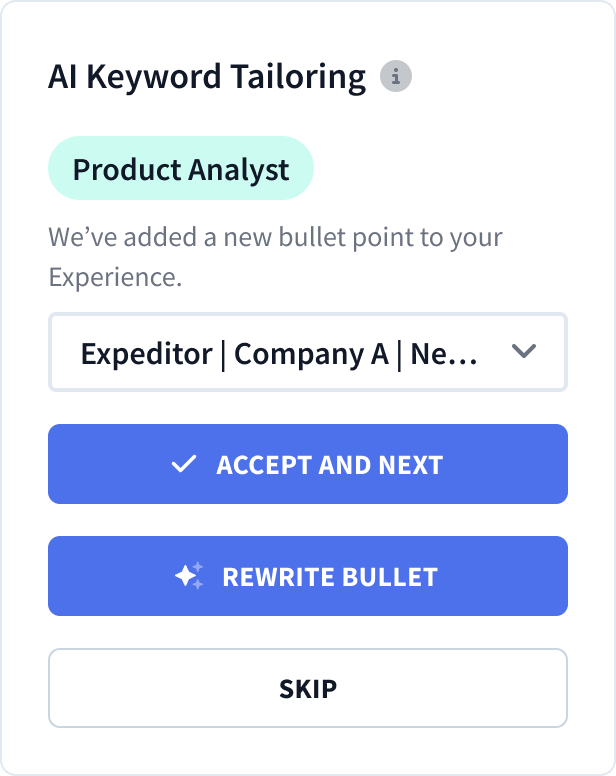
Automatic AI Resume Tailoring
Customize your resume with AI-guided precision.