Most resume objective examples you'll find online teach a format recruiters stopped reading years ago. An objective tells the employer what you want. A summary shows them what you've done, and in 2026 the summary wins in nearly every situation. Below are modern examples for the few cases where an objective still earns its place, plus the summary rewrites that outperform it everywhere else.
What is a resume objective, and do you still need one in 2026?
A resume objective is a one-to-three-line statement at the top of a resume describing the type of role you're seeking and what you hope to get from it. It was standard practice through the 1990s and early 2000s, which is why it still shows up in older career services handouts and in the template libraries of most resume builders.
You almost certainly don't need one. I've written over 1,200 resumes since 2019, across industries from engineering to retail, and the number of times an objective was genuinely the right call is small enough that I can walk you through every category of exception later in this article. For everyone else, the section that belongs at the top of the resume is a summary: a short, evidence-led paragraph about what you've already done and the value that work points to.
The distinction matters more than it looks. An objective is oriented toward you ("seeking a position where I can grow"). A summary is oriented toward the employer ("retail supervisor who cut shrink 18% across two locations"). Recruiters are screening for fit under time pressure, and only one of those formats helps them do it.
If you came here purely for copy-paste objective lines, you'll find examples below. But every example comes with the version I'd actually write instead, because handing you a polished version of an obsolete format wouldn't be doing you any favors.
Why do recruiters skip resume objectives?
Three reasons come up again and again, both in my client work and in the recruiter commentary on r/resumes, the community of 1.2 million members I moderate.
First, objectives state the obvious. You applied for the job, so the recruiter already knows you want it. A line like "seeking a challenging customer service role with opportunities for advancement" consumes the most valuable real estate on the page to communicate nothing the application itself didn't.
Second, objectives are self-oriented at the exact moment the reader is asking an employer-oriented question. A screener with a stack of applications is trying to answer "can this person do the job," and an objective answers a different question nobody asked, which is "what does this person want."
Third, objectives pattern-match to dated resumes. Hiring managers who came up after the mid-2000s associate the format with templates from a previous era, and that association does quiet damage before anyone has read your experience section. When the question "summary or objective?" comes up on r/resumes, the recruiters in the thread land on the same answer with boring consistency: the summary, and if you can't write a good one yet, neither.
None of this means the top of your resume should be empty. It means the thing at the top has to carry evidence. The whole approach is covered in our guide on how to write a resume summary, which is the companion piece to this one.
What's the difference between a resume objective and a resume summary?
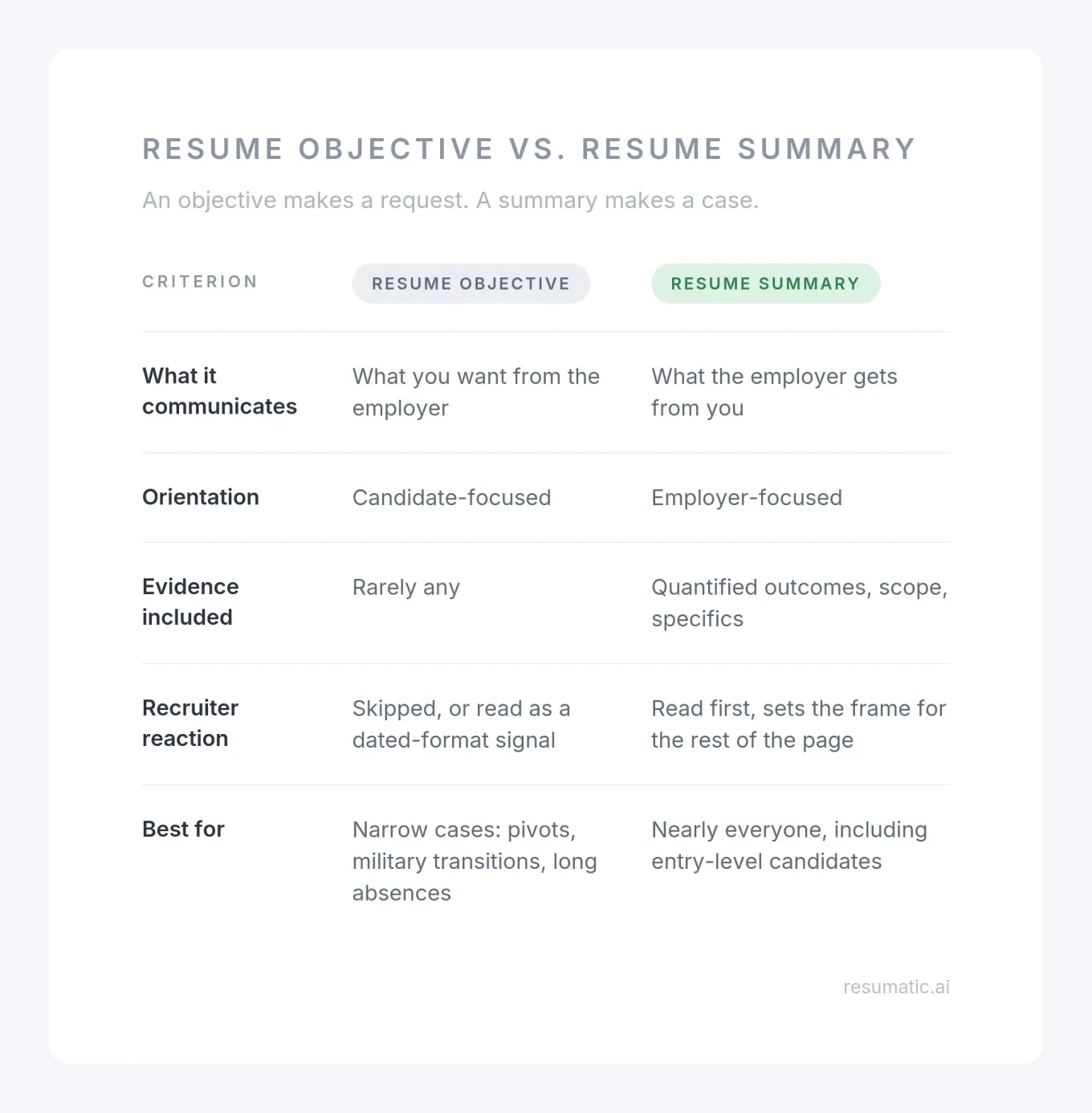
The shorthand I give clients: an objective makes a request, a summary makes a case. If your top section could end with "please," it's an objective no matter what you've titled it.
What do modern resume objective examples look like rewritten as summaries?
The fastest way to see the difference is side by side. Each pair below starts with a typical objective, the kind that fills most example listicles, followed by the summary I'd write for the same candidate. The candidates are composites drawn from patterns across my client work, not specific individuals.
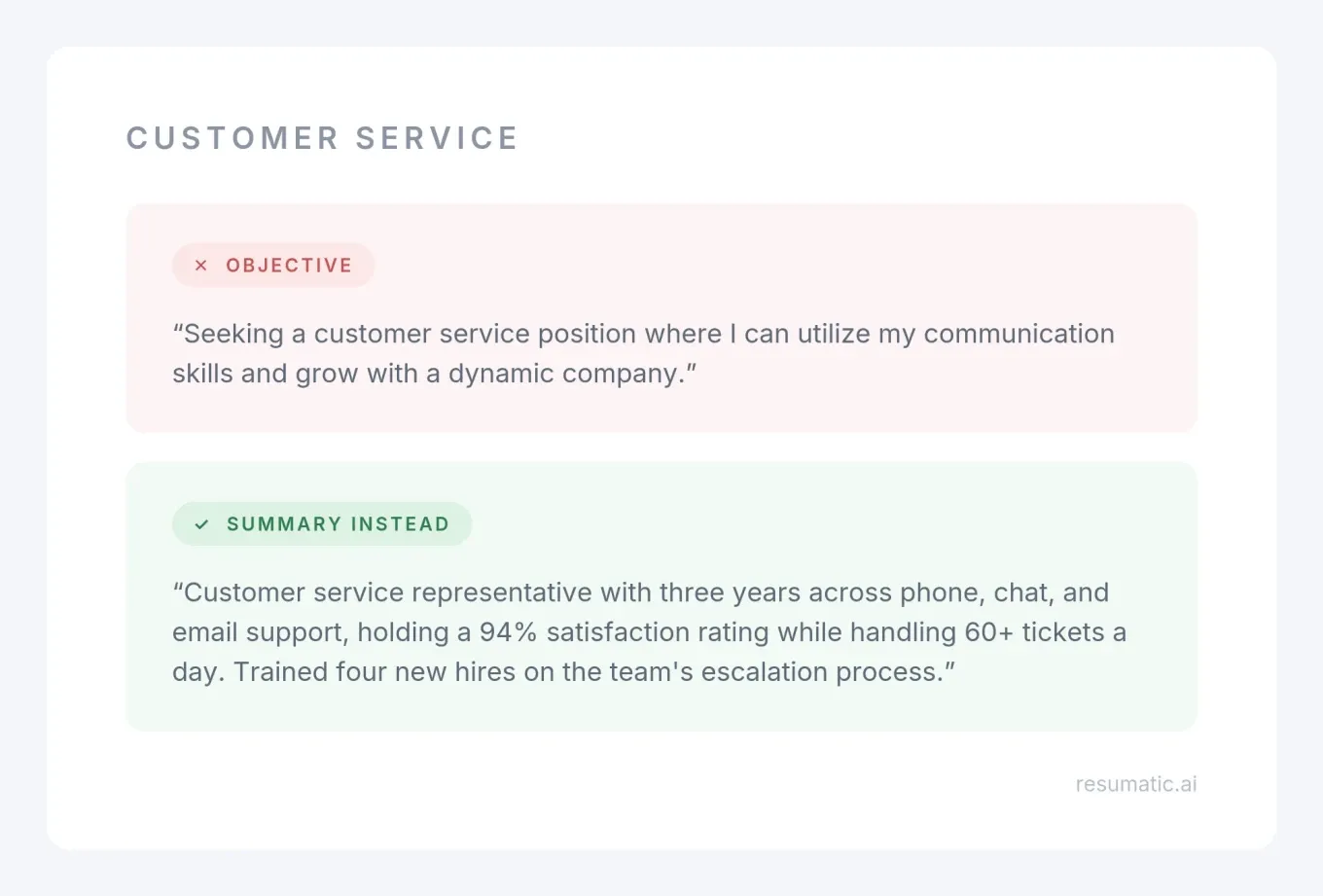
Customer service
Objective: "Seeking a customer service position where I can utilize my communication skills and grow with a dynamic company."
Summary instead: "Customer service representative with three years across phone, chat, and email support, holding a 94% satisfaction rating while handling 60+ tickets a day. Trained four new hires on the team's escalation process."
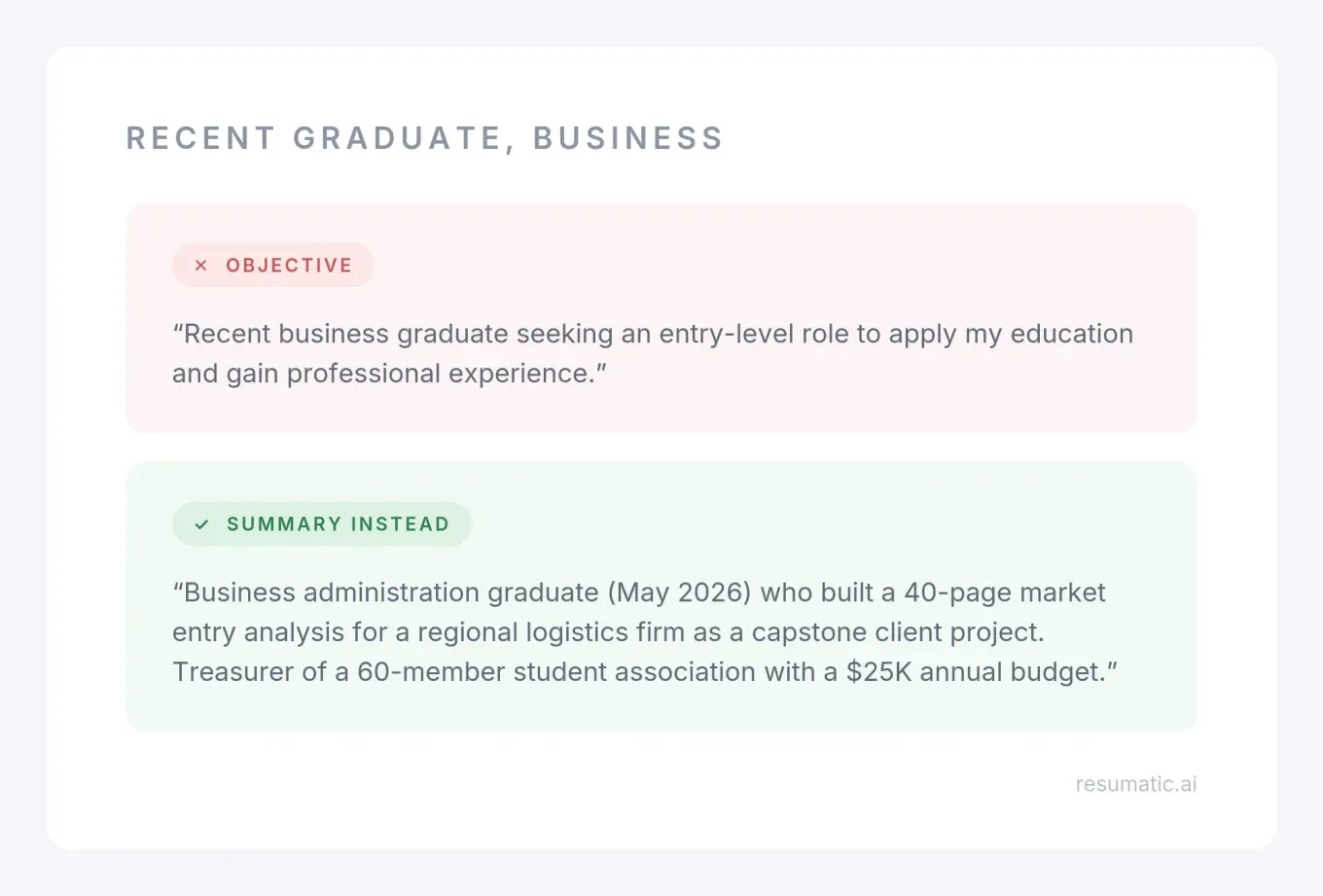
Recent graduate, business
Objective: "Recent business graduate seeking an entry-level role to apply my education and gain professional experience."
Summary instead: "Business administration graduate (May 2026) who built a 40-page market entry analysis for a regional logistics firm as a capstone client project. Treasurer of a 60-member student association with a $25K annual budget."
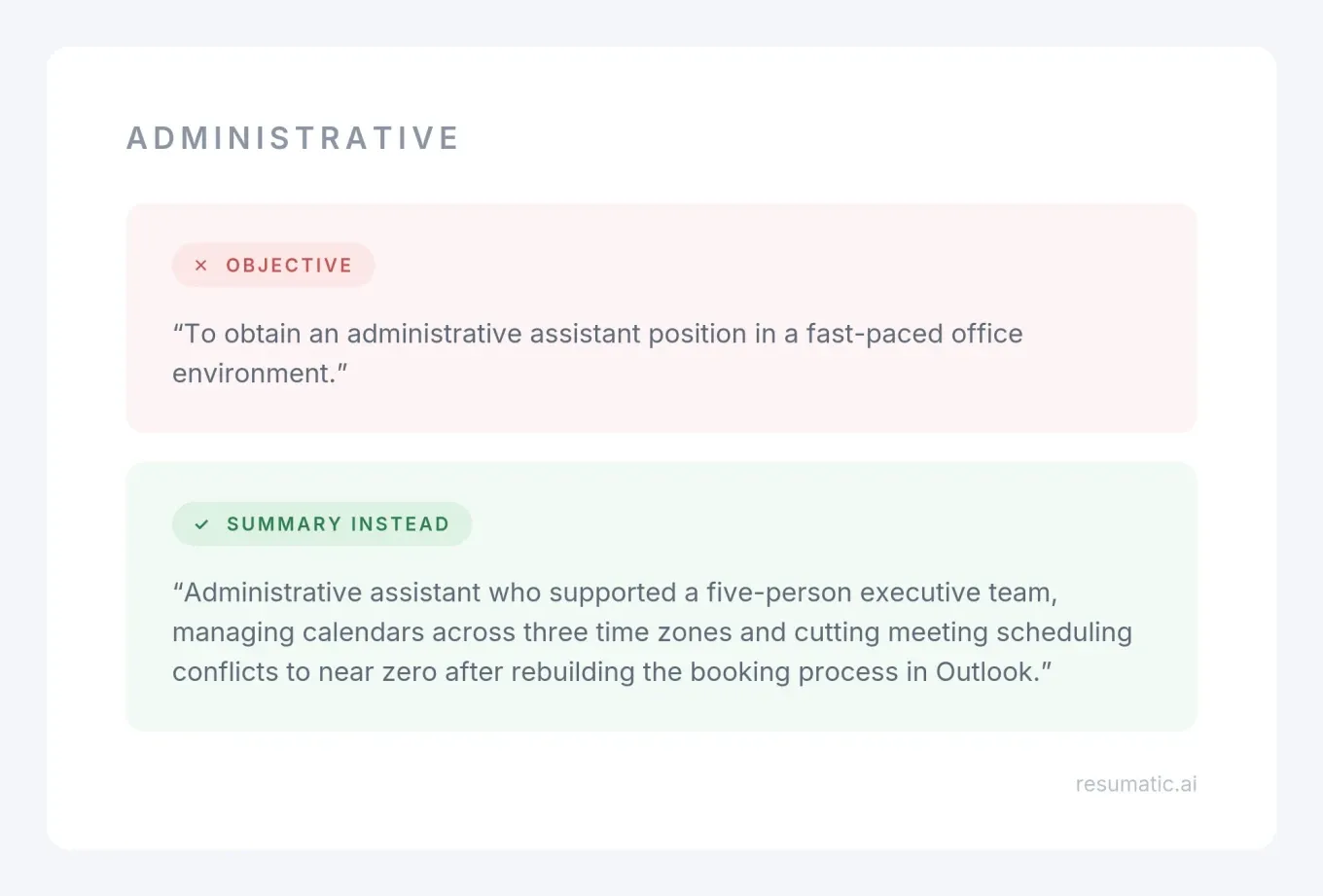
Administrative
Objective: "To obtain an administrative assistant position in a fast-paced office environment."
Summary instead: "Administrative assistant who supported a five-person executive team, managing calendars across three time zones and cutting meeting scheduling conflicts to near zero after rebuilding the booking process in Outlook."
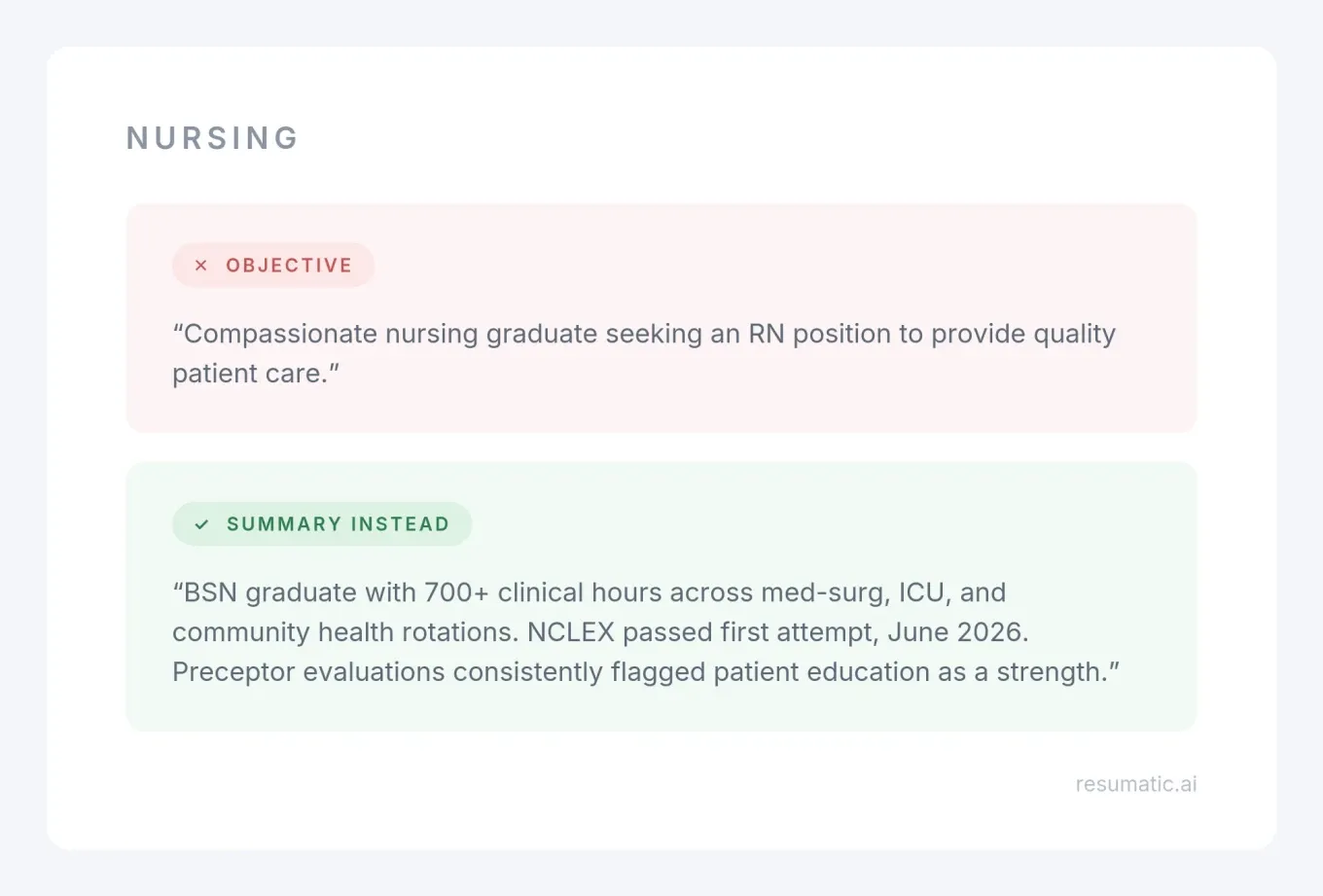
Nursing
Objective: "Compassionate nursing graduate seeking an RN position to provide quality patient care."
Summary instead: "BSN graduate with 700+ clinical hours across med-surg, ICU, and community health rotations. NCLEX passed first attempt, June 2026. Preceptor evaluations consistently flagged patient education as a strength."
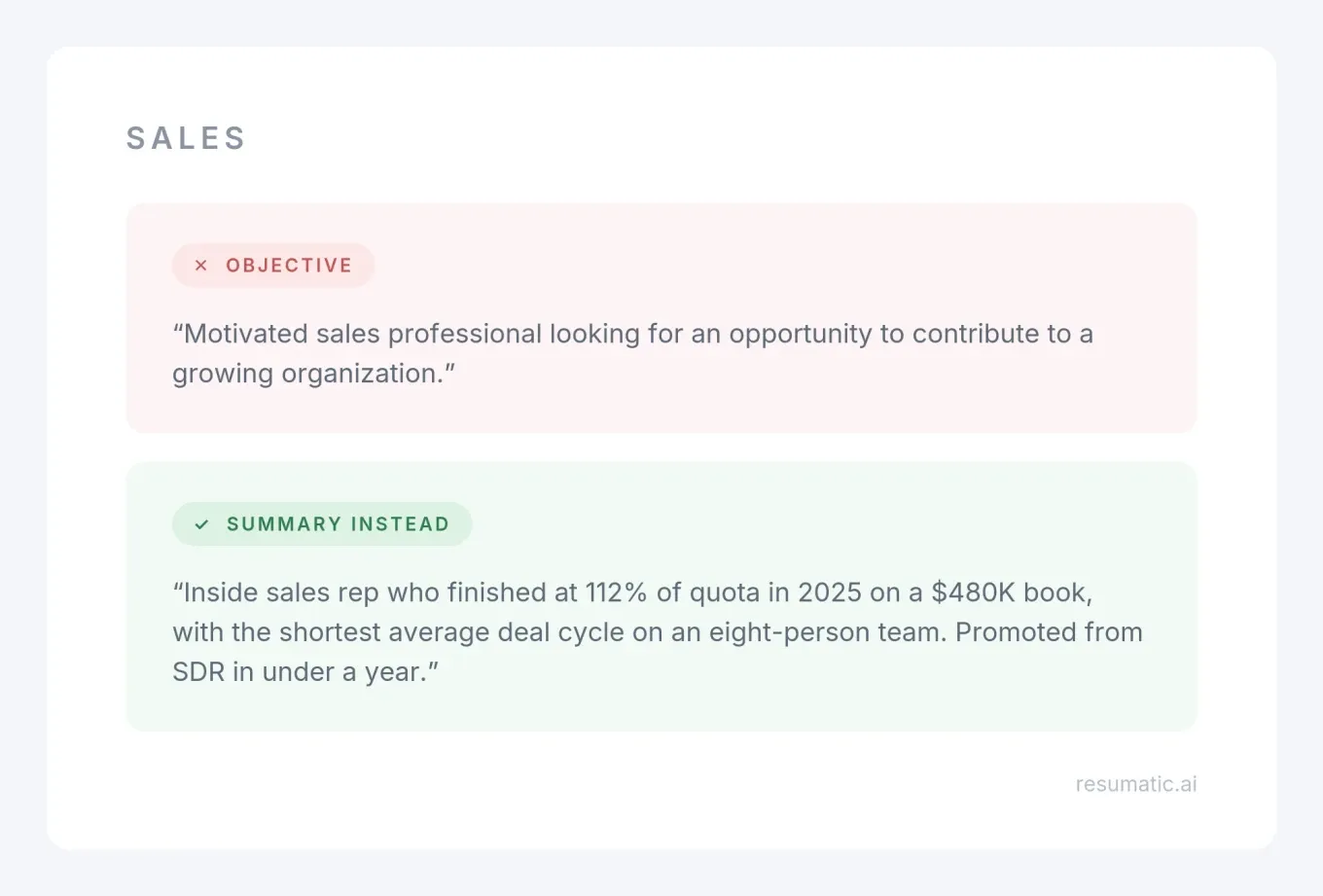
Sales
Objective: "Motivated sales professional looking for an opportunity to contribute to a growing organization."
Summary instead: "Inside sales rep who finished at 112% of quota in 2025 on a $480K book, with the shortest average deal cycle on an eight-person team. Promoted from SDR in under a year."
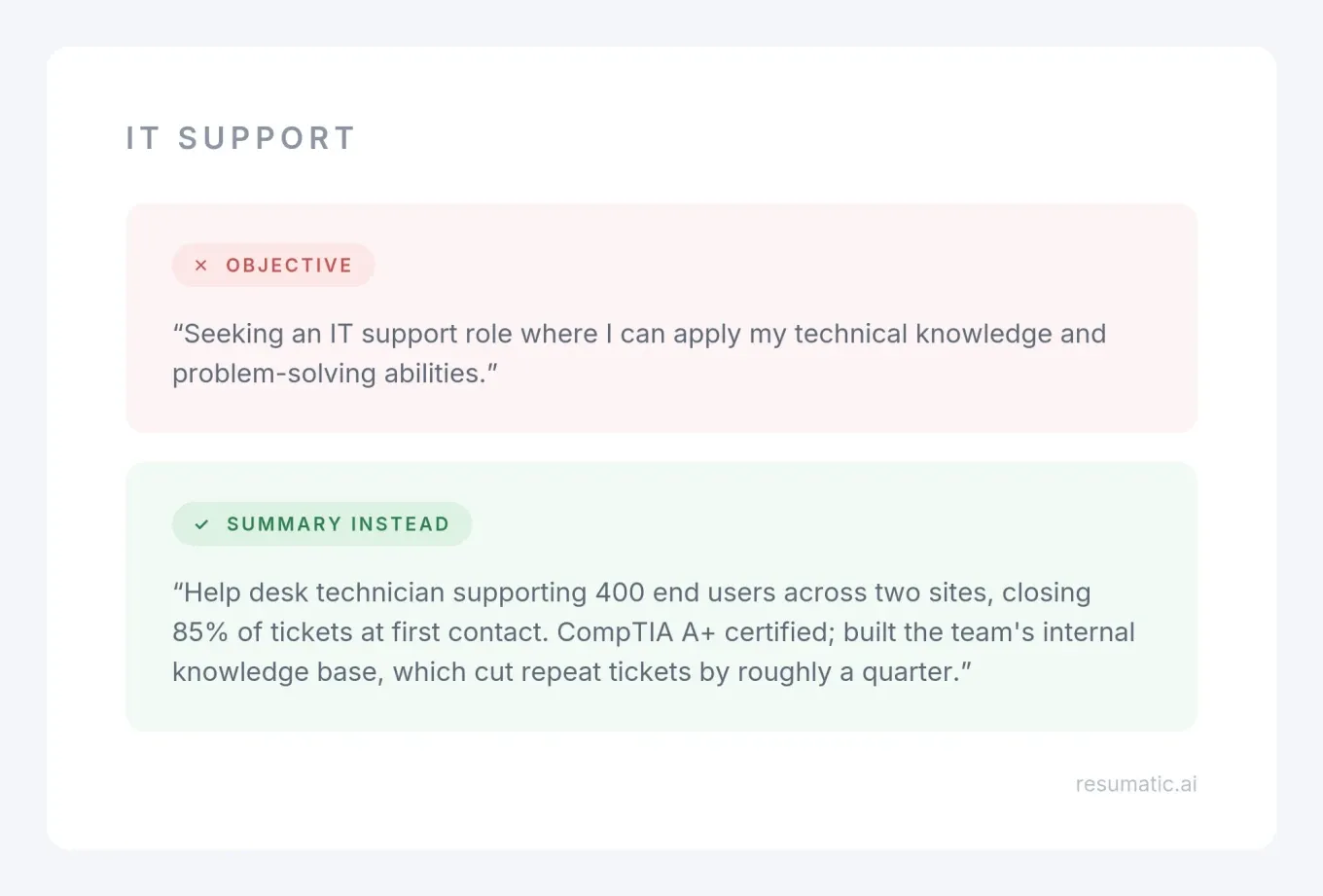
IT support
Objective: "Seeking an IT support role where I can apply my technical knowledge and problem-solving abilities."
Summary instead: "Help desk technician supporting 400 end users across two sites, closing 85% of tickets at first contact. CompTIA A+ certified; built the team's internal knowledge base, which cut repeat tickets by roughly a quarter."
Notice what changed in every pair. The rewrite is barely longer, but each one contains numbers, scope, and at least one detail a competing candidate couldn't copy. That's also what makes these sections work on an ATS-friendly resume: the summary is dense with the role-specific terms a parser and a human are both scanning for, where the objective contains almost none.
What should you write instead of an objective if you have no experience?
Entry-level candidates are the group most often told they need an objective, usually on the logic that with no experience there's nothing to summarize. That logic doesn't hold. You have coursework, projects, part-time work, volunteering, and campus roles, and any of those can carry a two-line summary with actual evidence in it.
The pattern that works: one line establishing who you are and your strongest credential, one line of proof, and optionally a third line naming the direction you're heading, which preserves the only useful function an objective ever had.
No work experience, applying to marketing roles: "Communications graduate who grew a student organization's Instagram from 800 to 4,500 followers in one academic year through a weekly content calendar. Comfortable in Canva, CapCut, and Meta Business Suite. Targeting coordinator-level roles in social media marketing."
Part-time experience only, applying to office roles: "Three years balancing 20-hour retail weeks with a full course load, the last one as a keyholder trusted with opening, closing, and cash reconciliation. Targeting administrative roles where reliability and scheduling discipline transfer directly."
Career starter in tech: "Self-taught developer with six deployed projects, including a scheduling app with 300 monthly active users built in React and Firebase. Targeting junior front-end roles."
If you'd rather start from a working layout than a blank page, the resume templates in our gallery all lead with a summary block for exactly this reason.
When does a resume objective still make sense?
There are three situations where a forward-looking statement still earns its spot, because in each one the work history on its own would actively mislead the reader. Even here, my honest position is that a targeted summary handles all three better, and these are the only situations where I'd consider writing an objective at all. If you use one, write it value-first.
A true career pivot. Ten years in accounting, applying to UX roles. The reader needs the bridge stated explicitly or they'll assume the application is a mistake. Modern version: "Senior accountant transitioning into UX research after two years of evening coursework and a Google UX certificate, bringing a decade of experience making financial data legible to non-finance audiences. Seeking a junior researcher role to apply both."
Military to civilian. Rank and unit structures don't translate on their own. Modern version: "Logistics NCO transitioning to civilian supply chain management after eight years coordinating movement of equipment and personnel for a 200-person unit. Secret clearance, active. Targeting operations roles in distribution."
Returning after a long absence. Seven years out for caregiving, returning to project coordination. Modern version: "Project coordinator returning to the workforce after a planned family care period, with PMP recertification completed in 2026 and recent volunteer experience running a 14-vendor community fundraiser. Targeting coordinator roles in healthcare or nonprofits."
Each of these does what the old objective format never did: it explains the gap between the history and the target, then immediately backs the explanation with proof. The fuller version of how these sections fit into the rest of the page is in our pillar guide on how to write a resume that gets interviews.


