How to Write a Resume With No Experience (With Examples That Get Interviews)
You can write a strong resume with no work experience by replacing the work history section with proof of capability: academic projects, volunteer roles, coursework, part-time or gig work, and transferable skills, all framed in terms of what you accomplished rather than what you were assigned. Lead with a short summary, keep the whole thing to one page, and quantify outcomes wherever you honestly can. No experience doesn't mean no evidence.
Key takeaway
- A no-experience resume works when it proves capability through projects, volunteer work, coursework, and transferable skills instead of a job history you don't have yet.
- Lead with a short summary rather than an objective, and keep the whole document to one page.
- The fastest way to sink a first resume is padding it with filler, so quantify what's real and cut everything that isn't.
What do you put on a resume when you have no work experience?
The honest answer is that you put everything that proves you can do the work, then reorganize the page so the strongest proof sits highest. A traditional resume leads with a work history, and you don't have one yet, so the page has to lead with something else. That something else is usually a mix of projects, coursework, volunteer roles, and any part-time or gig work you've done, even if none of it carried the title of the job you're now chasing.
What trips up most first-time applicants is the belief that none of this counts. It counts. A recruiter reading a no-experience resume isn't expecting ten years of relevant roles. They're looking for signals that you can show up, learn quickly, and finish what you start. A class project you actually shipped, a fundraiser you ran, or a part-time job where you handled cash and angry customers all send that signal, as long as you describe them in terms of what happened rather than what you were told to do.
Here's how the most common substitutes for work experience stack up, and where each one belongs on the page:
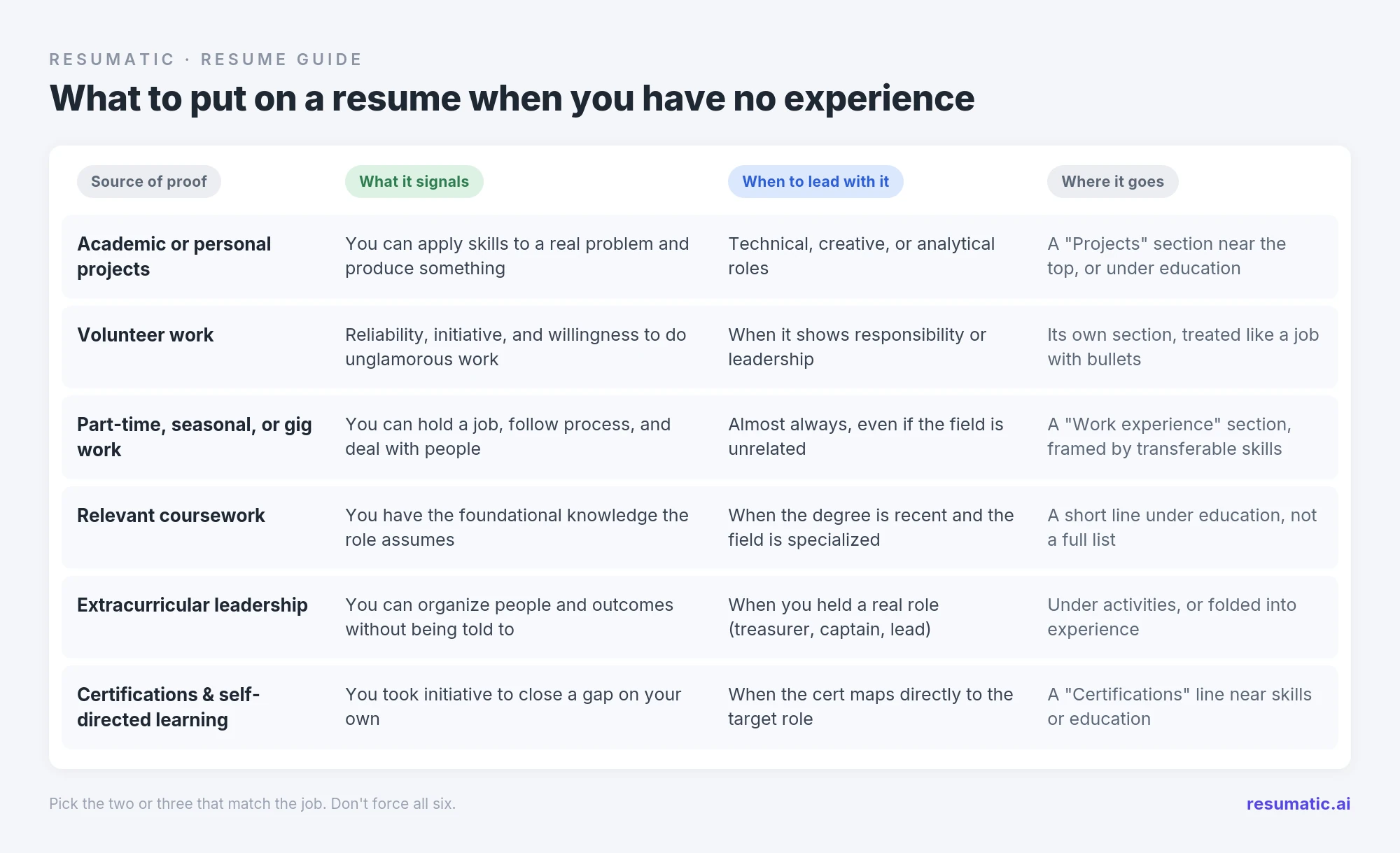
The point of the table isn't to use all six. It's to pick the two or three that best match the job you want and give them real estate, then mention the rest briefly or leave them off.
How should you structure a resume with no experience?
The structure is a reordered version of a normal resume, not a different document. You keep the standard sections, but you move whatever proves capability to the top and demote the empty work-history section or replace it entirely. A clean order for most first-time applicants looks like this:
- Contact information at the top, just name, city, phone, email, and a LinkedIn or portfolio link if you have one.
- A short summary, two or three lines, stating who you are and the role you're targeting.
- A skills section with the transferable skills employers actually screen for, grouped so they're easy to scan.
- Education, including your degree or diploma, plus relevant coursework or projects underneath if they strengthen the case.
- Experience, which can be paid work, volunteer roles, or major projects, each with two or three bullets describing outcomes.
- Optional extras, like certifications, languages, or activities, only if they add something.
Keep it to one page. There's no version of "no experience" that justifies two pages, and a recruiter who sees a first-time applicant stretching to fill a second page reads it as padding before they read a single word. Skip the photo, skip the full mailing address, and don't waste the top third of the page on an objective. If you want the underlying logic on section order and which format fits which situation, the resume formats guide covers the tradeoffs in more depth.
What should the summary say if you've never had a job?
The summary is the first thing a recruiter reads, so it has to do real work in two or three lines. It should name who you are, the kind of role you're going for, and one or two concrete proof points that back you up. The mistake nearly everyone makes is writing an objective instead, a sentence about what you want ("seeking an entry-level position where I can grow"). Recruiters already know you want the job. You applied.
Compare these two openings for a recent graphic design graduate:
The objective version reads, "Motivated recent graduate seeking an entry-level design role to grow my skills and contribute to a creative team." It tells the reader nothing they didn't assume.
The summary version reads, "Graphic design graduate who built a 12-piece brand identity for a local nonprofit and ran the design for three campus events reaching 2,000+ students. Comfortable in Figma and the Adobe suite, looking to bring that hands-on work into a junior design role." It's the same person, but now there's evidence.
Write a short summary that leads with what you can do, and reserve the objective format for the narrow cases where an objective still makes sense, which are rarer than most advice online suggests.
What does a strong no-experience resume actually look like?
The clearest way to see the difference is to look at the same candidate written two ways. The examples below are composites built from patterns I see constantly in client work and across r/resumes, not single real people, but the before-and-after gap is exactly the one that separates a resume that gets read from one that gets skimmed and closed.
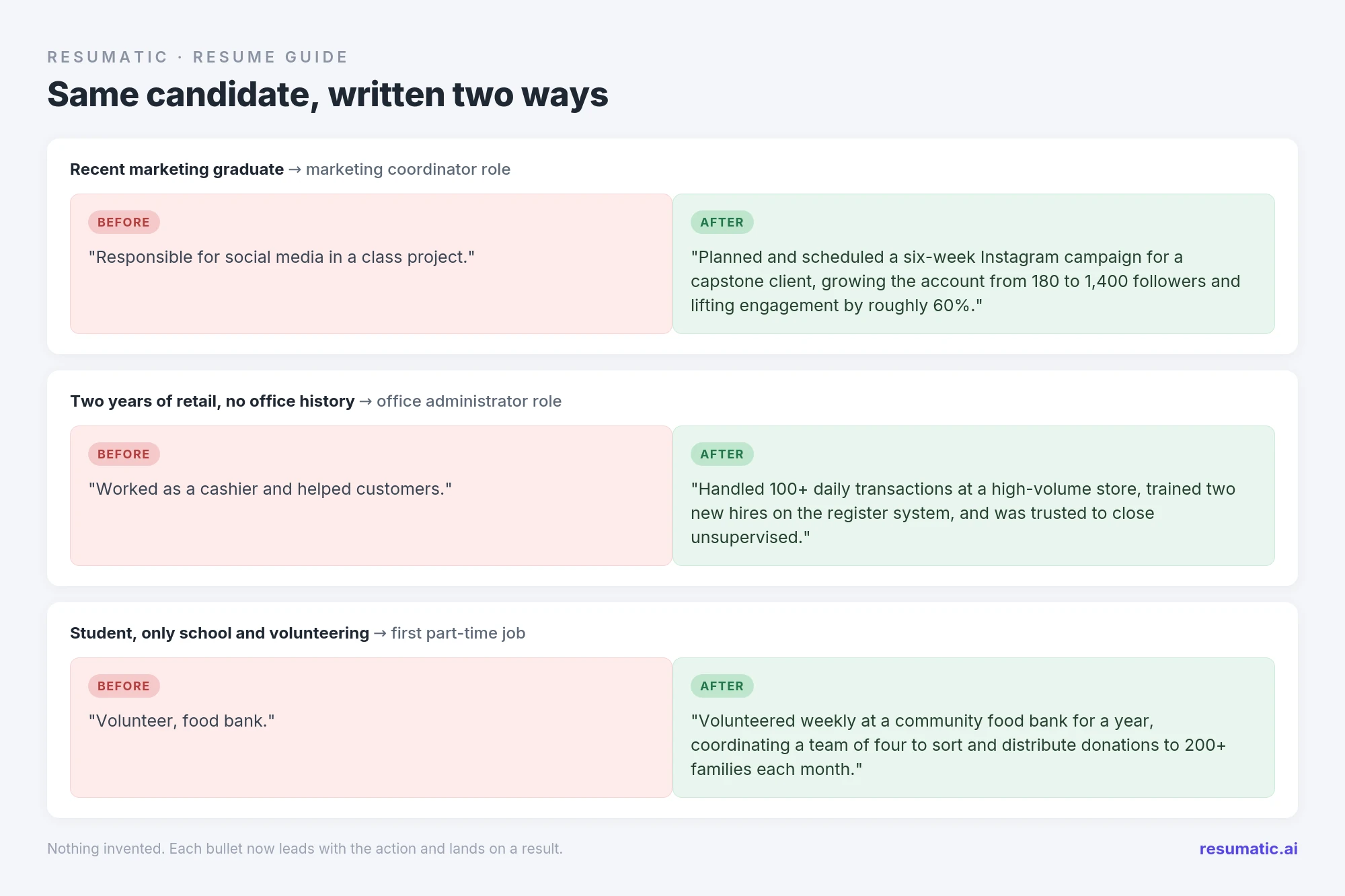
Recent marketing graduate, no full-time roles, applying for a marketing coordinator job:
The weak bullet reads, "Responsible for social media in a class project." The strong version reads, "Planned and scheduled a six-week Instagram campaign for a capstone client, growing the account from 180 to 1,400 followers and lifting post engagement by roughly 60%." Same project. One describes a task, the other describes a result.
Career starter whose only history is two years of retail, applying for an office administrator role:
The weak bullet reads, "Worked as a cashier and helped customers." The strong version reads, "Handled 100+ daily transactions and resolved customer complaints at a high-volume store, trained two new hires on the register system, and was trusted to close the store unsupervised." Retail experience reframed as reliability, training, and trust, which is exactly what an admin role needs.
Student applying for a first part-time job with only school and volunteering behind them:
The weak version lists "Volunteer, food bank." The strong version reads, "Volunteered weekly at a community food bank for a year, coordinating a team of four to sort and distribute donations to 200+ families each month." A year of consistency plus a number turns a one-liner into proof of commitment.
In all three cases nothing was invented. The facts didn't change. What changed is that each bullet now leads with the action and lands on a result, which is the single highest-leverage edit available to someone with a thin resume.
What mistakes make a no-experience resume worse?
This is where I spend most of my time as an r/resumes moderator, because the same handful of mistakes show up week after week, and they're almost all self-inflicted. Avoiding them matters more than any clever formatting trick.
- Leading with an objective statement. It burns your most valuable space telling the reader something they already know. Replace it with a summary that proves capability.
- Padding or inventing experience. Listing a job you held for two weeks, inflating a title, or claiming skills you can't demonstrate is the fastest way to lose a recruiter's trust, and it falls apart in the interview anyway.
- Dumping every course you've ever taken. A wall of coursework reads as filler. Pick the three or four classes that map to the role and cut the rest.
- Relying on "hard worker" and "fast learner" with nothing behind them. Every applicant claims these. None of them mean anything without an example attached, so show the trait through a bullet instead of asserting it.
- Using a skills-only "functional" format to hide the gap. It's a well-known signal that someone is hiding something, recruiters distrust it, and many applicant tracking systems parse it badly. A reverse-chronological layout with reordered sections beats it nearly every time.
- Writing duties instead of outcomes. "Responsible for" is the most common opening on a weak resume. Lead with what you did and what resulted from it.
- Running past one page. A first resume that spills onto a second page is almost always padding, and it signals that you can't prioritize.
- Ignoring the actual posting. Generic resumes get generic results. Mirror the language of the job description, especially the skills and tools it names, because that's what both the recruiter and the software are scanning for.
If you cut these eight things, you're already ahead of most of the no-experience resumes that land in a recruiter's inbox, because most of them make at least three of these mistakes at once.
How do you get experience to put on a resume in the first place?
The frustrating loop for first-time applicants is that the resume needs experience and the experience needs a job. The way out is to manufacture small, real proof points you can put on the page within a few weeks, rather than waiting for a job to hand you experience first.
Practical options that work fast: take on a tiny freelance or volunteer project in your target field, even unpaid, and treat it like a job with measurable outcomes. Build a personal project that solves a problem you actually have, then write it up with results. Complete a short certification that maps directly to the role, since employers read a relevant cert as initiative. Sign up for a free virtual work-experience program, where you complete realistic tasks from a real company and can list the outcome. Volunteer for a role with actual responsibility, like managing a budget or a small team, rather than one-off shifts. Any of these gives you something concrete to describe, and concrete is the whole game when you don't have a job history to lean on.
Frequently asked questions
Q: Can you write a resume with no experience at all?
A: Yes. A resume documents capability, and work history is only one form of proof. Projects, coursework, volunteer roles, certifications, and transferable skills from any setting all count. The goal is to show you can learn quickly, take responsibility, and produce results, then organize the page so your strongest evidence appears first. Almost everyone has more usable material than they think.
Q: Should I use a resume objective if I have no experience?
A: Usually no. An objective states what you want, which the recruiter already knows because you applied. A short summary that states who you are and shows one or two concrete proof points works far better. Objectives survive in a few narrow cases, like a major career change or a relocation that needs explaining, but for most first-time applicants a summary is the stronger choice.
Q: How long should a resume with no experience be?
A: One page, without exception. A first-time applicant who fills a second page is almost always padding, and recruiters read that as an inability to prioritize. One page forces you to keep only what proves capability and cut the filler. If you're struggling to fill a single page, the problem is usually that your bullets describe duties instead of outcomes, not that you lack material.
Q: What skills should I put on a resume with no experience?
A: Lead with transferable skills you can actually demonstrate, like communication, organization, problem-solving, and any tools or software relevant to the role. Avoid listing skills you can't back up in an interview. The strongest move is to prove a skill through a bullet ("coordinated a team of four") rather than just naming it, since a list of adjectives carries almost no weight on its own.
Q: Is it okay to put unpaid or volunteer work on a resume?
A: Absolutely, and for a no-experience resume it's often your best material. Treat a volunteer role exactly like a job: give it a title, a timeframe, and two or three bullets describing what you did and what resulted. Consistent, responsibility-bearing volunteer work (running a team, managing a budget, coordinating an event) reads as real experience, because it is.
About the author
Alex Khamis, CPRW, is the cofounder of Resumatic and the founder of Final Draft Resumes. He moderates r/resumes (1.2M+ members), where the "no experience" question is one of the most frequently asked, and has personally written resumes for over 1,200 professionals since 2019, including first-time job seekers breaking into their first roles. LinkedIn.
If you want a head start on your first resume, Resumatic is free to start, and it'll help you turn projects, coursework, and part-time work into bullets that lead with outcomes. Most first-time users have a clean, one-page draft in about 20 minutes, which beats staring at a blank page trying to figure out what counts.
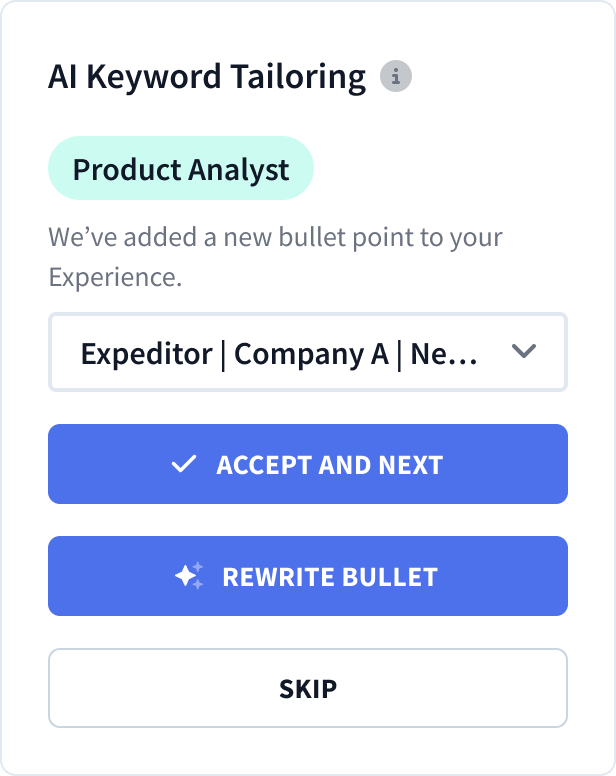
Automatic AI Resume Tailoring
Customize your resume with AI-guided precision.


