How to Write a Cover Letter That Stands Out
Most cover letter advice starts with personality, passion, or a clever hook. That gets the order wrong. If your letter doesn’t match the language of the job description, the ATS may screen it out before a person reads your opening line.
This is how to write a cover letter that stands out in the order that matters. First, make it searchable. Then make it persuasive. Then make it clean enough to submit without introducing avoidable mistakes.
Table of Contents
- Build a keyword matrix before you draft
- Map each keyword to one real example
- Decide what must appear in the letter
- Use STAR quietly and keep the job description visible
- Choose two stories that map to the posting
- Replace adjectives with operating detail
- Keep your proof consistent across your application
Analyze the Job Description to Beat the ATS
If you skip this step, you’re guessing.
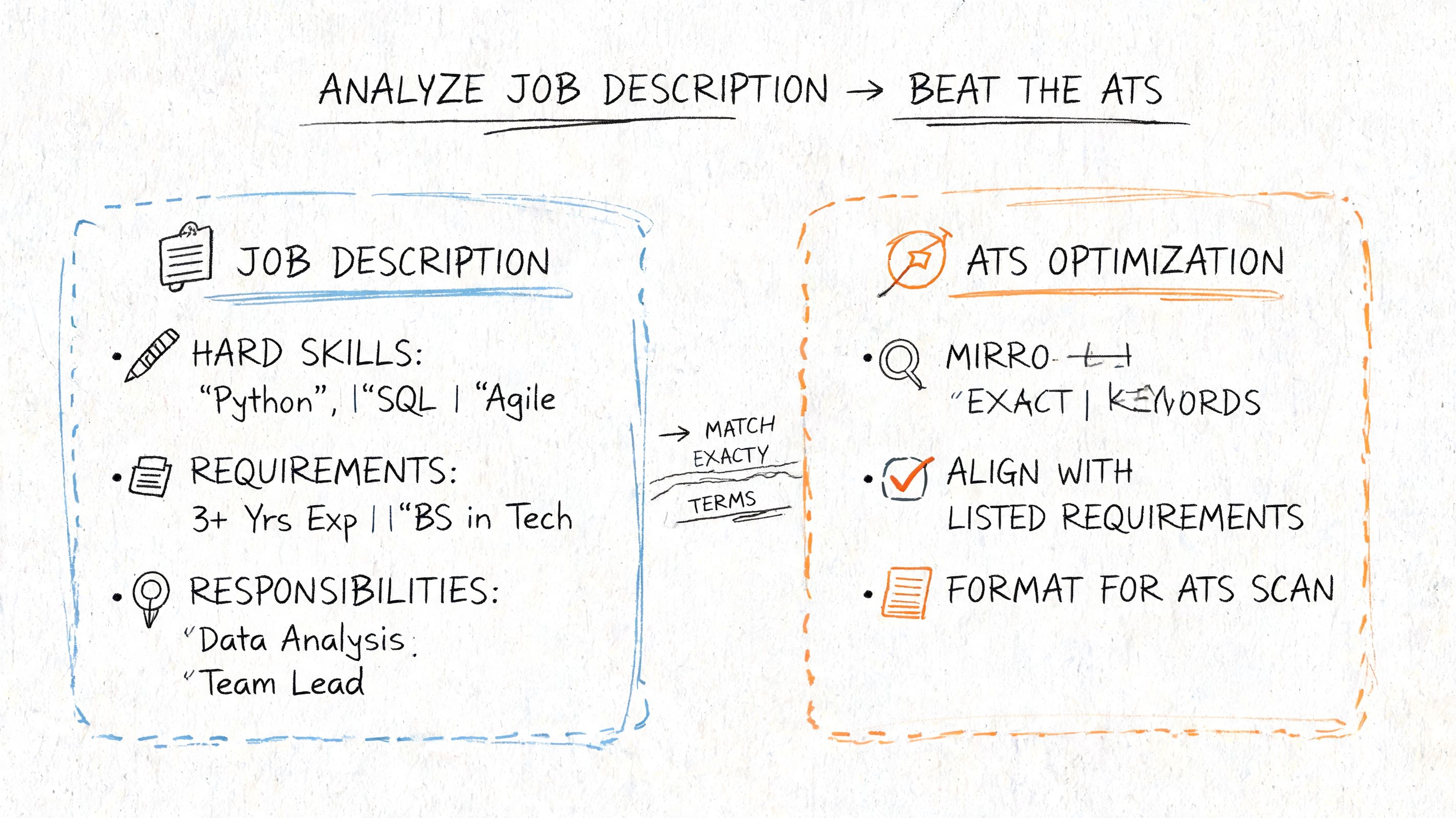
ATS optimization gets ignored in most cover letter advice, but it’s the first gate. Indeed notes that 99% of Fortune 500 companies use ATS that parse cover letters for keywords, that mismatched applications face 75% rejection, and that cover letters with 80%+ keyword match can boost interview rates by 42%. That means your first job is not to sound original. It’s to sound relevant.
Build a keyword matrix before you draft
Open the posting and copy it into a blank document. Highlight repeated nouns, verbs, tools, and outcomes. Then sort them into a simple matrix with three buckets:
| Category | What to extract | Example terms |
|---|---|---|
| Skills | Hard skills, software, methods | SQL, stakeholder communication, forecasting |
| Responsibilities | What the role does | manage roadmap, coordinate launches, analyze trends |
| Qualifications | Experience level, domain context, credentials | SaaS, B2B, internship experience, bachelor’s degree |
Don’t rewrite these terms into your own preferred language yet. Keep the employer’s phrasing. If the posting says “cross-functional collaboration,” don’t swap in “worked with different teams” unless that exact language appears elsewhere in the ad.
Practical rule: Mirror the language of the posting where it is true. Don’t paraphrase keywords that the ATS is likely scanning for.
Map each keyword to one real example
Once you have the matrix, add a note next to each important term:
- If you’ve done it directly, attach one result or project.
- If you’ve done a close variant, use the employer’s term only if you can support it in context.
- If you haven’t done it, leave it out.
A quick example:
- Keyword from posting: “customer onboarding”
- Weak use: “I have strong communication skills and enjoy helping customers.”
- Usable proof: “In my support internship, I built onboarding guides for new users and handled first-week product questions.”
This is the same discipline people use when they develop persuasive business proposals. You don’t lead with generic enthusiasm. You study the brief, match the buyer’s stated needs, and support each claim with relevant evidence.
Decide what must appear in the letter
Not every keyword belongs in the cover letter. Pick the terms that are both central to the role and easy for you to prove.
Use this filter:
- Must include: core skills named multiple times
- Good to include: one or two tools, methods, or domain terms
- Skip: long lists, certifications you already cover on the resume, and jargon you can’t support
If you want a fast check on whether your wording tracks with the posting, use an ATS scanner such as Resumatic’s ATS resume checker before you finalize the application materials. The point is not to stuff keywords. The point is to confirm that your documents use the same language the employer uses.
Craft a Compelling Opening Paragraph
The opening paragraph has one job. It must make the hiring manager think, “This person fits what we asked for.”
That first impression carries weight. Flair reports that 41% of hiring managers consider the introduction the most important part of a cover letter, and that a tailored letter can increase attention by up to 38%. So stop opening with filler.
Use a three-part opening
A strong opening paragraph usually includes these pieces in this order:
- Name the role clearly
- Show a specific connection to the company or work
- State your most relevant value in one line
Here is the ineffective version commonly sent:
I am writing to apply for the Product Analyst position at BrightLoop. I believe my background and skills make me a strong candidate for this role.
It says nothing beyond availability.
Here’s a stronger version:
I’m applying for the Product Analyst role at BrightLoop because your focus on usage-based product decisions matches the work I’ve done in analytics internships and research projects. My background in SQL reporting, cross-functional communication, and turning user data into clear recommendations fits the core work described in the posting.
The second version does three things fast. It uses the role title, points to a specific reason for interest, and states a value proposition tied to the posting.
Keep the first paragraph tight
Don’t try to tell your full story in the opener. Give enough information to earn the next paragraph.
Use this template:
I’m applying for the [job title] role at [company]. Your need for [specific need from posting] aligns with my experience in [relevant skill, tool, or domain]. In [recent role, project, or internship], I built strength in [2 to 3 matched areas], which I’d bring to this position.Example:
I’m applying for the Marketing Coordinator role at Rowan Health. Your need for someone who can manage campaign execution and track performance aligns with my experience in email marketing, content scheduling, and reporting. In my recent internship, I supported weekly campaign launches, updated performance dashboards, and coordinated assets across design and content teams.A good opening works like a news lead. It puts the important information first. If you want a useful model for that structure, learn from Whisper AI’s explanation of inverted pyramid writing and apply the same principle to your first paragraph.
What to avoid in the opener
Don’t open with any of these:
- A generic statement of excitement like “I’m thrilled to apply”
- A life story about when you first discovered the industry
- A claim with no proof such as “I’m the ideal candidate”
- A sentence that repeats the posting without adding evidence
If you need examples of role-specific openings, review a few cover letter examples organized by job type and compare them against the posting in front of you. The useful pattern is relevance, not decoration.
Connect Your Skills to Their Needs with Proof
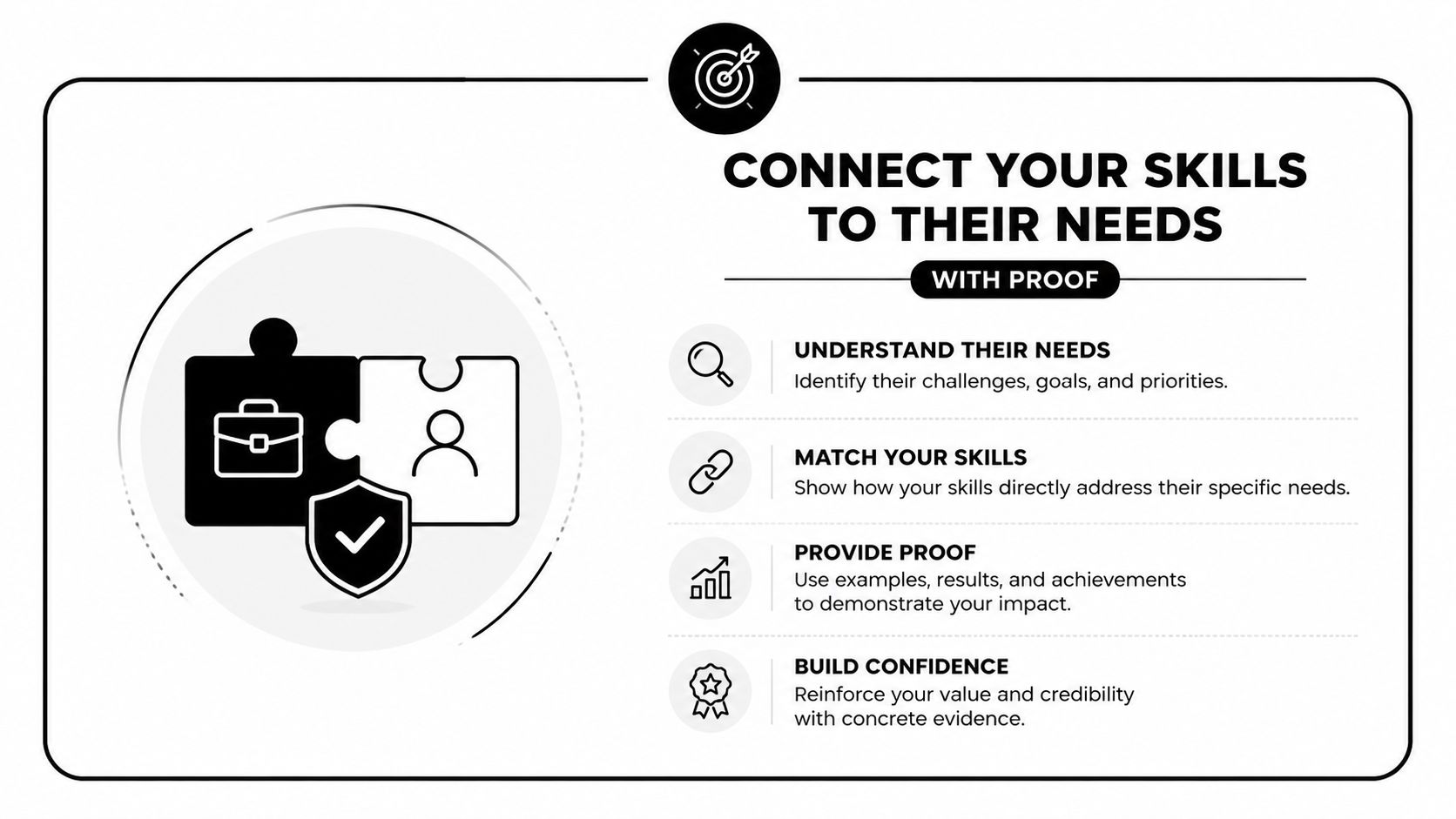
Hiring teams say they want personality. The first screen usually wants keyword match and proof. Your middle paragraphs need to do both at once.
Don’t fill this section with soft traits. Build two short proof blocks that mirror the job description language and show what you produced. If the posting asks for campaign reporting, cross-functional coordination, or client communication, use those exact terms where they truthfully match your experience. Then attach evidence. That combination helps your letter survive ATS parsing and gives the recruiter a reason to keep reading.
Use STAR quietly and keep the job description visible
STAR still works because it forces specificity. The mistake is writing it like a worksheet.
A strong body paragraph usually covers four points in three or four sentences:
- Situation and task: what needed attention and what you owned
- Action: what you changed, built, analyzed, or coordinated
- Result: what improved, shipped, saved time, or reduced errors
- Match: how that example connects to the role’s stated need
That last point is what many applicants skip. They describe a project, then leave the recruiter to do the translation work. Don’t. State the connection.
Here’s a weak body sentence:
I managed social media and worked with the team to improve engagement.
Here’s the stronger version:
During my internship with a student-led nonprofit, I took over a social media calendar that had inconsistent posting and little performance tracking. I built a weekly schedule, reviewed post-level engagement, and adjusted content based on the formats that performed best. That gave the team a repeatable process and clearer visibility into what content was resonating. That experience matches your need for someone who can manage content operations and report on performance.That version does more than sound better. It gives the ATS relevant language such as “performance tracking” and “content operations,” and it gives the reader a clear result.
Choose two stories that map to the posting
Two examples are enough. Three is usually too many for a half-page letter.
Pick the two requirements that appear most often in the posting or sit closest to the core of the role. For each example, pressure-test it with these questions:
| Question | Weak answer | Strong answer |
|---|---|---|
| What did you own? | Helped with reports | Built weekly SQL reports for sales and product teams |
| What problem did you solve? | Improved process | Replaced ad hoc tracking with a shared dashboard |
| What changed? | Things ran better | Cut manual reporting time and gave stakeholders one source of truth |
| Why does it fit this job? | Shows I’m a team player | Matches the role’s need for cross-functional reporting |
This filter saves space. It also prevents the common mistake of cramming in six disconnected claims because they sound impressive.
Replace adjectives with operating detail
Recruiters do not need more claims like “strong communicator” or “detail oriented.” They need evidence they can picture.
Write like this:
Instead of “I’m a strong communicator”
Write “I coordinated updates across design, engineering, and support teams during a product rollout”
Instead of “I’m analytical”
Write “I reviewed campaign data and summarized performance trends for weekly stakeholder meetings”
Instead of “I work well under pressure”
Write “I handled competing deadlines across client requests and internal reporting without missing weekly delivery targets”
If you have numbers, use them. If you do not, use concrete operational outcomes such as reduced backlog, faster turnaround, fewer revisions, smoother handoffs, or clearer reporting. Specificity beats inflated language every time.
If your resume still reads like a task list, fix that before drafting the body paragraphs. Your strongest cover letter examples usually come from your strongest resume bullets. This guide on how to write accomplishments on a resume will help you turn duties into evidence you can reuse in the letter.
Keep your proof consistent across your application
I see this problem often. The letter says “content strategist.” LinkedIn says “social media manager.” The portfolio shows mostly graphic design work. That mismatch creates friction, and friction costs interviews.
Check three things:
- Headline alignment: Your LinkedIn headline should support the direction stated in the letter
- Project alignment: Public work should reinforce the two examples you chose
- Language alignment: Reuse the same truthful keywords across your resume, letter, and profile so the application reads as one clear story
If you need to tighten that public-facing layer, this guide on how to create a cohesive online profile is a useful companion to your application materials.
Write a Confident and Concise Closing
Most cover letter closings collapse into weak politeness. They don’t need to.
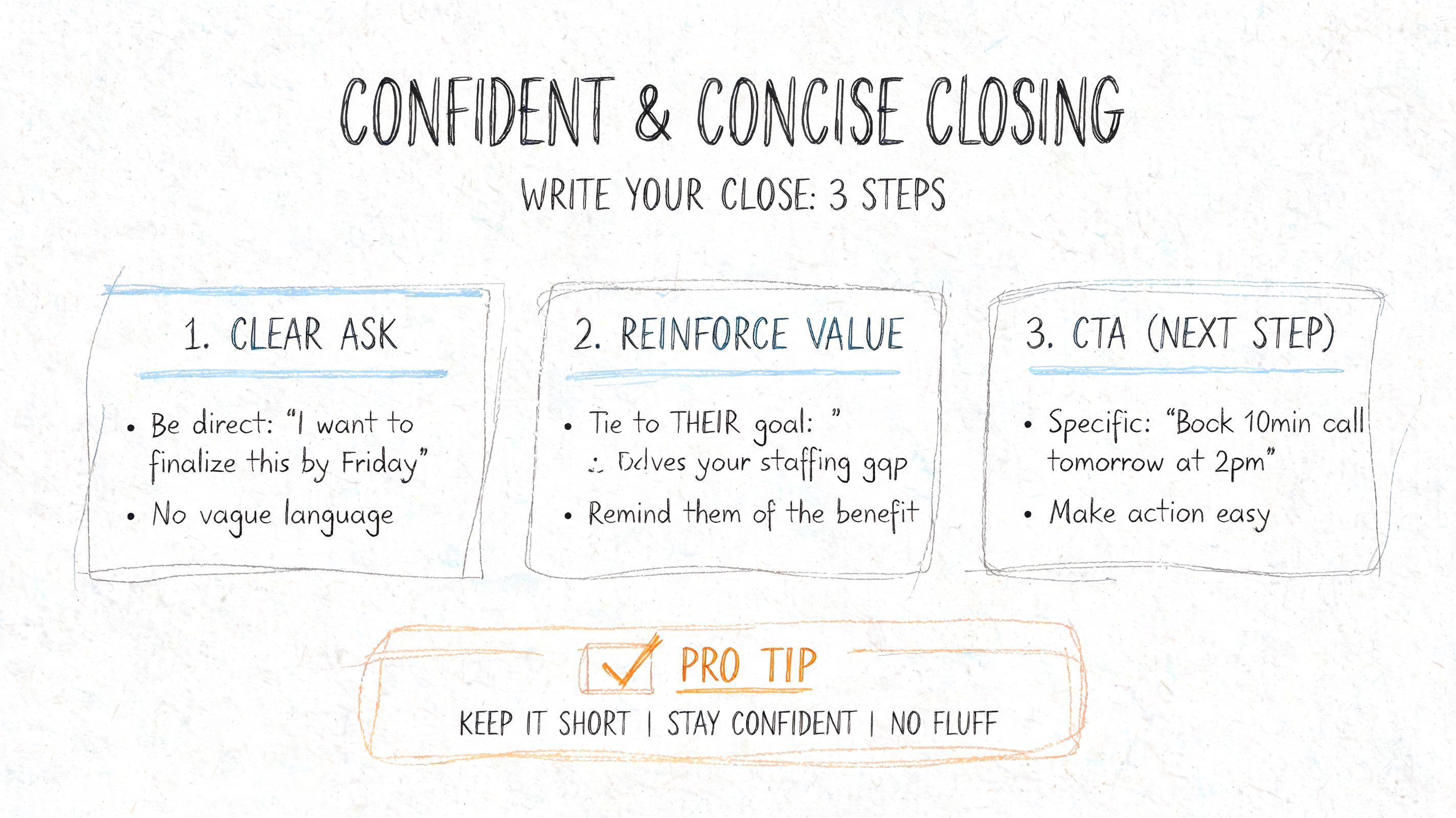
Your closing paragraph should do three things. Reaffirm fit. Show interest in the next step. End without sounding passive or inflated. It also needs to be brief, because length discipline matters across the entire letter. MyPerfectResume reports that 70% of employers prefer a half-page cover letter, 49% of managers specifically prefer that format, 32% of applicants choose a full page, and only 1% go longer.
End by restating value, not repeating yourself
A weak close sounds like this:
Thank you for your time and consideration. I hope to hear from you soon.
There’s nothing wrong with being polite. The problem is that this ending wastes the final lines.
A better close does this:
My background in campaign coordination, reporting, and cross-team execution matches the core needs of this role. I’d welcome the chance to discuss how I can support your team’s upcoming marketing initiatives. Thank you for your consideration.Best regards,Jordan LeeThat version is short, specific, and forward-looking.
Cut anything that creates drag
Your closing paragraph is not the place for:
- Apologies about missing experience
- Pressure tactics about following up aggressively
- Extra biography that should have appeared earlier
- Another long story that introduces new information too late
Use one of these sentence patterns instead:
My experience in [matched areas] would let me contribute quickly in this role. I’d welcome the opportunity to discuss that fit in more detail.I’m interested in bringing my background in [skills or domain] to [company name], particularly in support of [specific team need]. Thank you for considering my application.Keep the close businesslike. Confidence sounds calm. It doesn’t sound theatrical.
If you need help trimming a long draft into something that fits the half-page preference, a tool like Resumatic’s Cover Letter Builder can generate a concise draft from your resume and job description, then give you something to edit for tone and accuracy. Use it as a starting point, not a final submission.
Finalize Your Letter for Submission
A good cover letter still fails if the final version introduces preventable errors or breaks ATS parsing. The last review is not cosmetic. It is the point where you confirm the letter still matches the posting, still reads cleanly, and still survives the upload process.
Do the final pass outside the application portal. Browser fields hide spacing problems, strip formatting, and make rushed edits more likely.
Run a submission checklist
Use this order:
- Read it out loud: hearing the letter exposes clunky phrasing, repeated words, and sentences that sound less confident than they look on screen.
- Check every proper noun: confirm the company name, role title, hiring manager name, department, product names, and location.
- Compare it against the job description: verify that your highest-value keywords still appear in the letter naturally, especially the exact terms used for skills, tools, and responsibilities.
- Check file naming and metadata: use a clear file name such as
Jordan-Lee-Cover-Letter-Marketing-Coordinator.pdf. Make sure the wrong company name is not sitting in the document title from an older draft. - Review the first and last lines: recruiters skim both. If either one sounds generic, fix it before you submit.
- Export and reopen the file: confirm the spacing, line breaks, and bold text held up after export.
Keep formatting easy for humans and machines to read
Plain formatting gives you fewer ways to make a mistake.
Use these defaults:
- Standard font: choose a readable font such as Arial, Calibri, Times New Roman, or Georgia
- Consistent spacing: keep paragraph spacing even and avoid dense text blocks
- Left alignment: it scans faster and tends to convert more cleanly in ATS systems
- One page maximum: if you cannot make your case in one page, the draft is still too loose
- PDF when allowed: it usually preserves layout better than Word files
Some portals handle PDFs well. Others convert attachments into plain text badly. If the application asks for a specific file type or asks you to paste the letter into a form field, follow the portal instructions exactly. Then check how the pasted version looks before you hit submit.
If you want a starting draft you can tighten by hand, use a tool that builds around the job description instead of spitting out generic language. Resumatic’s cover letter generator can help you structure the letter around your resume and target keywords, but the final check is still your job. Review every line for accuracy, tone, and ATS alignment before sending it.
What to do now
Do these five steps in order. Don’t start writing before step one.
Choose one target job posting
Copy the posting into a document. Highlight repeated skills, responsibilities, tools, and qualifications. Mark the terms that appear central to the role.
Build your keyword and proof list
Create three columns: skills, responsibilities, qualifications. Under each important term, add one honest example from your work, coursework, internships, or projects.
Draft a four-paragraph letter
Write:
- an opening paragraph with the role, company, and your matched value
- two body paragraphs with proof stories
- a closing paragraph that restates fit and points toward an interview
Trim hard
Cut generic claims, repeated resume content, and weak transitions. Keep only the lines that help the ATS match your application or help a hiring manager see clear relevance.
Run one final application check
Confirm that your resume and letter use the same target language. Check names, spelling, file format, and tone. If you want to tighten your resume before submitting the full application, use an AI resume builder to revise bullets around the same job description language you used in the letter.
The pattern is simple. Match the posting. Prove the match. Keep the letter short enough to scan. Then submit without preventable mistakes.
If you want a faster way to build a customized resume and cover letter around a specific posting, Resumatic lets you paste in the job description, identify the right keywords, draft achievement-focused content, and check ATS alignment before you apply.
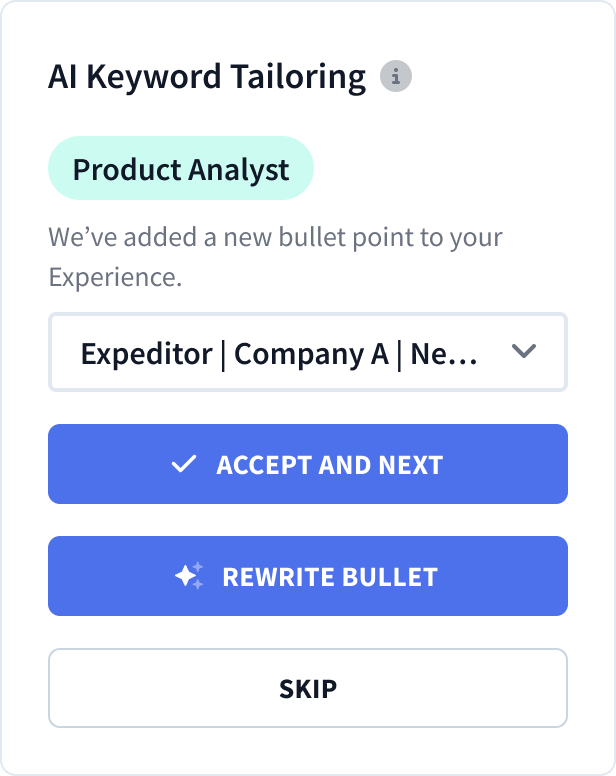
Automatic AI Resume Tailoring
Customize your resume with AI-guided precision.