How to Write a Resume That Gets Interviews
To write a resume that gets interviews, open with a short summary that states what you do and your strongest result, list your experience in reverse-chronological order with bullets built around outcomes instead of duties, add a focused skills section, and keep it to one or two pages. Most resumes get cut in the first ten seconds, so the top third does the heavy lifting.
Key takeaway
- A resume's only job is to survive a short first screen and earn a longer read, so the summary and your first two bullets matter more than everything below them.
- Outcomes beat duties: a bullet that names a result with a number gets read, while "responsible for" gets skipped.
- Most of the rules people stress about (one page, fancy templates, the perfect action verb) matter far less than whether a recruiter can see your value in seven seconds.
I moderate r/resumes, a community of more than 1.2 million people, and the single most repeated question there is some version of "how do I write a resume." I've also personally written more than 1,200 of them since 2019, across executive, technical, and career-change roles. This guide is the version I'd give a friend: section by section, framed around what actually happens when a recruiter opens the file, and honest about which conventions are worth your time and which ones are noise.
What does a resume actually need to do?
A resume isn't a complete history of your career, and treating it like one is the most common reason good candidates get passed over. Its job is narrow. It has to survive a fast first screen, convince a recruiter or hiring manager that you're plausibly a fit, and earn a slower second read where the details actually get absorbed. The most cited eye-tracking study, from The Ladders, puts that first pass at roughly seven seconds, and while the exact number gets argued about, anyone who has screened a stack of resumes will tell you the first impression forms fast and the top third of page one is where it happens.
That single fact reorganizes everything. It means the summary and your first two or three bullets are doing most of the work, and the certifications section at the bottom of page two is doing almost none. When people ask me why a strong candidate isn't getting callbacks, the problem is rarely that they lack experience. It's that the experience is buried under a wall of duty statements that read the same as everyone else's, so nothing flags them as worth a longer look in the few seconds they get.
What are the core sections of a resume, and what goes in each?
Almost every effective resume uses the same handful of sections in roughly the same order. The order matters because it controls what a recruiter sees first.
Contact information sits at the very top: your name, one phone number, one professional email address, your city and province or state, and a LinkedIn URL. You don't need a full street address, and you shouldn't bury contact details in the document header, because some applicant tracking systems won't read text placed there.
The summary comes next, and it's the most valuable real estate on the page. Three or four lines that state what you do, your level, and your single strongest, most quantified result. This is not an objective ("seeking a role where I can grow"), which tells the reader nothing they don't already know. If you want the full breakdown of how to write this section, including templates by career stage, that lives in the dedicated guide to the resume summary.
Work experience is the body of the resume and almost always belongs in reverse-chronological order, most recent role first. Each role gets a line for title, company, location, and dates, followed by three to six bullets. We'll get to how those bullets should be written in a moment, because that's where most resumes win or lose.
The skills section is a short, scannable list of the hard skills and tools that matter for the roles you're targeting. Keep it specific and keep it honest. A recruiter screening for a data role wants to see "SQL, Python, Tableau," not "strong analytical thinker." For how to choose which ones to include and which to cut, see the guide on which skills to put on a resume.
Education goes near the bottom once you're a few years into your career, with degree, institution, and graduation year. Early on, it can sit higher. Optional sections (certifications, volunteer work, publications, projects) earn a place only when they genuinely support the roles you're going after. If a section doesn't help a recruiter say yes, it's taking up space that your experience should have.
Which resume format should you use?
Format is the question people overthink the most, partly because the parent topic Google associates with "how to write a resume" is literally "resume format." There are three formats, and for the large majority of people the right choice is the first one.
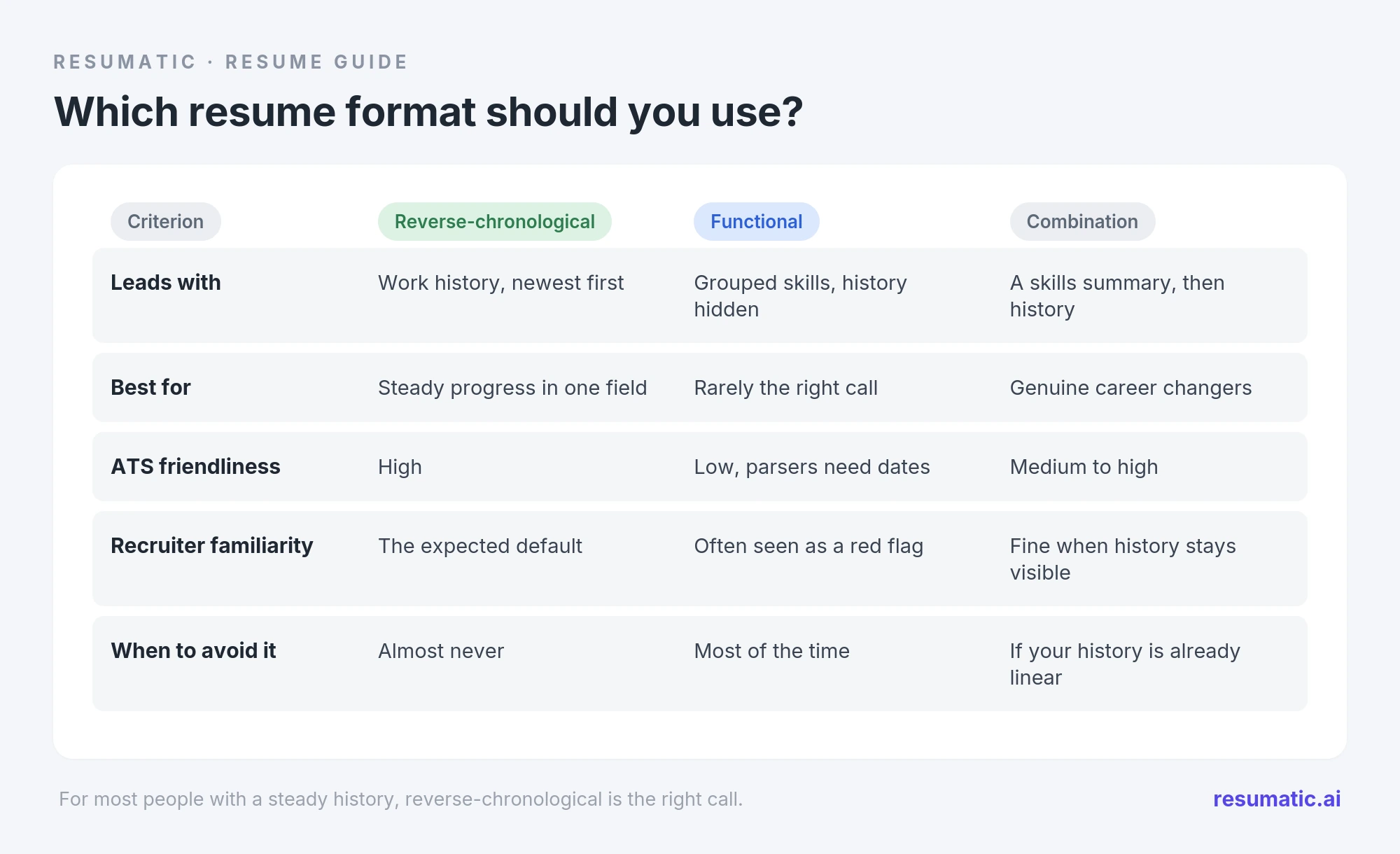
The reverse-chronological format is the default for a reason: recruiters expect it, applicant tracking systems parse it cleanly, and it answers the question they care about first, which is what you've been doing lately. The functional format, which hides dates and titles behind skill groupings, tends to read as an attempt to conceal something, and experienced screeners know it. The combination format has a legitimate use for genuine career changers who need to surface transferable results before the job titles make sense. If you're weighing these in detail, the full comparison of the chronological, functional, and combination formats walks through each with examples.
How do you write bullet points that actually get read?
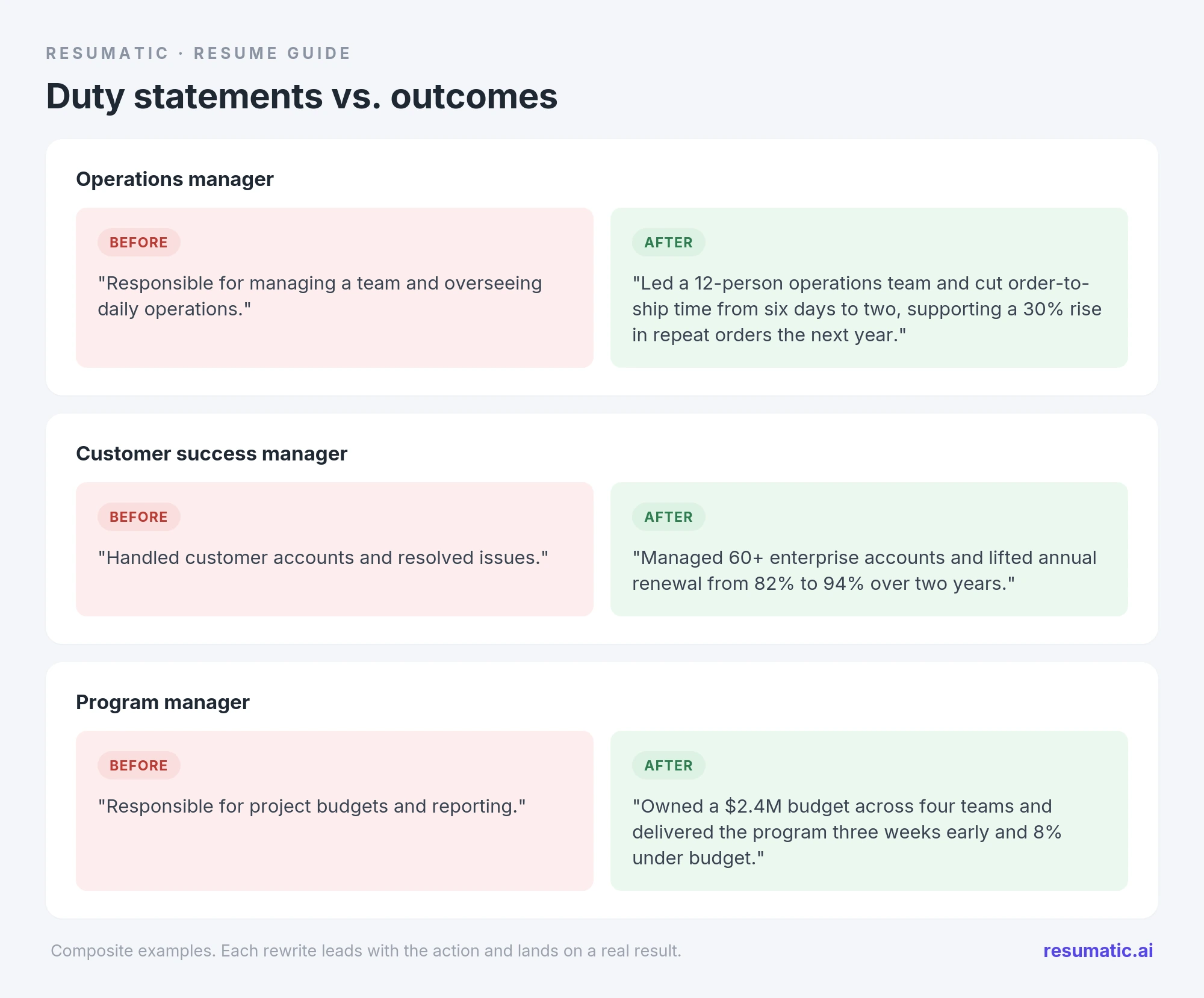
This is the part that separates a resume that gets interviews from one that gets archived. The default instinct is to describe responsibilities, which produces bullets that all sound the same: "responsible for managing a team and overseeing daily operations." A recruiter reads that and learns nothing, because every candidate for the role could write the identical line.
The fix is a simple structure: lead with the outcome or the action, then add the scope and a number wherever an honest one exists. Here's a composite example, drawn from the kind of rewrite I do constantly rather than from any single client.
Before: "Responsible for managing a team and overseeing daily operations to ensure efficiency and meet company goals."
After: "Led a 12-person operations team and cut order-to-ship time from six days to two, which supported a 30% increase in repeat orders the following year."
The second version isn't more impressive because of fancier words. It's more impressive because it names what happened, how big it was, and what it produced. The number doesn't have to be a percentage, and you shouldn't invent one. Scope works ("a 12-person team"), money works, time saved works, volume works. The job is to surface the numbers that are already true about your work, not to manufacture statistics. Strong verbs help the bullet land, and there's a full reference of strong action verbs organized by what they signal, but a plain "led" attached to a real result beats a thesaurus "spearheaded" attached to a vague one every time.
How do you tailor a resume without rewriting it every time?
Tailoring is the step most people skip and the one that moves callback rates the most, but it doesn't mean rewriting the whole document for every application. That's unsustainable, and you'll stop doing it by the third job. What it means is adjusting the summary to mirror the role, reordering your top two or three bullets so the most relevant ones sit highest, and swapping in the actual keywords from the posting where they honestly apply to you. That's usually twenty to thirty minutes of work per application. Skipping it is the most common reason a genuinely qualified candidate gets filtered out, because the resume reads as generic and the screener has no reason to believe you read the job description.
How do you write a resume with no experience?
If you're early in your career, switching fields, or coming back to work after a gap, the section-by-section logic above still holds, but the emphasis shifts. You lean harder on projects, coursework, internships, volunteer work, and transferable results, and you use the summary to frame where you're headed rather than where you've been. This is common enough, and asked often enough in r/resumes, that it has its own complete walkthrough: writing a resume with no experience, which includes worked examples. It's also the one situation where a short objective-style opener can earn its place, and there's a set of resume objective examples for exactly that case.
What matters less than people think?
This is where most resume advice online quietly steers you wrong, usually because the person giving it has never screened resumes for a living. A few conventions get treated as iron rules when they're closer to preferences, and chasing them wastes time you could spend on bullets that actually matter.
The one-page rule is the biggest offender. One page is right when you're early-career and genuinely have one page of relevant material. If you have a decade of relevant experience, forcing it onto one page by shrinking the font to 9pt and deleting your accomplishments is worse than running to two. Recruiters care about whether the content earns the space, not about a page count.
Templates and visual design matter less than the internet's obsession with them suggests. A clean, plainly formatted resume that a parser can read beats a beautifully designed one with text in columns and graphics that scramble in an applicant tracking system. Design should get out of the way of the content, not compete with it.
The "applicant tracking systems automatically reject 75% of resumes" claim is largely a myth, and it's one the resume industry repeats because fear sells services. Most systems don't auto-reject anything. They store, parse, and rank, and a human still looks at the shortlist. The real risk isn't a robot trashing your resume out of spite. It's that a poorly structured file parses badly, so your experience shows up garbled, and that your content is too weak to earn a spot on the list a human reviews.
A few smaller ones: the perfect action verb matters less than a real result behind it, "references available upon request" is a line you can delete and no one will miss, and opening with "results-driven professional" or "team player" actively hurts you because it signals you didn't have anything specific to say. None of these are worth the anxiety they generate.
How do you know your resume is ready to send?
Before you submit, run through this. If every item is true, the resume is doing its job.
- Contact line is current and clean: name, one phone, one professional email, city plus province or state, and a LinkedIn URL, with no contact details hidden in the document header.
- The top third earns a longer read: your summary and first two bullets state what you do and your best result without the reader having to scroll.
- Every bullet leads with an outcome or an action, not a duty, and the phrase "responsible for" appears nowhere.
- Numbers appear wherever an honest one exists: scope, scale, money, time, or volume, none of them invented.
- The file is saved as a named PDF (Firstname-Lastname-Resume.pdf) unless the posting specifically asks for a .docx.
- It parses cleanly: no text boxes, no tables used for layout, standard section labels, and contact information in the body rather than the header.
- It's tailored to the posting: the summary is adjusted, the top bullets are reordered, and the real keywords from the job description are present where they apply to you.
- Someone else read it: one human caught the typo you stopped being able to see three drafts ago.
Frequently asked questions
How do I write a simple resume?
Use one column, reverse-chronological order, and four sections: contact, a three-line summary, work experience with outcome-based bullets, and a short skills list. Education goes at the bottom. Save it as a PDF. A simple resume that's easy to read and parse outperforms a complex one almost every time, so simplicity is a feature, not a compromise.
What are the basic steps to writing a resume?
Start by choosing the reverse-chronological format. Add your contact information and a short summary that states what you do and your strongest result. List your roles newest first, writing three to six outcome-based bullets each. Add a focused skills section and your education. Then tailor the summary and top bullets to the specific job before you send it.
What are the 3 C's of a resume?
It's an informal mnemonic rather than an official standard, usually given as clear, concise, and compelling. Clear means a recruiter can find your value in seconds. Concise means no filler or duty statements. Compelling means the content shows real results. It's a fine sanity check, but don't treat it as a rule that overrides writing strong, specific bullets.
How long should a resume be?
One page if you're early-career or have under roughly ten years of relevant experience, and two pages once you genuinely have two pages of relevant material. Length should follow content, not the other way around. Never shrink the font or cut accomplishments just to hit one page, and never pad to fill a second page when one page says everything that matters.
Should I use an AI tool to write my resume?
An AI resume builder is good at producing a clean, ATS-aware first draft fast, which removes the blank-page problem most people get stuck on. It works best when you bring real results for it to shape rather than expecting it to invent them. For a major executive transition you'll likely still want a human writer involved, but for most job seekers a solid AI draft you then tailor is a genuinely efficient starting point.
About the author
Alex Khamis, CPRW, is the cofounder of Resumatic and the founder of Final Draft Resumes. He moderates r/resumes (1.2M+ members) and has spent over a decade working with hiring managers, recruiters, and applicant tracking systems to understand what actually gets a resume read. He's personally written more than 1,200 resumes across executive, technical, and career-transition roles since 2019. LinkedIn.
If you'd rather not start from a blank page, Resumatic is free to start, and the AI bullet rewriter that turns duty statements into outcome-based lines is included on the free tier. Bring your real results, and most people have a tailored first draft in about twenty minutes.
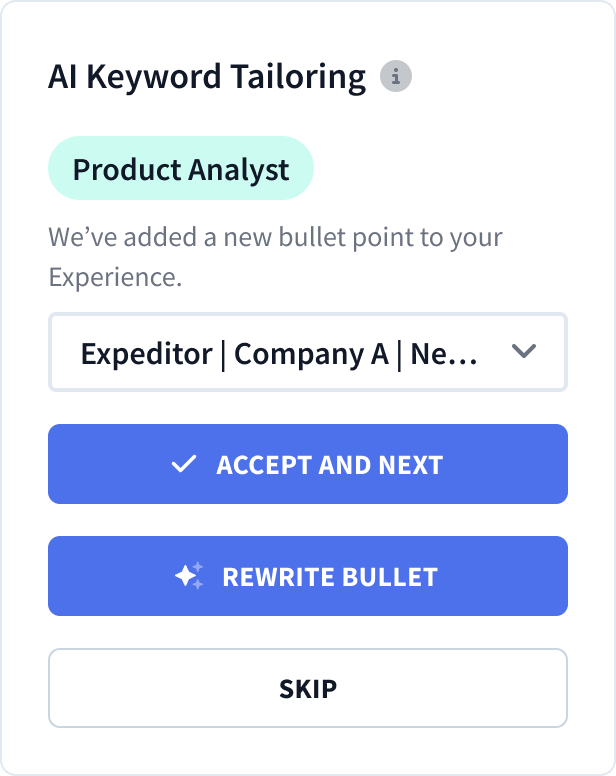
Automatic AI Resume Tailoring
Customize your resume with AI-guided precision.