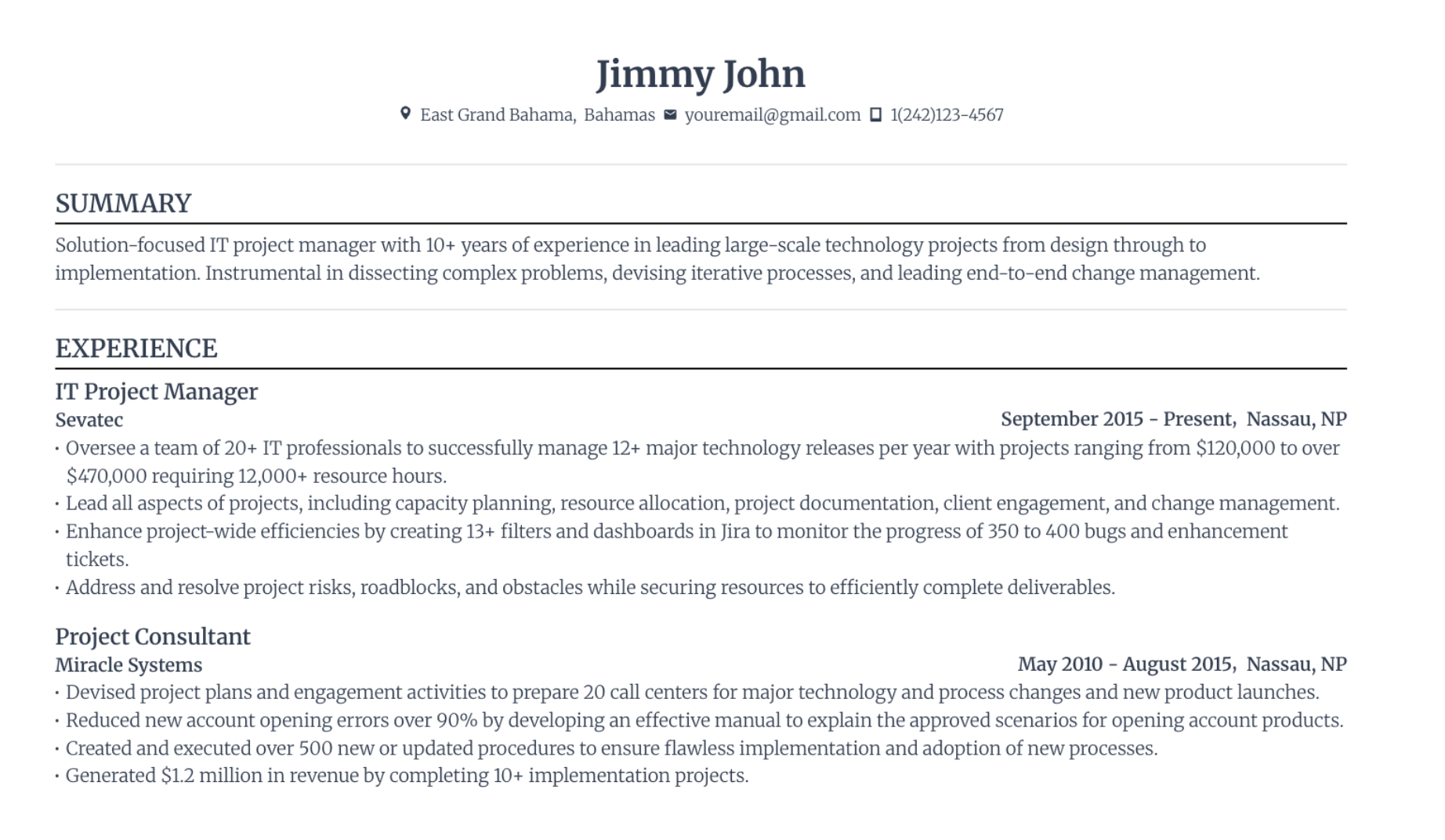
Best Resume Format for Engineers: A 2026 Guide
Most engineers start in the wrong place. They pick a template that looks polished, then try to force their experience into it. That’s backward. The best resume format for engineers depends on your career stage, the role you want, and whether the document survives ATS parsing before a human sees it.
Use a format that makes your work easy to scan, easy to parse, and easy to trust. That usually means reverse-chronological. Not always. The exceptions matter, especially if you’re senior or changing disciplines.
Table of Contents
- Use the bullet formula
- Rewrite duty bullets into achievement bullets
- Find metrics without inventing them
- Keep bullets tight and selective
- Pull the keywords that matter
- Put the keywords in the right places
- Use tooling when the match is large
Introduction
If your resume isn’t getting traction, format is one of the first things to fix. I’ve reviewed enough engineering resumes to know the pattern. Good experience gets buried under weak structure, vague bullets, and layouts that break in ATS.
Pick the format that fits your career stage. Then structure it so both software and humans can read it fast. The sections below give you a decision framework, a format comparison, and the exact setup that gets an engineering resume into the yes pile.
Compare the Three Core Resume Formats
The three standard resume formats are reverse-chronological, functional, and combination. For most engineers, this isn’t a real contest. The reverse-chronological format is the default because it’s easier to scan and easier for ATS systems to parse. Engineering guides cited by Exponent note that recruiters spend an average of 7 to 10 seconds on an initial scan, and 99% of Fortune 500 companies use ATS (Exponent on data engineering resume structure).
That combination matters. If the layout slows down the recruiter or confuses the parser, your content won’t get a fair read.
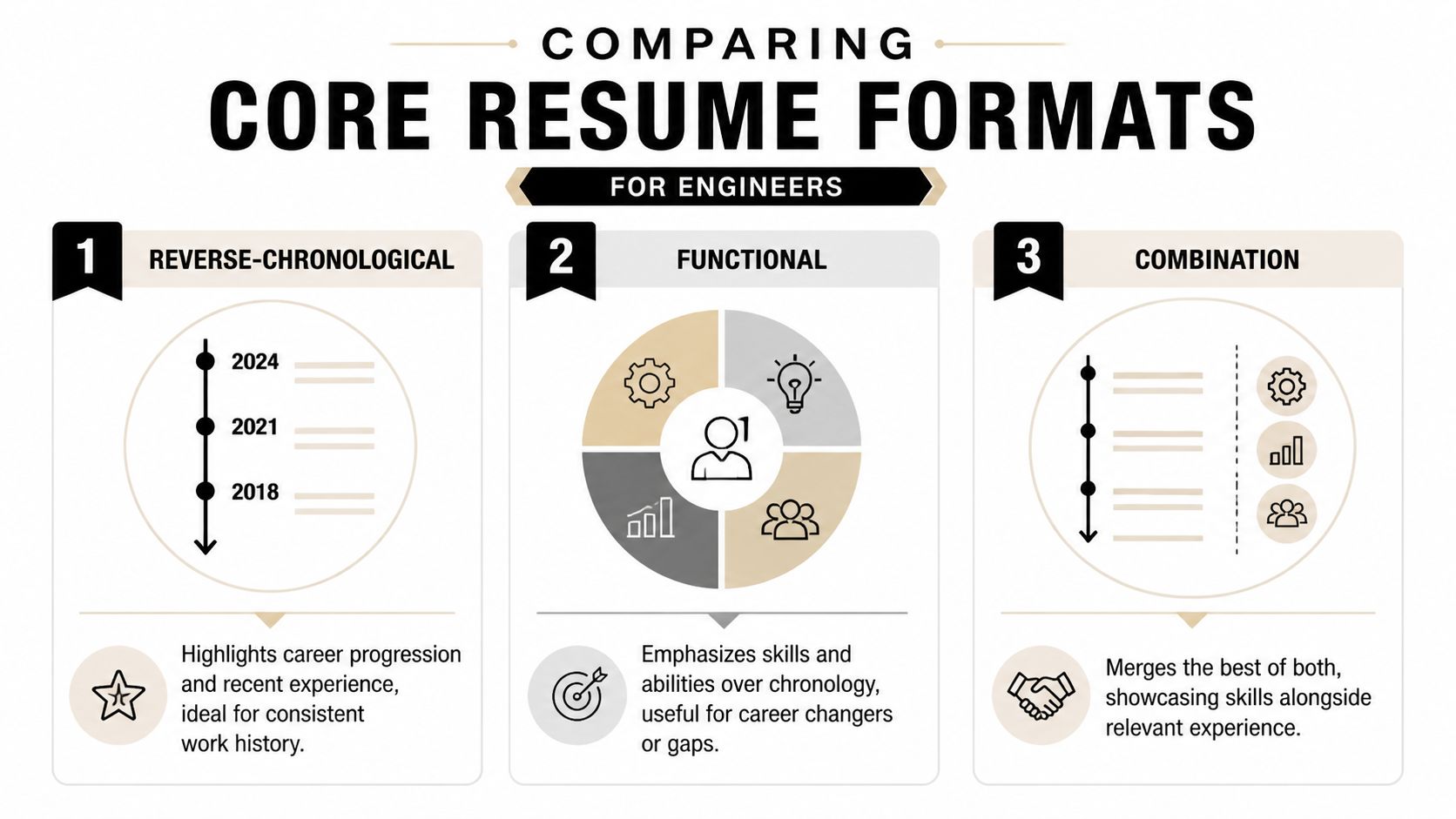
Use this comparison table first
| Format | Best For | ATS Compatibility | Recruiter Perception |
|---|---|---|---|
| Reverse-chronological | Most engineers, recent grads, engineers with steady relevant experience | Strong when you use standard sections and simple formatting | Clear, credible, easy to skim |
| Functional | Rare cases with major career disruption or heavily unrelated work history | Often weaker because skills get detached from job context | Often read as evasive |
| Combination | Career changers, engineers with transferable technical work, engineers with relevant projects but mixed titles | Can work if kept simple and machine-readable | Useful when skills need foregrounding, but only if chronology stays visible |
Know what each format signals
Reverse-chronological leads with work history. Recent role first. Bullets under each role. Skills and projects support the story instead of replacing it. This is the strongest format for engineers because engineering hiring is built around evidence. Teams want to see where you worked, what you built, what tools you used, and what changed because of your work.
Functional leads with skills instead of job history. On paper, that sounds helpful for someone with gaps or a pivot. In practice, it often creates suspicion. Hiring managers want proof attached to a real environment. “Data analysis,” “testing,” or “project leadership” means little if I can’t quickly see where you did it and at what level.
Don’t hide chronology unless you have no alternative. Hidden timelines create more questions than they solve.
Combination sits in the middle. It can work for engineers changing disciplines, moving from academia to industry, or shifting from adjacent technical work into a more formal engineering title. The mistake is letting the skills section become a wall of keywords. Keep it controlled. The timeline still needs to be visible.
What works and what doesn’t
Use reverse-chronological unless you have a concrete reason not to. It wins on clarity. It also matches the standard advice in technical resume guidance, which is why it remains the safest choice for engineering roles.
Functional resumes usually fail for one simple reason. They separate capability from evidence. Combination resumes work only when they keep both.
If you want a deeper side-by-side breakdown, review this guide on chronological vs functional resume formats. The short version is simple. Engineers should optimize for proof, not style.
Choose the Right Format for Your Engineering Career Stage
Format choice changes with career stage. Most bad advice ignores that. A new grad and a principal engineer shouldn’t use the same page strategy, even if both should usually use a chronological structure.
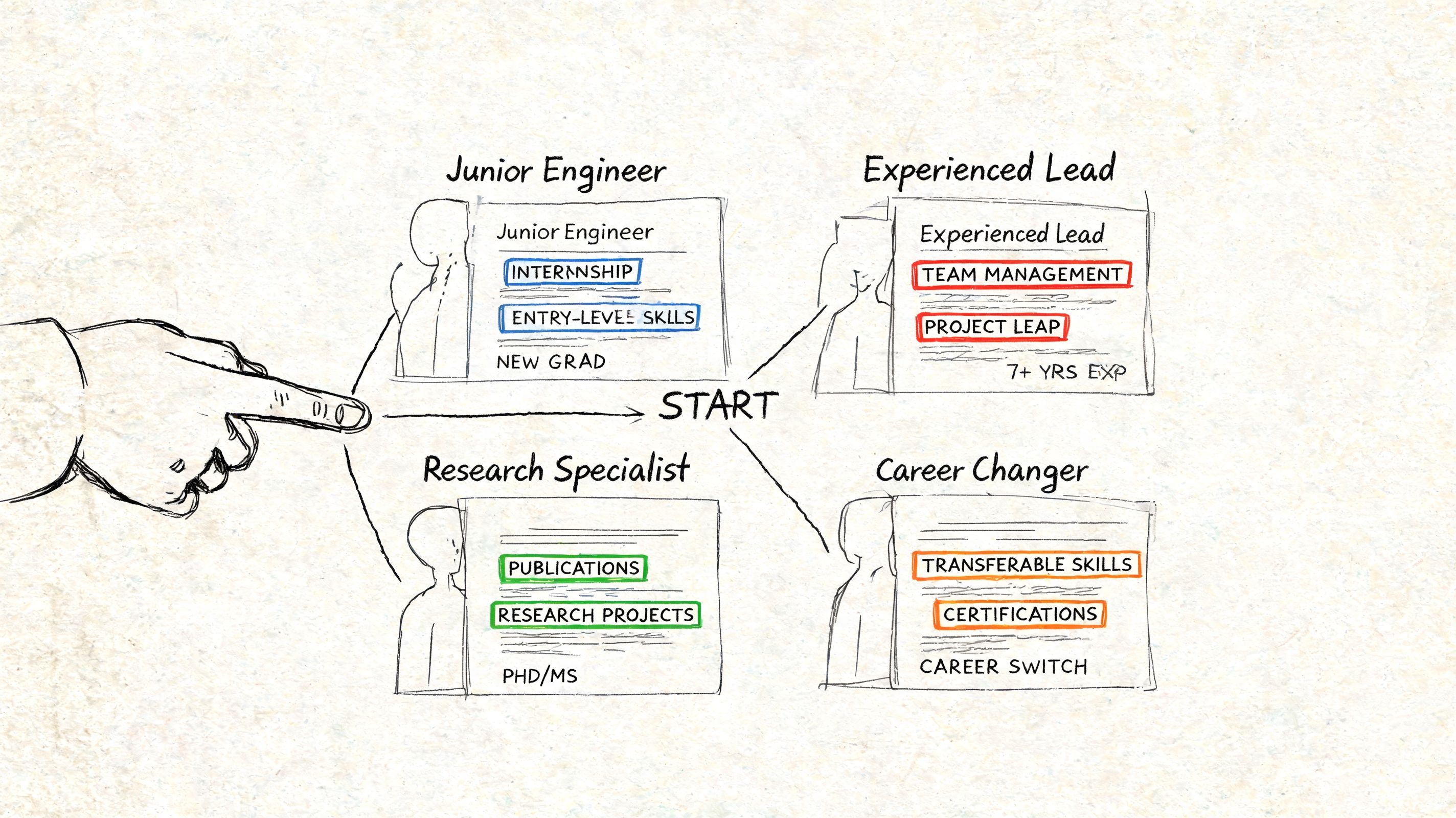
Recent graduate
Use a one-page reverse-chronological resume. Put your summary first, then skills, projects, education, and experience if you have it. If your internships are stronger than your coursework, lead with those. If your academic projects are stronger, let them carry more weight.
Don’t use a functional resume to compensate for limited experience. It won’t help. A clean timeline with internships, capstone work, teaching assistant roles, research, and technical projects is more credible than a broad “Core Competencies” page.
A practical layout for a recent graduate looks like this:
SummarySkillsProjectsExperienceEducationMid-career engineer
Use a one-page reverse-chronological resume if you have under a decade of experience and your background is directly relevant. Tighten older roles. Expand recent ones. Your resume should show progression, technical depth, and scope without turning into a biography.
Many resumes often become bloated. Engineers try to preserve every project. Don’t. Keep the most recent and most relevant work visible. Compress the rest.
The test is simple. If a bullet doesn’t help you get the next role, cut it.
Senior engineer
Use a two-page reverse-chronological resume if you have 10+ years of experience. That isn’t a style preference. It reflects the practicalities of senior technical hiring. A 2025 LinkedIn Workforce Report cited by PPI found that two-page resumes had an 18% higher callback rate for senior engineering roles because they leave room for quantifiable achievements and specialized certifications (PPI engineering resume guidance).
For senior roles, one page usually forces the wrong cuts. It removes architecture work, leadership scope, certifications, and the larger project outcomes that justify seniority.
Use page two for things that matter:
- Technical leadership: Architecture decisions, platform ownership, mentoring, design reviews.
- Large project context: Cross-functional programs, major migrations, infrastructure rebuilds, regulated work.
- Credentials that support the role: P.E., security clearances, domain certifications, advanced tools.
Career changer
Use a combination resume, not a functional resume. Lead with a compact summary and a relevant skills block, then show a clear chronological history. The point is to foreground transferable engineering value without hiding where you’ve been.
If you’re moving from mechanical to manufacturing automation, from data analyst to data engineer, or from research to product engineering, the format should connect the dots. It shouldn’t erase the past.
A simple combination layout looks like this:
SummaryTechnical SkillsSelected ProjectsExperienceEducationIf you want examples specific to technical roles, this guide to a software engineer resume in 2025 is useful because it shows how engineering resumes handle projects, skills, and chronology without drifting into a skills-only format.
Structure Your Resume for ATS and Recruiter Scans
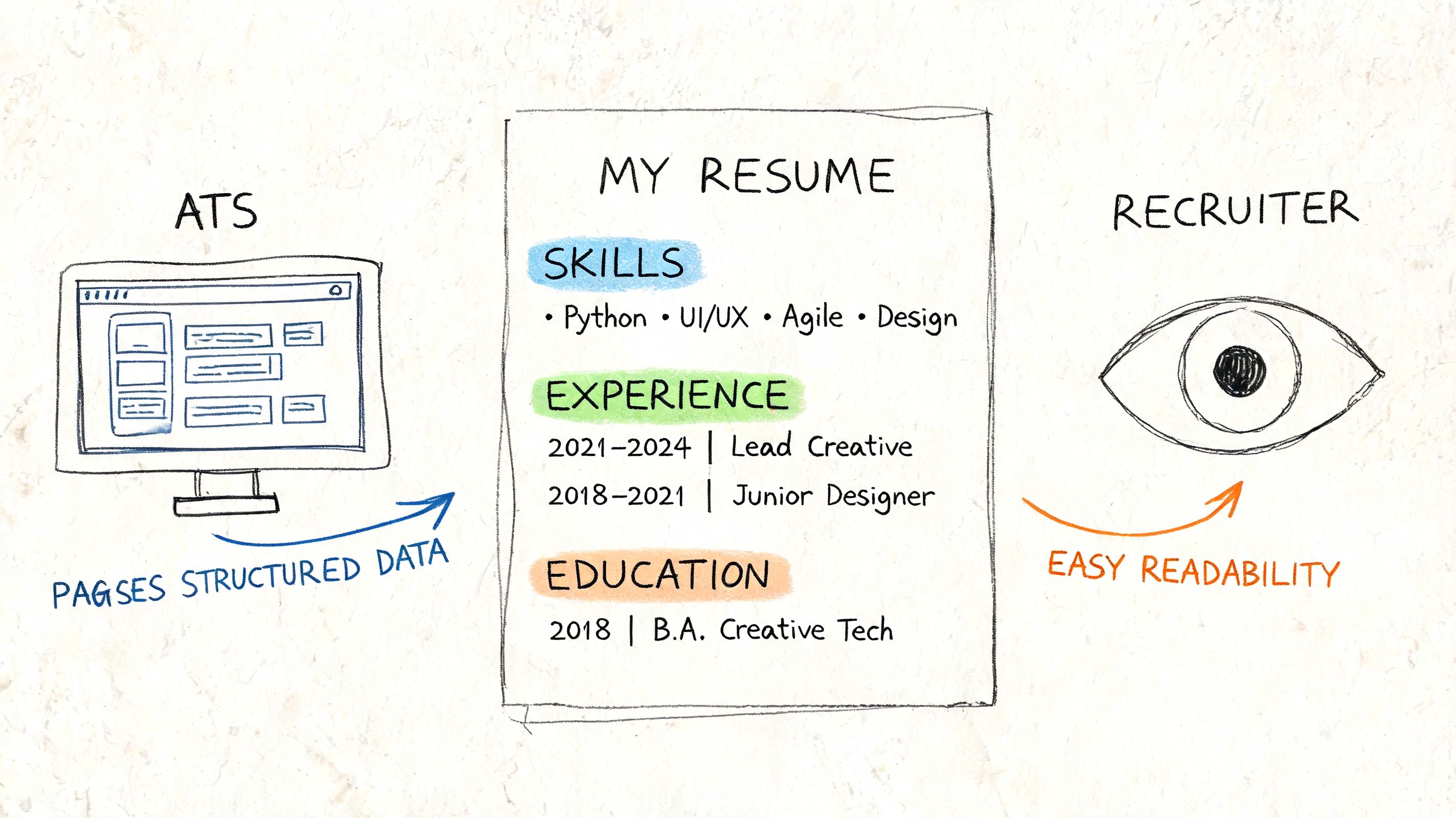
Once you’ve chosen the format, structure decides whether it survives first contact. In technical hiring, specialized templates perform better than generic ones. Resufit cites a 37% higher success rate for specialized engineering resume templates and 98.7% parsing accuracy for ATS-optimized layouts, with best practices including 11 to 12 pt Arial or Calibri and standard headers (engineering template analysis from Resufit).
That aligns with what hiring teams need. We don’t need visual flair. We need a clean read.
Use this section order
For most engineers, use this order:
- Contact information
- Professional summary
- Skills
- Work experience
- Projects
- Education
This order works because it answers the first scan quickly. Who are you. What kind of engineer are you. What tools do you use. Where have you worked. What have you built.
A summary should be short. Keep it to a few lines. State your discipline, years of experience if that helps, core stack or domain, and the type of problems you solve.
Data Engineer with experience building ETL pipelines, warehouse models, and analytics tooling in Python, SQL, Snowflake, and Airflow. Strong record of improving data reliability, reducing manual reporting, and partnering with product and analytics teams.Remove the formatting that breaks parsing
A surprising number of engineering resumes fail because the file is visually clever and structurally broken. Cut the elements that interfere with extraction.
- Avoid columns: Many ATS systems read left to right in the wrong order.
- Avoid icons and graphics: They waste space and can corrupt parsing.
- Avoid tables for core content: Skills, work history, and project descriptions should be plain text sections.
- Avoid unusual fonts: Stick to Arial or Calibri in the recommended size range.
- Avoid vague headers: Use standard labels like Skills, Experience, Projects, Education.
If you want a practical reference, this article on how to make an ATS-friendly resume covers the parsing issues that show up most often.
A short walkthrough helps if you want to see the mechanics in action.
Keep the page visually plain
Plain doesn’t mean ugly. It means controlled.
Practical rule: If a recruiter can’t find your last job, your core tools, and your strongest project in a fast skim, the format is wrong.
Use clear spacing. Keep bullets to one or two lines when possible. Let content carry the document.
Write High-Impact Engineering Bullet Points
Format gets the file opened. Bullets decide whether it moves forward. Most engineers undersell themselves by listing responsibilities instead of outcomes.
That’s the easiest fix in the whole resume.
ResumeWorded’s engineering guidance supports the standard formula: [Action Verb] + [Task] + [Metric]. It also cites an analysis showing that metric-heavy resumes get 40% more interviews in tech fields, with stronger examples like “Designed dashboard saving 10 hours/week” or “Reduced reconciliation errors by 17%” (data engineer resume examples and metrics guidance).
Use the bullet formula
Write each bullet in this pattern:
[Action Verb] + [What you built, improved, or owned] + [Result]Good verbs for engineers include:
- Engineered
- Designed
- Built
- Automated
- Migrated
- Optimized
- Deployed
- Refactored
- Validated
- Tested
- Integrated
- Led
Avoid weak phrasing such as “responsible for,” “worked on,” “helped with,” and “involved in.” Those phrases tell me almost nothing about ownership.
Rewrite duty bullets into achievement bullets
Here are the rewrites I make most often.
Software engineer
Before:
Responsible for backend API development and bug fixes.After:
Built and maintained backend APIs for core product workflows, improving reliability and reducing production issues through targeted debugging and release support.If you have a measured result, use it:
Optimized reporting dashboard pipeline, saving 10 hours/week in manual validation work.Data engineer
Before:
Worked on ETL pipelines and data warehouse tasks.After:
Engineered ETL pipelines in Python and SQL for warehouse ingestion, improving data availability for analytics and reducing manual reconciliation.Mechanical engineer
Before:
Helped with manufacturing process improvements.After:
Redesigned manufacturing workflow for critical components, improving throughput and reducing rework through process standardization.Civil engineer
Before:
Worked on site planning and project documentation.After:
Prepared site planning and project documentation to support permitting, contractor coordination, and on-schedule execution across active builds.These examples show the point. Even when you don’t have a precise metric, you can still write a stronger bullet by naming the system, scope, and operational effect. If you do have a metric, use it.
Strong engineering bullets show effect. Weak bullets show attendance.
Find metrics without inventing them
You don’t need revenue numbers to quantify engineering work. Start with operational measures you already know.
Look for:
- Time saved: Hours per week, manual effort removed, cycle time reduced
- Error reduction: Defects, incidents, failed jobs, reconciliation issues
- Scale handled: Pipelines owned, systems supported, users served, environments maintained
- Delivery scope: Launches, migrations, integrations, audits, design packages
- Team impact: Mentoring, review ownership, cross-functional coordination
If you can’t support a number, don’t make one up. Use a qualitative result instead.
Automated release checks for embedded firmware builds, improving consistency across validation handoffs.Keep bullets tight and selective
Use your best bullets first under each role. Don’t give every job equal space.
A practical pattern:
- Most recent role: strongest set of bullets
- Previous relevant role: fewer bullets, still outcome-focused
- Older roles: compressed, especially if the tools are dated or the work is no longer relevant
If you want help turning raw duties into stronger achievement statements, this guide on how to write accomplishments on a resume is a solid reference.
Convert a Job Description into a Targeted Resume
A generic engineering resume usually reads like a work archive. Hiring teams don’t want an archive. They want a match.
The job description tells you what to emphasize, what language to mirror, and which parts of your experience should move up or down in importance. Tailoring doesn’t mean fabricating experience. It means translating your actual background into the employer’s terms.
Pull the keywords that matter
Start with the posting. Read it once for role scope, then a second time with a highlighter.
Extract these categories:
- Core technical tools: Python, SolidWorks, AutoCAD, AWS, PLCs, Snowflake, MATLAB
- Methods and workflows: CI/CD, FEA, testing, data modeling, root cause analysis, design verification
- Domain language: embedded systems, civil infrastructure, manufacturing quality, data pipelines
- Role expectations: cross-functional collaboration, ownership, documentation, mentoring, compliance
Build a short list. Then compare it to your current resume. If the posting asks for “data modeling” and your resume only says “warehouse work,” rewrite the language if that’s the same work.
Put the keywords in the right places
Don’t dump keywords into a giant skills block. Spread them where they belong.
- Summary: Put the target title, discipline, and core stack here.
- Skills: List tools and platforms in simple categories.
- Experience bullets: Use the exact job language when it accurately describes your work.
- Projects: Surface the projects that map to the role’s priorities.
Scale.jobs’ engineering template review notes that ATS-friendly layouts such as a “Simple Engineering” or “Technical Skills Resume” perform best when they keep machine-readable sections for skills and projects, while two-column layouts often fail parsing (engineering visual template comparison).
A simple tailoring workflow looks like this:
- Copy the job description into a notes file.
- Highlight the repeated nouns, tools, and methods.
- Match each one to real work on your resume.
- Rewrite the summary and top bullets using that language.
- Move the most relevant project closer to the top.
Use tooling when the match is large
If the posting is dense or the role is highly specific, a resume tool can speed up the rewrite. For example, Resumatic’s guide to tailoring a resume to a job description shows the exact matching process, and Resumatic can also identify keywords from a pasted posting and score the resume against them.
Use that kind of tool to check alignment. Don’t let it write fiction into your work history.
What to Do Now
Stop tweaking fonts and make the structural decisions first. The right format for engineering resumes is usually straightforward once you tie it to your stage and target role.
Use this checklist in order.
| Step | Action |
|---|---|
| 1 | Choose reverse-chronological unless you’re making a clear career change that justifies a combination format. |
| 2 | Set the length correctly. Use one page for earlier-career roles and two pages if you’re senior and need room for relevant scope, certifications, and outcomes. |
| 3 | Rebuild the layout in a plain ATS-safe format with standard section headers, simple fonts, and no columns or graphics. |
| 4 | Rewrite every bullet using action, task, and result. Keep only bullets that support the role you want next. |
| 5 | Tailor the summary, skills, and top experience bullets to each job description before you apply. |
| 6 | Review your cover letter with the same standard. If you used AI to draft it, check guidance on bypassing AI detectors in cover letters so the final version still sounds like a person wrote it. |
| 7 | Export, proofread, and test the final file before submission. |
A good engineering resume isn’t creative. It’s legible, targeted, and evidence-based. That’s enough.
If you want a faster way to do the rewrite, Resumatic can turn a job description into an ATS-ready resume draft, surface missing keywords, and score the match so you can fix the document before you apply.
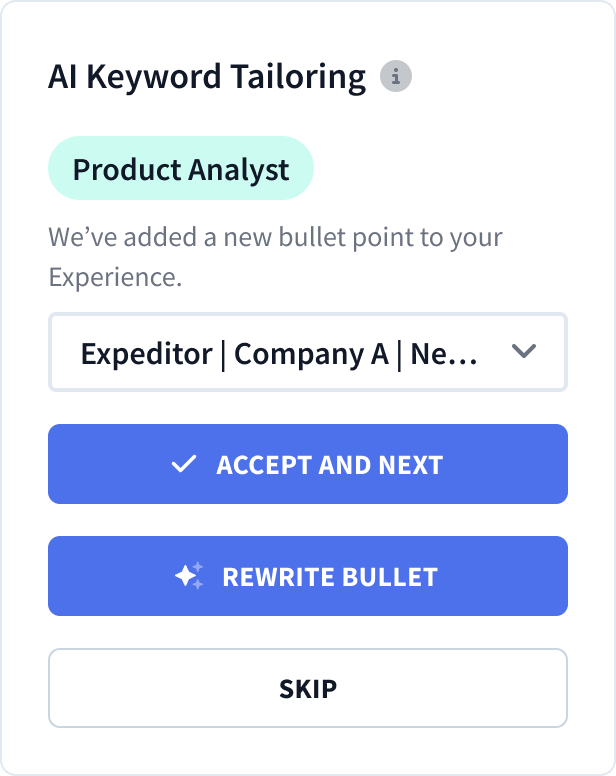
Automatic AI Resume Tailoring
Customize your resume with AI-guided precision.