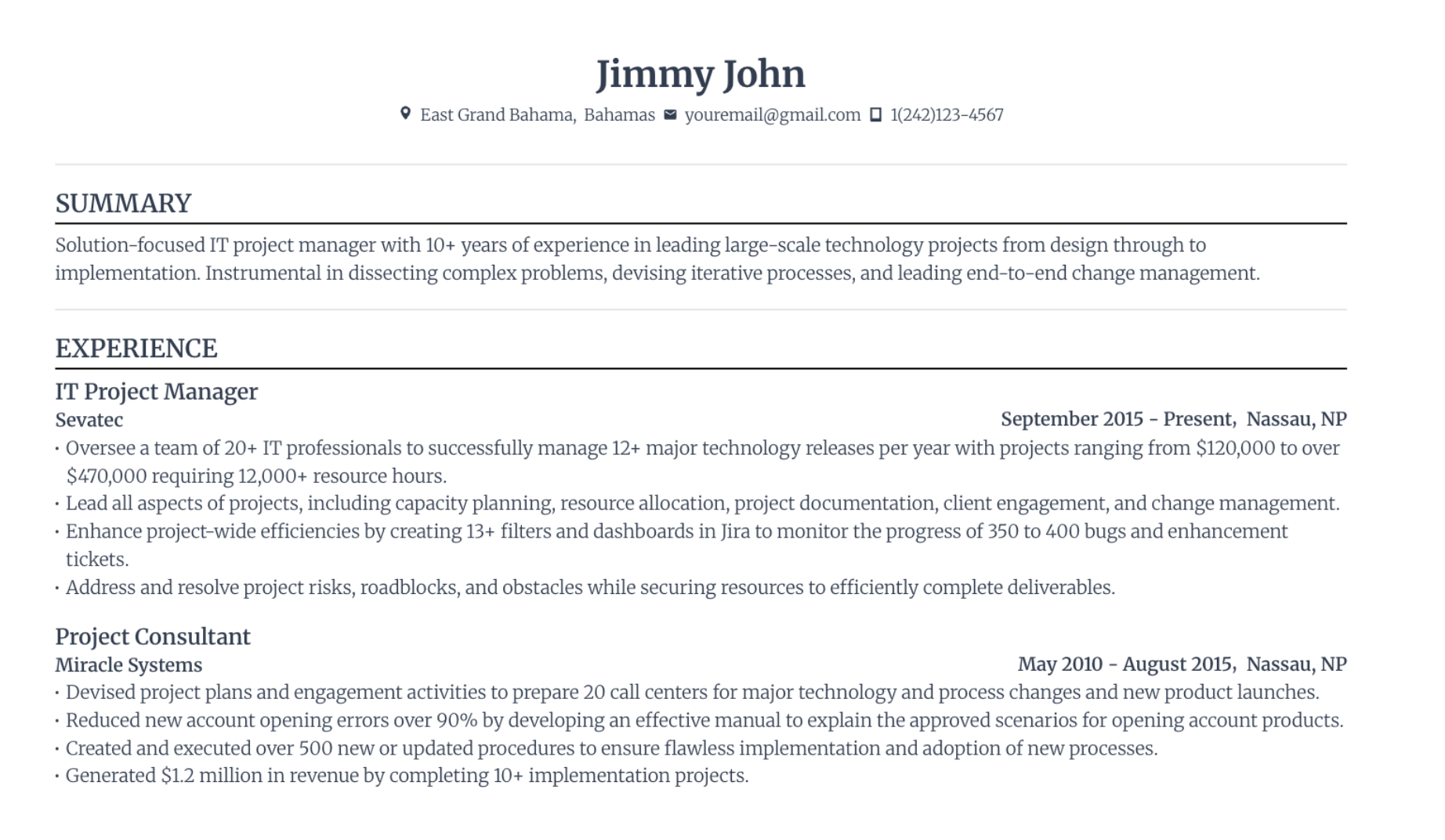
Is a 3 Page Resume Too Long for 2026? Find Out Now
A 3 page resume is almost always too long for US-based jobs. For most professionals, 1 page is the standard, and 2 pages are acceptable for senior executives. This only changes in a few specific cases, and if your resume has drifted to page three, you should assume it needs cutting.
The reason is simple. Recruiters scan fast, ATS software rewards focus, and extra pages usually signal weak editing, not stronger experience. Below is the short rule, exceptions, and the fastest way to cut a bloated resume down to a sharp 1 or 2 pages.
Table of Contents
- Cut anything older than the last 10 to 15 years
- Replace duty bullets with outcome bullets
- Consolidate stacked promotions and similar roles
- Remove low-value sections entirely
- Tailor harder, not longer
- Use a tight but readable layout
- Remove design elements that waste space
- Do a final visual compression pass
Decide If You Are the Exception to the Two-Page Rule
Start with the default rule. In the US, only 3% of recruiters tolerate a third page without frustration, while 90% prefer up to two pages, according to Resumly's breakdown of recruiter preferences. If you're applying for a standard corporate, tech, operations, finance, sales, marketing, or product role, page three is a mistake.

Keep three pages only if your target role requires detail
A longer document makes sense when the employer expects a record, not a pitch. That usually means:
- Academic and research roles: Publications, teaching, grants, presentations, and committee work often belong in a CV, not a resume.
- Senior medical roles: Clinical training, certifications, research, affiliations, and speaking history can require more space.
- US federal government applications: These often require detailed work histories, dates, hours worked, and additional background information.
- Certain international markets: Some employers outside the US expect a more detailed career history.
If none of those apply, cut it.
Practical rule: If you're applying to a US corporate role and your third page exists because you “have a lot of experience,” that is not an exception.
Use this decision test
Keep your document at 1 to 2 pages unless you can answer yes to one of these:
- The posting asks for a CV, not a resume.
- The employer is a US federal agency and requests detailed employment records.
- The role is academic, scientific, or research-heavy and a publication list matters.
- You're targeting a market where longer CV-style histories are standard.
If you're a senior leader in a normal US business role, stay disciplined. You may use two pages. You still usually don't need three. A tight leadership summary does more work than a full career autobiography. If yours is rambling, rewrite the top section first. This guide to an executive summary statement shows the right structure.
Understand How Length Affects Recruiters and ATS
A 3 page resume fails in two places. It fails with the human scanning it, and it fails with the system parsing it. Those are different problems, but they lead to the same outcome. Your best information gets buried.

Recruiters stop early
Recruiters don't read resumes like books. They scan for role fit, trajectory, keywords, and evidence of results. When a document is long, that scan gets harder. According to Resume Worded's analysis of 3 page resume performance, 3-page resumes have an 18% lower ATS pass rate than 2-page resumes due to truncation risks, and recruiters spend an average of 7.4 seconds on the initial scan.
That means page three is often invisible in practice. Even if the content is strong, it arrives too late.
If your best bullet sits halfway down page three, treat it as missing.
This is the psychological problem with long resumes. The document feels expensive to read. A recruiter has a stack of applicants and limited time. When your resume looks dense, repetitive, or historically exhaustive, they assume the same about your judgment.
ATS systems reward focus, not volume
Applicant Tracking Systems don't award points for effort. They look for relevance, structure, and readable formatting. Long resumes often weaken all three.
Common problems include:
- Keyword dilution: Important skills get buried under old duties and outdated tools.
- Parsing risk: More sections and more text create more chances for the system to misread content.
- Truncation: Some systems handle long or complex files poorly.
- Noise: Irrelevant experience competes with the requirements in the target job description.
If you need a plain-English refresher on how ATS software works, DynamicsHub's 2026 ATS guide is useful background.
For the resume itself, keep the structure basic. Use standard headings. Put recent, role-matched keywords high on page one. Skip decorative layouts that make parsing harder. This ATS-friendly resume guide is a good checklist for that cleanup.
Choose Your Document Resume CV or Executive Bio
Many 3 page resumes aren't resumes. They're accidental CVs.

Use the right document for the job
According to Indeed's explanation of 3 page resumes and CV norms, 1-page resumes are standard for most US professionals, 2 pages are acceptable for senior executives, while CVs in markets like Germany or Japan can be 3 to 4 pages because detailed histories are valued. A common mistake is sending a CV-style document to a US corporate employer.
Use this comparison:
| Document | Best use | Typical scope | Length rule |
|---|---|---|---|
| Resume | US corporate jobs | Relevant experience only | 1 page for most, 2 for senior leaders |
| CV | Academia, research, medicine, some global markets | Full record of work, publications, credentials | Can run longer |
| Executive bio | Networking, board introductions, speaking, website profiles | Short narrative summary | Usually much shorter than a resume |
Fix the mismatch before you edit line by line
If you're applying for a software engineering manager role in the US, send a resume. Don't include conference appearances from a decade ago unless they support the role. Don't list every training course. Don't build a publications section unless the job needs it.
If you're pursuing a faculty role, use a CV and stop trying to compress it into a corporate format.
Your document should match the hiring context. Most bloated resumes are just the wrong document type.
If you need examples of document types and when to use them, this overview of different kinds of resumes gives the distinctions clearly.
Execute a Content-First Reduction Strategy
You fix the problem. Not by shrinking fonts first. By removing weak content.
A long resume usually bloats for one of three reasons. It goes too far back, it describes duties instead of impact, or it repeats the same story across multiple roles. The fastest cure is to cut by relevance and recency.

Cut anything older than the last 10 to 15 years
A summary of the Ask The Headhunter guidance notes that 77% of resumes fall outside the optimal 500 to 600 word sweet spot, often because they are padded with irrelevant details from jobs held more than 15 years ago. That is the cleanest cutting rule you can use.
Keep old roles in a brief Earlier Experience section if the company names matter. Remove bullets. Keep titles, employers, and dates.
Before
Operations Manager | North Ridge Manufacturing | 2004 to 2009- Responsible for day-to-day plant operations- Managed staff scheduling and vendor coordination- Oversaw quality checks and weekly reporting- Helped with training and safety proceduresAfter
Earlier ExperienceOperations Manager, North Ridge Manufacturing | 2004 to 2009Production Supervisor, Lakeview Industrial | 2000 to 2004Replace duty bullets with outcome bullets
Most page-three content is dead weight because it says what you were assigned, not what changed because you did the work.
Before
- Responsible for managing project timelines and cross-functional communication- Worked with stakeholders to gather requirements- Participated in Agile ceremonies and team meetingsAfter
- Led cross-functional delivery of product releases across engineering, design, and operations- Gathered requirements from stakeholders and translated them into prioritized implementation plans- Removed delivery blockers and kept sprint work aligned to launch deadlinesThe second version is still concise, but it sounds like ownership. If you need help tightening language without changing the meaning, Documind explains summarizing vs paraphrasing in a way that's useful for resume editing.
Consolidate stacked promotions and similar roles
If you held three near-identical roles at the same company, don't repeat the company description and ten bullets under each one. Group them.
Before
ABC TechSenior Analyst | 2022 to Present- 5 bulletsAnalyst II | 2020 to 2022- 5 bulletsAnalyst I | 2018 to 2020- 4 bulletsAfter
ABC Tech | 2018 to PresentSenior Analyst | Analyst II | Analyst I- Promoted through three roles based on expanding scope and performance- Delivered analysis for product, finance, and operations leaders- Built reporting and process improvements used in recurring business reviewsThat single change can remove half a page.
Here is a practical walkthrough of resume trimming in motion:
Remove low-value sections entirely
Delete these first if you're over length:
- Objective statement: Replace it with a summary only if you need one.
- References available upon request: Useless. Remove it.
- Old software lists: Keep only tools relevant to the target role.
- Soft skills section: Show communication, leadership, or ownership in your bullets instead.
- Full address: City and state are enough for most roles.
- Irrelevant certifications or coursework: If it doesn't help you get shortlisted, cut it.
Tailor harder, not longer
Candidates add content because they don't want to leave anything out. That's backward. A resume should be selective.
Take the job description and align your top bullets to it. If the role values SQL, stakeholder management, forecasting, or roadmap delivery, those should appear high and clearly. If an older project doesn't support the target role, remove it. This guide on tailoring your resume to the job description shows the mechanics.
A strong resume doesn't tell your whole career story. It proves fit for one job.
Apply Formatting Changes to Reclaim Space
Only do this after cutting content. Formatting can't rescue a bad draft. It can finish a good one.
Use conservative spacing changes that preserve readability. The point is to reclaim space, not to make the document look cramped.
Use a tight but readable layout
Apply this checklist:
- Set margins to 0.5" to 0.75" on all sides.
- Keep body font between 10 and 12 pt.
- Use one clean font such as Calibri, Arial, or Helvetica.
- Reduce space before and after headings if section gaps are too loose.
- Limit bullets per role to the strongest points only.
- Put contact details on one line if space is tight.
- Move skills into compact rows instead of a tall stacked list.
Remove design elements that waste space
A lot of resume templates burn space on decoration. Cut these:
- Large name headers
- Long summary paragraphs
- Icons and graphics
- Progress bars for skills
- Thick section dividers
- Multi-line contact blocks
A plain format usually performs better anyway. If you need clean layout options that don't overdesign the page, this roundup of best resume formats is a useful reference.
Do a final visual compression pass
Print to PDF and scan it like a recruiter would. Look for:
- Dense paragraphs
- Orphan lines pushed to page three
- Repeated verbs
- Bullets that say the same thing in different words
- Empty space caused by oversized headings or line breaks
If page three contains only a few lines, don't debate it. Get rid of it.
What to Do Now
Do these steps in order:
- Decide whether you're a real exception. If you're not applying to academia, medicine, federal government, or a market that expects a CV, cut to 1 or 2 pages.
- Choose the right document type. Use a resume for US corporate jobs, a CV for academic or research paths, and an executive bio for networking or board-facing uses.
- Cut old experience first. Use the 10 to 15 year rule. Move older roles into a brief Earlier Experience section with no bullets.
- Rewrite bullets around outcomes. Remove duties, repetition, and generic filler.
- Delete low-value sections. Objectives, references, outdated tools, and irrelevant coursework go first.
- Apply formatting last. Tighten margins, spacing, and layout without shrinking readability.
- Save as PDF and test the final version. Make sure the strongest evidence sits on page one and page two, not on a page that shouldn't exist.
If your resume is stuck at three pages, Resumatic is a practical way to cut it down without losing substance. Paste in the job description, rebuild the bullets around the right keywords, and use the resume score and content analysis to see where the document is still bloated or off-target.
Automatic AI Resume Tailoring
Customize your resume with AI-guided precision.